

Benefits of digestible cocksfoot and tall fescue in drought
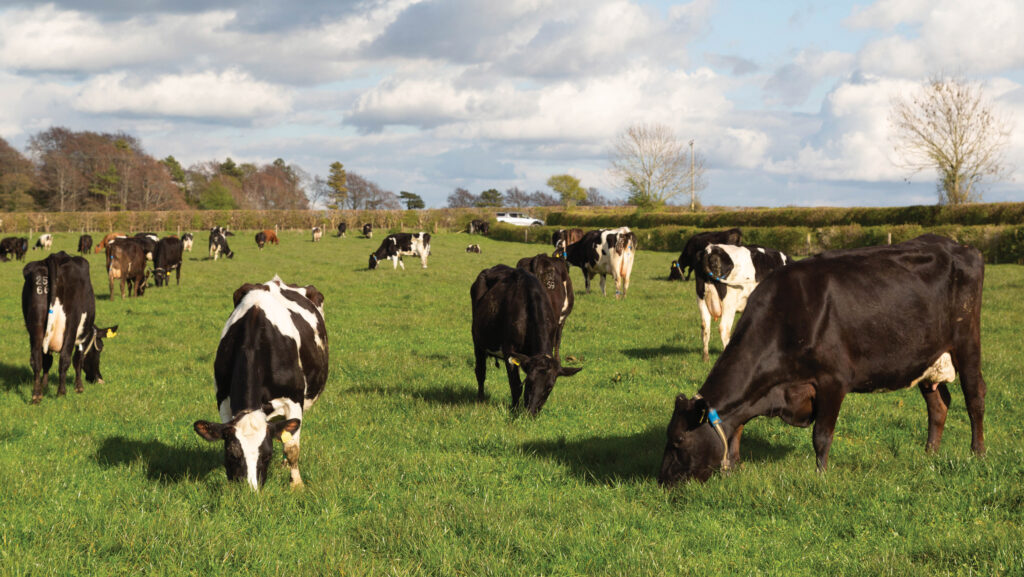 Cows at Windmill Dairy readily graze leafy cocksfoot © MAG/Judith Tooth
 Demand for grass mixes that perform dependably in dry conditions can be met by growing cocksfoot and tall fescue, with only slight changes in management to ryegrass-dominant swards.
While perennial ryegrass (PRG) will not drop out of grass mixes, it has proved unreliable in periods of low rainfall or drought, says independent grass and forage seed specialist Francis Dunne of FD Seeds.
See also: How a dairy is using grass data to identify paddocks for reseeding
“And the more so the further east you go – especially on drought-prone chalk, limestone or sandy soils, where farmers are struggling to produce their budgeted dry matter/ha.
“In terms of energy density, PRG is king. But because it’s relatively shallow-rooted, most of its nutrients come from where the fertiliser is put.
“Cocksfoot has more nutrient-scavenging ability, so it’s well suited to lower-input systems and has more drought tolerance,” he explains.
Varietal improvement
In the past, people have been put off by the poor nutritional and palatability characteristics of cocksfoot and tall fescue, Francis says.
Yet, while each seed merchant will have these species on their books, there are enormous differences between varieties.
And dramatic improvements have been seen in areas of the world where these species are most important.
“Breeders have been ‘selecting’ for much more digestible fibre – we’ve just not been ‘looking’,” he says, adding that he saw the results on a recent sabbatical to New Zealand and the more temperate areas of Australia.
Here, soft leaf varieties of cocksfoot and tall fescue, developed in France, were being grown successfully.
Range of performance between varieties and species |
||||
|
Species |
Dry matter (DM) yield (t DM/ha) |
Energy density (UFL*/kg DM) |
Crude protein (%) |
Sugar content (%) |
|
Perennial ryegrass |
7.5-10 |
0.86-0.99 |
9-13.2 |
16.9-24.6 |
|
Cocksfoot |
10-11 |
0.82-0.85 |
13.1-14.2 |
6.7-9.6 |
|
Tall fescue |
10-12 |
0.82-0.87 |
12-13.3 |
10.2-14.4 |
|
Note: UFL is a unit of energy equivalent to 1kg air-dried barley. Source: FD Seeds (French Recommended List 2025) |
||||
Seed mixes
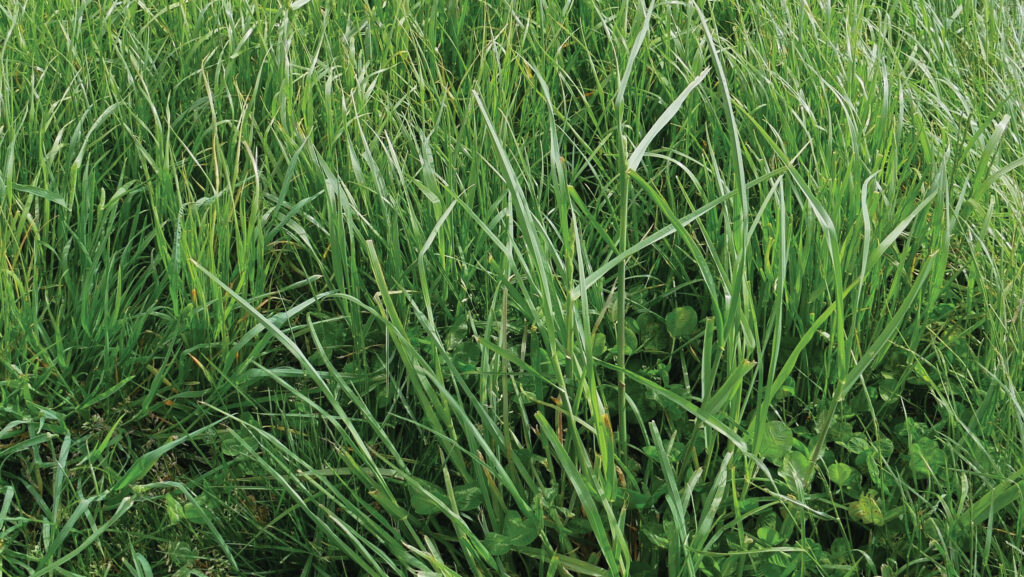
Cocksfoot-based mix in April/May © Francis Dunne
Cocksfoot has more relevance in grazing swards, while tall fescue, with a higher sugar content, is more suited to silage leys.
To introduce either of these species, it is important to include enough in the seed mix for them to show their benefits and not get outcompeted by PRG in the establishment phase.
“Cocksfoot and tall fescue will come through more slowly in the first two months [after sowing] – they are building deeper rooting systems, so contributing more to soil organic matter and sequestering more carbon,” Francis points out.
For a drought-tolerant silage seed mix, he recommends including 5-6kg/ha of cocksfoot, 8-9kg/ha of tall fescue and 8kg/ha PRG, along with timothy and three different clovers (one of them annual), to make a total of 34kg/ha.
A grazing mix would include slightly less tall fescue. “You need diversity but also compatibility so they are easy to manage,” he adds.
Sowing window
For germination, cocksfoot and tall fescue like a soil temperature of more than 8-10C, whereas PRG will appear at 6-7C. August/early September following cereals is ideal, says Francis.
April is also suitable in most of the UK, when the seed mix can be undersown in spring barley to offer a degree of protection. (The barley is then harvested as green or wholecrop silage.)
Grazing and cutting frequency
“Between early May and late June, cocksfoot and tall fescue tend to go to head a bit faster than PRG, so you need to be tough, grazing or mowing hard – to the same height, but more frequently,” says Francis.
“In a dairy grazing rotation of 20 or 21 days, that might mean grazing every 15-16 days instead.
“Protein and energy density are lower, but if you increase the frequency of cutting and grazing to compensate for the lower energy, you can yield more in a season – whatever the season.”
Case study: Windmill Dairy, Wantage, Oxfordshire
Farm facts
- Joint tenancy on Lockinge estate
- 389ha of mainly grass, with 25ha maize undersown with Westerwolds
- 380 three-way crossbred cows
- 10-week calving block from 14 February
- Average yield 6,635 litres at 4.75% butterfat and 3.54% protein from 1.4t concentrate
- Milk from forage 3,835 litres
- 16% replacement rate
- Milk sold to Arla Aldi
- Contract-rearing 150 autumn-born heifers
- Four full-time staff

Chris Whitford © MAG/Judith Tooth
Spring block-calver Chris Whitford is increasing herd size despite low annual rainfall and weather extremes.
Additional land for silage has accelerated his plans, but ongoing careful grassland management remains key to sustainable business growth.
Chris relies on diverse leys for grazing and silage, which do well on the chalky soils of the North Wessex Downs.
“We graze them hard, and they are just as diverse as they were when we sowed them up to eight years ago. We don’t treat them kindly and they still last,” he says.
He was encouraged to try them by trials his seed supplier, Francis Dunne, had been involved in – where dry matter yields were 1.2t/ha greater when chicory, plantain and yarrow were added to a mix of perennial ryegrass, white clover and timothy.
All fields have since been reseeded “one way or another”, except for those used to outwinter cows on deferred grass and silage bales. “For an extra £4.50/bag, it was a risk well worth taking,” he adds.
Drought tolerance
© MAG/Judith Tooth
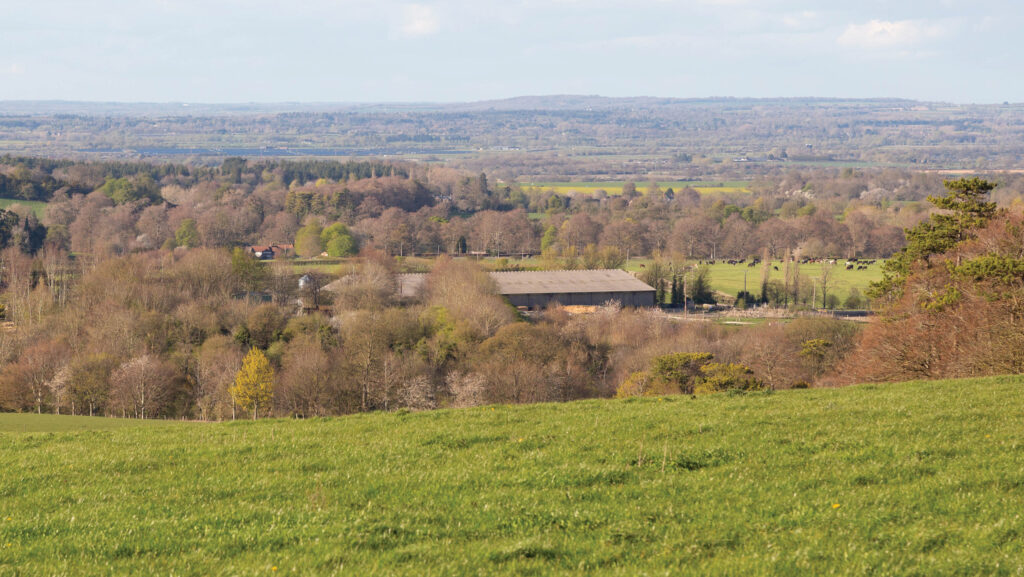
The grass mixes at Windmill Dairy, where annual rainfall averages 773mm, also include cocksfoot for drought tolerance.
“All fields are set up for 24- to 36-hour grazing. I measure the grass weekly anyway, but I consciously make an effort to keep an eye on the fields with more cocksfoot, and graze these at 18-19 days rather than 23-24 days.
“You need to catch it while it’s green and leafy – if you wait too long, it gets thick and clumpy and the cows won’t clear it. If it did get too far ahead, I’d leave it and then bale it.”
Chris calculates that the addition of cocksfoot has added 0.6-0.9t DM/ha a year as well as improving soil health.
“Our soil organic matter is massive these days [8-9%]. Because it’s deeper rooting, cocksfoot really helps with that.”
Previously, the focus was on grazing the core fields and managing dual-purpose use on outlying ones.
Now that the additional 117ha of arable land are down to a cutting mix of grasses including cocksfoot and tall fescue, grazing management will be easier – and allow for expansion, says Chris.
“We were at 300-320 cows; this year, there are 370-380, and by 2028 – once the new leys are bedded in and performing well – we’ll have 450 cows.”
Silage quality
He is also aiming for better-quality silage. Instead of clamping one big cut and producing bales for outwintering from a second cut, Chris will take three silage cuts.
The second cut will still be baled for outwintering “so we know we’ve got what we need”, while the third cut will be clamped.
“Previously, we were going for quantity,” he admits, adding that the aim is for a metabolisable energy of 11.5MJ/kg DM, rather than 10.
“That means we can give high-quality silage to the fresh cows and rely less on bought-in feed, especially at the back end of the year. I want to get down to less than 1t [of concentrates] a cow a year.”