

Benefits of hay over silage for outwintered suckler cows
 © MAG/Shirley Macmillan
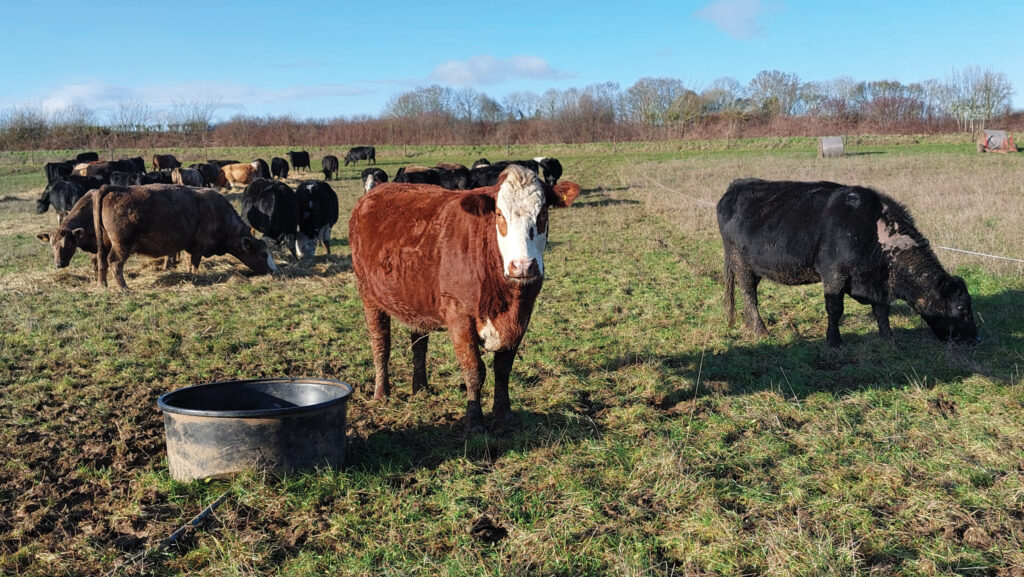
 Conserving multispecies swards as hay instead of silage has cut losses from spoilage and saved wrapping and disposal costs for Sam Pearman’s outwintered suckler cows on a bale-grazing system.
See also: Tips to help make beet and bale grazing work in a wet winter
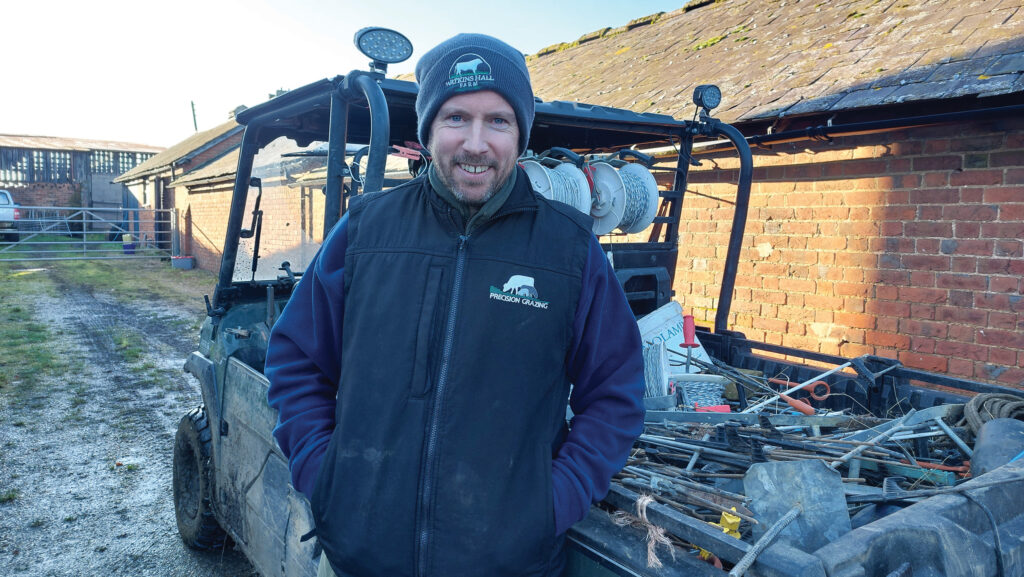
With hot dry summers the norm, making hay is something he can do, says Sam, who farms 198ha (489 acres) at Watkins Hall Farm near Hertford. Aside from 20ha (49 acres) of permanent pasture, his land is down to GS4 and SAM3 herbal leys, and ryegrass-clover leys.
Cows have been outwintered since 2019 to save money, and because Sam’s traditional brick farm buildings were hard work when full of livestock.
Sam Pearman © MAG/Shirley Macmillan
Crow and deer damage
Initially half the herd went out, grazing cover crops supplemented with silage bales in ring feeders.
But, fed up with crows pecking holes in wrapped bales and deer ripping open plastic, resulting in mouldy silage, Sam wanted to stop annual losses of 20%.
Encouraged by his Precision Grazing discussion group, he switched to fully using hay in a bale-grazing system four years ago.
“If you bring silage bales inside to protect them [from attack], then you have to take them out again in winter,” says Sam.
“And wrapping bales with six layers for suckler cows cost a lot when we were trying to save money – particularly when, post-Covid, silage wrap was £90/roll.”
He adds that in an area with minimal livestock, he has invested in his own grassland kit. “I mow, ted, rake and bale. It’s flexible.”
Now, Sam takes a hay cut from surplus grass as part of the rotation or paddocks he has earmarked for hay.
Grazing fields are shut up in May (dedicated paddocks after the last grazing round in October or November) and are allowed to grow on without artificial fertiliser or muck, just nutrients deposited by grazing cattle.
Conditions for haymaking
He mows at the end of June/early July. At this stage of growth, crops are dry and fibrous and in a hot summer it works perfectly.
“I mow to leave a 10cm stubble, so I don’t damage the crown of plants, and I also want a quick regrowth. If it’s hot and dry, I turn the swath once, but ted it twice gently with a 9m tedder – just flick it – then roll and bale. In ideal conditions – as 2025 – I bale after four days; in a 20C year, it might be after five to six days,” Sam explains.
Bales are net wrapped on a 4ft round baler, with those to be used for winter grazing given “an extra one or two turns to hold them together”.
They are left in the field for about a month, then moved into position by early September, when outwintering fields are closed to grazing.
“This year, 70 cows and a bull have 0.25ha/day plus three hay bales. The grass is wet and has a thick cover and the hay is fibrous.”
© MAG/Shirley Macmillan
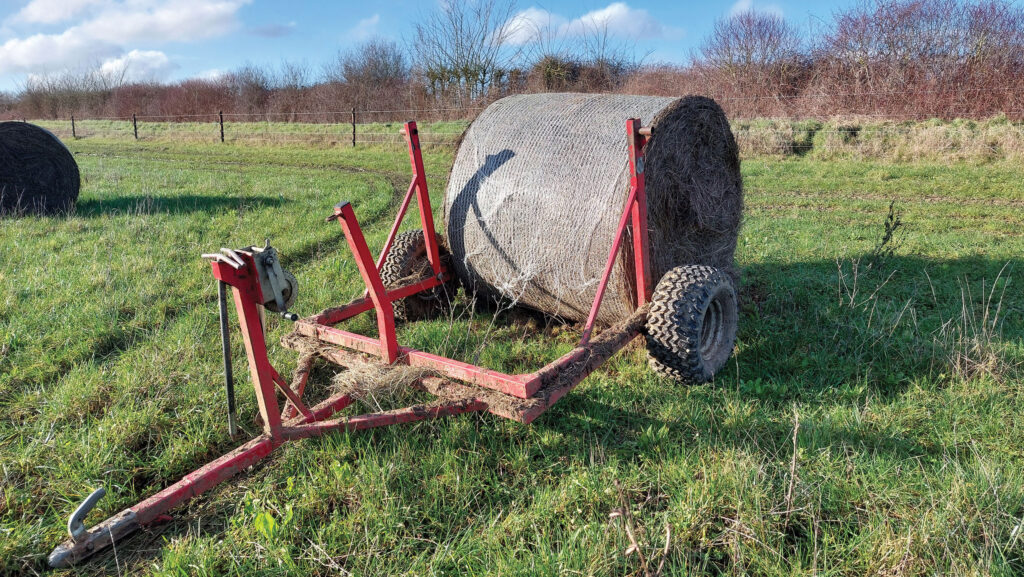
Sam uses a bale unroller (which is ideal for heavy, dense bales in extremely wet weather), so it takes him just five minutes to unwrap and unroll one bale, he says. He is also back fencing to prevent poaching and using mobile water troughs.
“I don’t outwinter on the same field two years in a row – there is a rotation,” he says. “Because it’s an ex-arable farm, it is quite exposed and there are no in-field trees, but we have four good blocks for outwintering near some woodland.
“With rotation, poaching is minimised, so there is no need for a full reseed afterwards.” He says, pointing out that fields noticeably benefit from hay seed dropped at grazing.
Yield and cost
Hay bales are not analysed because Sam considers it a maintenance feed for in-calf cows, whereas growing youngstock are fed ryegrass-clover silage.
“Hay yields 15-20 bales/ha – though last year we only got 10 bales; fortunately, we had some carryover from 2024 – and costs £35/bale including carting.
“We could still wrap in a wet year if necessary. But we have made hay every year for the past 10 years on this farm – apart from the really wet 2012. It is an advantage of being here: you just have got to be ready to go and take it.”
Farm facts: Watkins Hall Farm, Hertfordshire
- 85 Angus-cross cows bred to Aberdeen Angus bull
- Calving in a six-week block from mid-April
- 15% heifer replacements reared annually
- Calves sold at 12-18 months into the store market
Haymaking tips
To make good hay from herbal leys, mixes with fibrous grasses should be selected – leaving out the chicory, is the advice from Rod Bonshor general manager at DLF Seeds.
“Chicory soon produces a big, woody stem and a blue flower once it stops being grazed,” he explains.
Equally, plantain, often viewed as a “cure-all” for many situations, is also best left out of conserved forages because its big leaves soon turn black.
“Tailor a mix for hay production and use species that give the best chance of making the best crop of hay,” says Rod.
“If you get too high [a proportion of] herbs and legumes, unless you have a summer like 2025, there are too many different species of plants at different stages of maturity.”
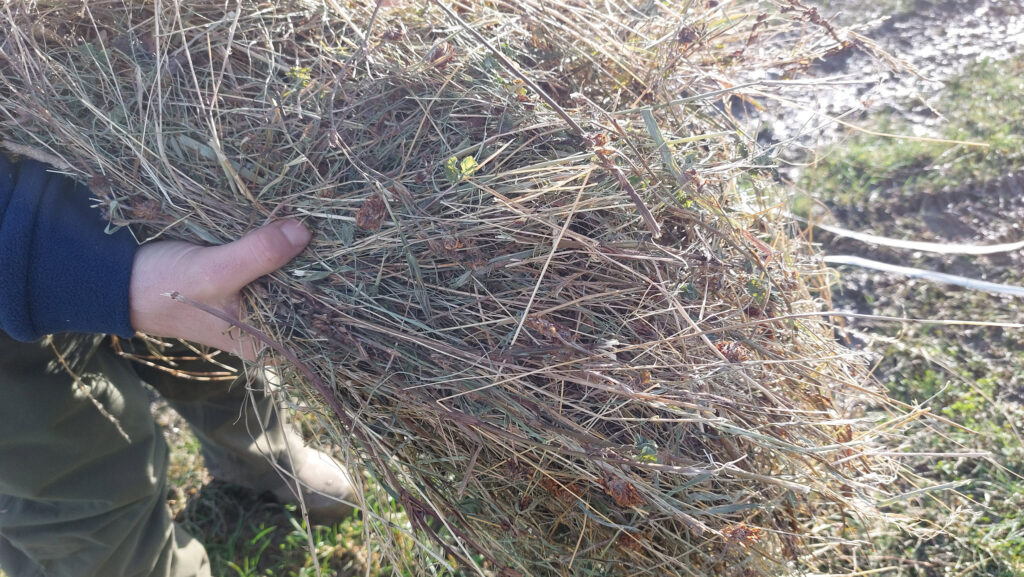
Mixed-species hay © MAG/Shirley Macmillan
Balancing act
Rod suggests sowing low-growing legumes and herbs such as trefoils and white clover, which will meet scheme requirements and suit hay making.
But he says a balancing act is needed: while these plants offer nitrogen-fixing and soil conditioning, they take longer to dry in a swath, and when too dry, they get leaf shatter and protein loss.
Mixed species swards with more moisture inevitably increase the risk of spoilage in a conserved forage, which is why Rod says it is wise to use a preservative.
Other tips include the need to leave a higher stubble at mowing because many species grow from a crown: “If you scalp [when you mow], then you damage the crown and the plant dies.
“A 10cm stubble lets the plant recover quickly, as the smallest leaves at the bottom are left to photosynthesise,” he explains.
Flexible approach
A mower-conditioner is useful to remove moisture from stems. “You need to take as much moisture out as quickly as you can: good hay is 85% dry matter, better at 90%.
“But if the year is [wetter] and you want it made quickly – so it’s only lying for two days, not four – it might need to be haylage at 40-60% moisture. Again, you usually need an additive because once a bale has moisture in it, it heats and this leads to mould.”
Ideally, Rod says that hay should be cut at the end of May/beginning of June when the sward will mostly comprise grasses.
Lower soil temperatures in spring favour grass growth and they dominate the field. Herbs and legumes begin to take over after cutting, when the sward opens up and soil temperatures rise, says Rod.
As with traditional hay making, hot, sunny days do the drying work; and a lighter, thinner crop dries quickly and needs little tedding.
But in higher yielding years, producing a thick swath results in more crop to dry: “Then you accept you lose protein because of leaf shatter,” he adds.
Bales should not be moved until needed, as multiple moves lead to more damage. If they cannot be left in situ for grazing over winter, they should only be moved just before bale grazing.
The business case
There is a growing trend to use hay instead of silage as a complement to wet, deferred grass in bale grazing for beef cattle, says Precision Grazing consultant James Daniel.
This has been partly driven by cost, but also environmental reasons, he says.
“Plastic bale wrap is 2.6t carbon dioxide equivalent for every 1t of bale wrap used,” he points out.
Disposing of clean netting is usually possible, whereas dirty netting is a challenge, so research into biodegradable or edible net wrap will be “really useful” if it leads to practical products, he adds.
Maintenance diet
More of his suckler herd clients are using hay as a maintenance diet for in-calf cows. “It gives rumen fill and cow satisfaction, slowing down forage through the rumen [as cows graze].
“The majority of hay is still made from ryegrass-based swards, though there is interest in multispecies with more SFI [Sustainable Farming Incentive] coming on.”
However, successful haymaking is still very weather dependent, meaning that farmers need to be ready to bale and wrap silage if necessary. James says it is best to start with the intention of making hay, then, if it is not possible in May, there is still chance later.
“Be flexible: be prepared to wrap if the weather window is not there. People are doing it, trying and learning,” he says, adding that because hay is densely made, it can be stored outside on its side without significant loss due to wastage.
“If you can keep bales in the same field for deferred grazing, that’s ideal. It retains nutrients and soil fertility and is labour saving, but it doesn’t always work, as a bale grazing field needs to be free draining and also be in rotation.
“Equally, you can move bales to another part of the farm to manage P and K levels from dung applications.”
Full cost analysis
James also advises analysing full costs (by nutrient content on a dry matter basis) for true comparison to see whether hay is really cheaper than silage.
He uses NAAC contractor charges, which show that a typical silage yield of 17 bales/ha works out at about at £16.44/bale, whereas hay yielding 25 bales/ha costs £9.72/bale.
“This is operational costs only and more bales produced will dilute costs further,” he adds.
Winter feed demand bale grazing |
|
|
Stock class |
Suckler cow |
|
Average weight kg |
650 |
|
Intake factor (% bodyweight) |
2 |
|
Daily intake (kg dry matter) |
13 |
|
Winter period (days) |
120 |
|
Conserved forage as % of diet |
70 |
|
Conserved forage (kg dry matter) |
9.1 |
|
Total conserved forage (kg dry matter) |
1,092 |
|
Cost baled silage £ a head |
64.10 |
|
Cost baled hay £ a head |
37.84 |
|
Difference in cost £ |
26.26 |
|
Herd size – number of cows |
100 |
|
Total cost of silage £ |
6,409.91 |
|
Total cost of hay £ |
3,783.54 |
|
Difference £ |
2,626.37 |
|
Source: James Daniel, Precision Grazing |
|