

How efficient grazing unlocked hill farm’s potential
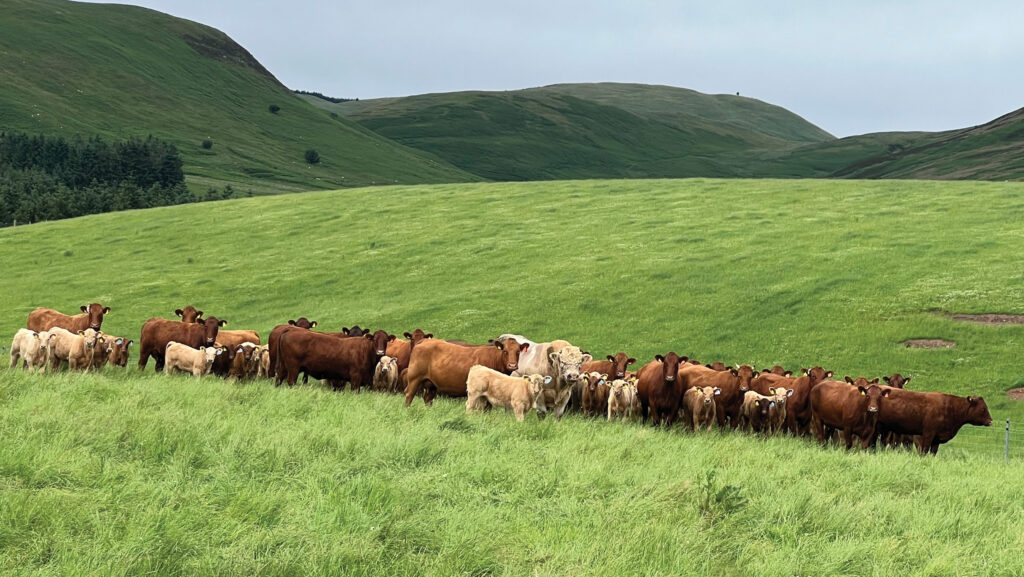 Cows with Charolais bull © Sara Gregson
 Fertiliser costs have been cut by 80% and feed costs halved on a Dumfriesshire beef and sheep farm that credits improved grassland management for its changing fortunes.
Taking part in Quality Meat Scotland’s Better Grazing Programme almost 10 years ago gave Alisdair and Emma Davidson the tools they needed to get on a sounder footing at Poldean Farm, near Moffat.
They now balance productivity with efficient grazing, using appropriate breeds, with production timed to align with pasture growth.
See also: How to start rotational grazing with beef and sheep
Farm facts
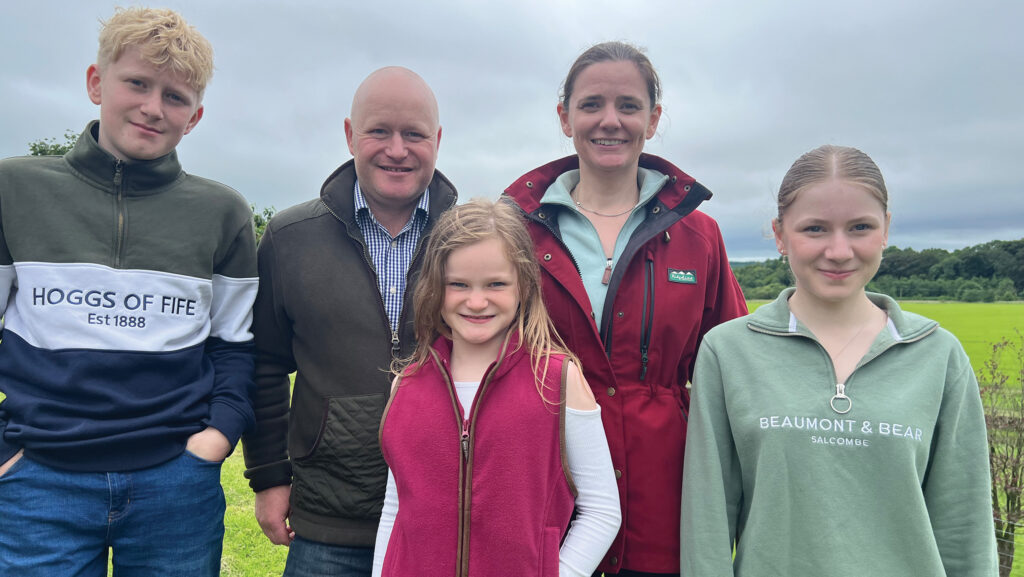
Alisdair and Emma Davidson with children Rory, Abbie and Lucy © Sara Gregson
Poldean Farm, near Moffat, Dumfriesshire
- Tenants of Crown Estates Scotland
- 850ha, including 300ha improved grassland
- 1,315mm annual rainfall
- Land rising to 540m above sea level
- 270 Salers-cross suckler cows, 30 purebred Salers and 40 Belted Galloway-crosses
- Charolais calves sold as strong stores through Wallets Mart, Castle Douglas
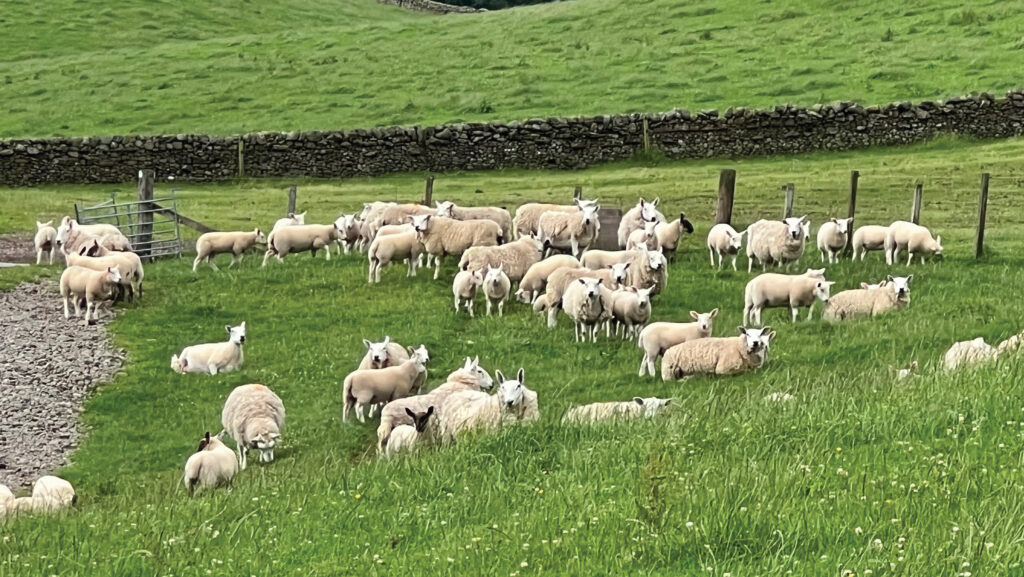
- 450 Lleyn cross Cheviot ewes
- Grazing fields overseeded with white clover
- Red clover silage leys
- Barley/oats grown for winter feed
Some 300ha (735 acres) of grassland have been agriculturally improved at the 888ha (2,176-acre) tenanted hill farm. Grazing management has also improved.
“The change to paddock grazing from set stocking has significantly increased our profitability, allowing us to keep on investing for future generations,” says Alisdair.
“We used to have 300 pure Salers cows and 600 pure Lleyn ewes.
“They were fed heavily on expensive bought-in feed, the silage we made was rubbish and the sheep were inside for lambing. We were making no money, so something had to change.”
There are still 300 suckler cows, but most are now Salers-Angus crosses.
Cows are selected for good maternal traits, calving without assistance and holding onto their condition outside.
Calving shift
Calving used to start in the middle of May but is now timed to catch the first flush of grass growth in early April.
Replacement heifers and second calvers are served with a Salers or Red Angus bull, while the older cows are bred to a Charolais.
The aim is to produce highly sought-after store calves, which are typically sold at nine to 10 months of age at 350kg.
Steers have recently made top prices of £5.28p/kg and heifers £5.19p/kg.
Grazing management
Winter feed is silage only. After calving, cows are batched into bulling groups with a maximum size of 40 to ease cattle movements.
They are shifted every two to three days on a paddock-grazing system using temporary and semi-permanent electric fencing.
“The paddocks are 2-3ha [5-7.3 acres] in size and rotation length is as little as 14 days in periods of high growth, and up to 60 days when it slows,” Alisdair explains.
“We like to have flexibility so we can adapt to changing conditions.”
The calves are weaned at housing – usually in November – and fed a diet of silage, home-grown barley and oats and a bought-in protein balancer.
The extra grass produced by paddock grazing has released land to grow higher-quality silage and cereal crops for feed and straw.
A small herd of Belted Galloway-cross cattle has been introduced to outwinter and graze on 102ha (250 acres).
This land has been fenced within 408ha (1,000 acres) of previously unused heather hill.
With only 300 cubicles for winter housing, this is one way to increase cattle numbers and utilise more land.
© Sara Gregson
The sheep enterprise complements the cattle by using grass – and labour – resources efficiently across the farm.
Breeding ewes are rigorously culled to reduce the need for any assistance at lambing. Target lambing percentage is 175%.
“After lambing in April, the ewes and lambs are rotated on the hill in 20ha [50-acre] blocks, followed by more controlled grazing once the lambs are weaned,” says Emma.
Lambs are finished on red clover leys and drawn to sell at 42-43kg liveweight, ideally by Christmas.
Fencing and water provision
When Alisdair returned to the farm from college, the field on the in-bye hill was one large block of 160ha (400 acres] with few tracks and little fencing.
This area is now split into 20 paddocks with opportunities for further division when needed.
The original wooden posts have now rotted, prompting a move to metal fencing only.
“We often trial fence placement with a temporary polywire fence for a year.
“Once we feel it is in the right position, we replace this with a permanent metal fence,” says Alisdair.
“We have a variety of four-wire, six-wire and rylock fencing, depending on position and purpose.
“The electric fencing is run from a 4,600W mains energiser based in the farm buildings.”
Water infrastructure has also been upgraded. Previously, stock would drink only from burns; now, water is pumped from a well close to the steading to two header tanks at 191m elevation and then gravity-fed to 150 concrete water troughs.
Water can also be pumped a further 50m to another header tank, allowing the Davidsons to split fields into paddocks higher up the farm.
Investment in soils
Soils across the farm range from alluvial soils in the valley bottom to brown soils and peaty gleys.
The higher fields are rougher and very stoney, causing issues for field work.
“Improving the land is a long process – one 8ha [20-acre] field has taken three years to get it where we want it to be,” says Alisdair.
Unsuitable for ploughing, the field was fenced off and limed to increase the pH to 6.6.
It was then sprayed off with glyphosate and drilled with a hybrid brassica using a Duncan drill, which broke up the soil.
A crop of kale was grown the following year, after which a Kirby Crusher was brought in to pulverise the stones, leaving a good seed-bed.
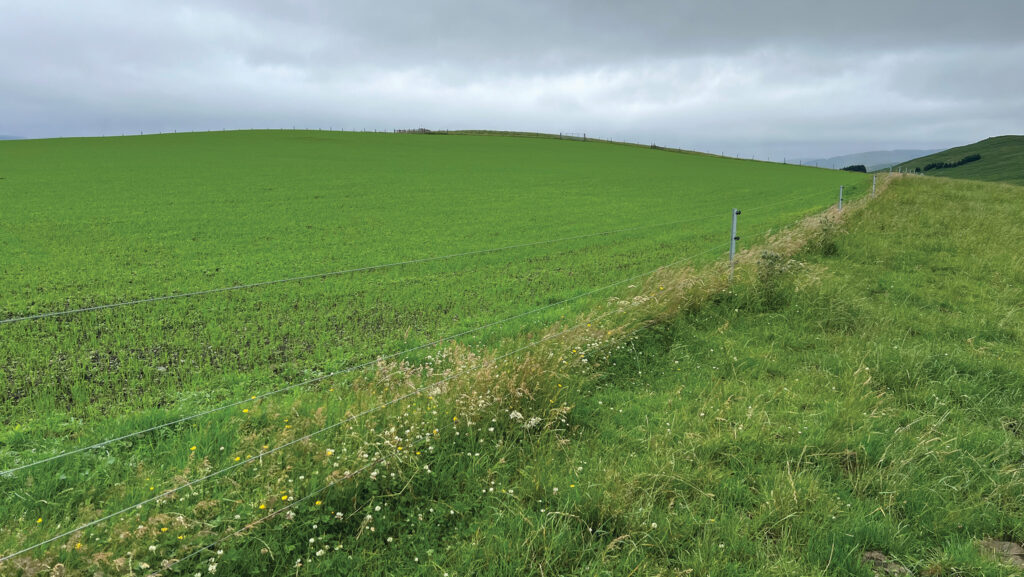
Red clover grass ley reseed © Sara Gregson
The ground was levelled using a paddle roller, drilled with a red clover grass mix then rolled again.
“This area is now producing a forage crop that we are happy to take a mower and baler into,” he says.
Importing food waste digestate to fertilise the fields has been another key change.
A part-funded 11,365cu m lagoon was built in 2019 giving enough capacity for 4,546cu m of digestate along with 4,546cu m of their own slurry.
Liming has brought pH up from the low 4s to the level required for good grass growth.
Bulk calcium lime is spread at 5t/ha every two to four years until a pH of 6.5 is reached.
This is maintained with prilled lime spread with a fertiliser spreader at 250kg/ha.
Impact of grass focus
“Focusing on growing and utilising grass has certainly had the biggest impact on our business,” says Emma.
“We have invested in all the infrastructure and the field improvements ourselves and this has opened many different opportunities.
“For instance, we might take on more store cattle in summer or finish some of our own beef calves.
“The changes have not happened overnight, but we are starting to reap the benefits.
“We are building a business so that if any of our three children wish to carry on after us, it is in the best position possible for them.”
Alisdair and Emma Davidson hosted a farm walk as part of the British Grassland Society’s Summer Meeting