

3 milking settings to check that help lower mastitis risk
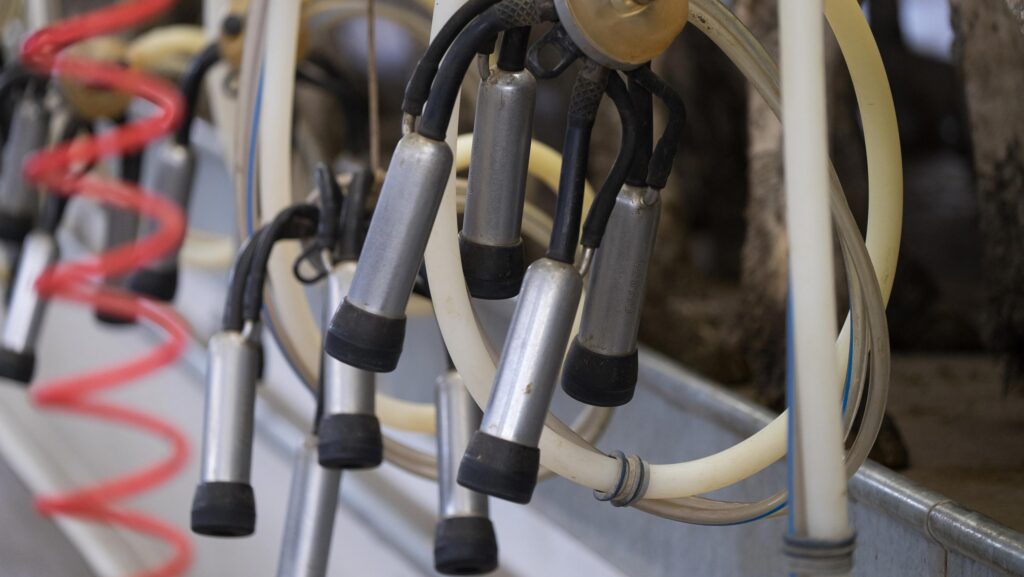 © Tim Scrivener
 Herds with excellent control of environmental hygiene can nevertheless struggle with environmental bacteria infecting cows during lactation. In such cases, a milking time assessment may provide some answers.
While parlour hygiene and good teat preparation remain key to controlling environmental pathogens, some settings in the milking equipment can also be linked to mastitis infections.
See also: Advice on carrying out a dynamic dairy parlour test
Norman Beggs of Udder Health Solutions emphasises that milking equipment can milk cows completely and gently – when settings are correct.
But in herds where environmental infections are acquired during lactation (confirmed by clinical data and somatic cell count), a milking time assessment should be done.
“[An] annual milking time assessment, in my experience, is an essential component of mastitis control in dairy herds,” he says.
“At the very least, a milking time assessment should be carried out on all new milking installations a month after commissioning.”
Norman has identified three main settings which, if not correct, are likely to assist bacteria to enter the teat system, via the teat canal.
1. Automatic cluster removal
The most common form of automation in all milking systems is automatic cluster removal.
This is where the settings are most likely to negatively impact udder health, says Norman: “Specifically, the setting that covers the time delay between vacuum shut-off and automatic cluster rope pull.”
If set incorrectly, this can result in a painful “tug of war” between the rope and the cow’s teats.
In extreme cases, the vacuum sweep may also suck the teat back into the liners and generate force.
This can push a droplet of milk, which may contain environmental bacteria, back into the teat.
“We should scrutinise in detail the manner in which units are being removed from teats,” he says, adding that this includes the angle at which clusters are being removed.
A five-minute conversation with the technician who set up the equipment can allow them to change settings remotely.
Milking operators can then observe whether milking has become gentler or not.
2. Cluster flush
“A cluster flush system can reduce the number of bacteria on the liner.
“Many farmers who are under the mistaken impression that they have a contagious mastitis problem install this type of equipment, at a cost of approximately £1,000 per unit,” says Norman.
However, he would argue that if the problem is environmental mastitis, a good teat prep routine is more effective.
If the cluster flush system is activating too quickly, take-off events can mean that water and disinfectant solution will be pushed against the teat end, followed by compressed air.
3. Liner fitting
Incorrect liners can cause excess vacuum and overmilking, which can lead to swelling and ringing of the teats and teat congestion.
“If vacuum in the liner is sufficiently high, the tissues at the base of the teat may swell – and they have to swell inwards because there’s a liner constricting the outside of the teat,” he says.
This congestion can cause poor milk flow from the udder into the teat.
“If the tissues around the teat canal are congested, the teat canal may take up to eight hours to close between milkings.
“A teat canal that is not congested may be closed 15 minutes after the end of milking,” Norman explains.
Pressure from a poor fitting liner on the teat end can also cause hyperkeratosis (hardened, thickened skin caused by excessive keratin growth) after a few months.
“The risk of new infection is increased when severe hyperkeratosis is observed in more than 5% of teats in a herd,” he points out.
Norman Beggs was speaking at the British Mastitis Conference on 17 June in Worcester