

How eggs cracked a profitability challenge for upland farm
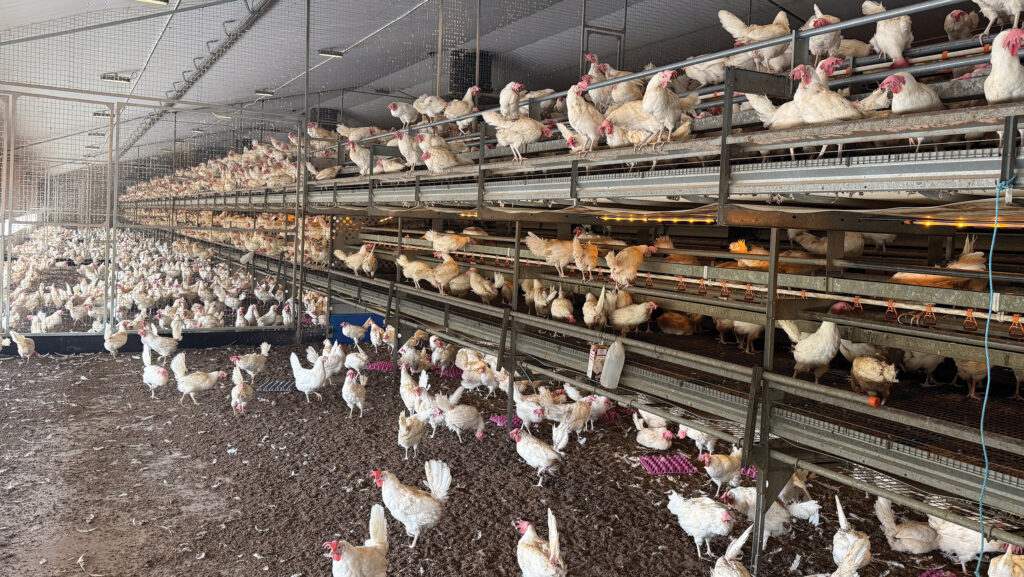 Each shed houses 16,000 birds © Rhian Price Media
 Diversifying into egg production has helped one family secure the future of their Welsh upland farm and create a business capable of supporting the next generation.
Gareth and Rhianon Jones had been running a 70-cow suckler herd and 500 ewes at Rhiwhiraeth Isaf near Llanfair Caereinion, Powys, in partnership with Gareth’s mother, Sandra.
However, the couple admit the farm was not profitable enough to support their family, prompting Rhianon to work off farm to supplement their income.
See also: Why rearing organic poultry is good fit for dairy farm
However, driven to improve the farm’s earning potential and provide viable succession prospects for their three sons (15-year-old twins Brian and Bedo and 12-year-old Ceiron), the couple applied for planning permission to build a 16,000-bird free-range laying unit in 2017.
The new enterprise allowed Rhianon to return to the farm full-time. In 2021, the Joneses doubled the poultry unit to 32,000 birds and dispersed their suckler herd, switching to rearing Charolais-cross weaned calves.
These are now bought at about eight months old from Welshpool and Ruthin Markets, then sold eight months later as forward stores.
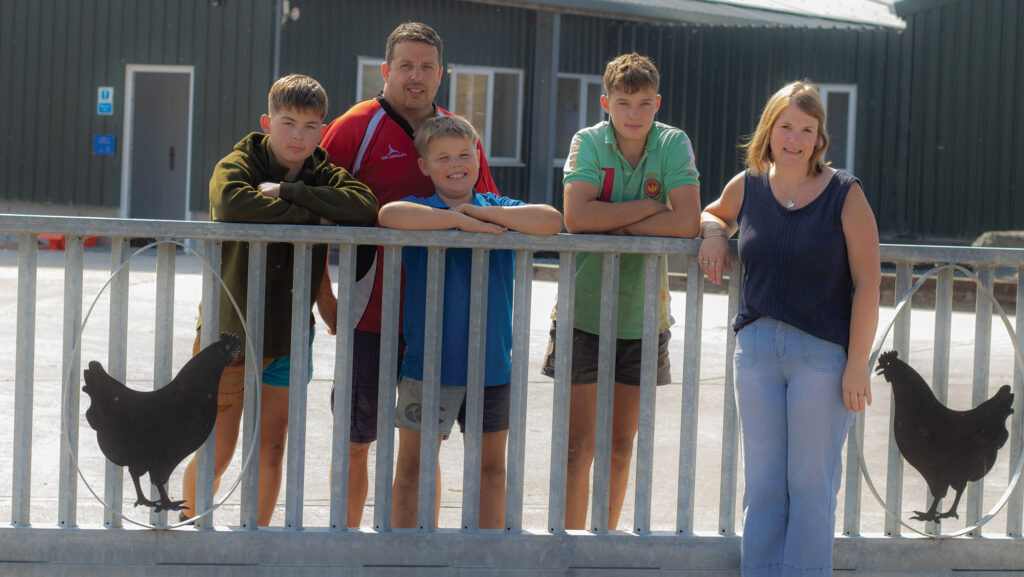
Rhianon and Gareth pictured with twins Brian and Bedo, and Ceiron (centre) © Rhian Price Media
Rhiwiraeth Isaf farm facts
- 32,000 laying hens
- Supplies Stonegate/Clarence Court and a local butcher, hotels and restaurants/cafes
- RSPCA Assured
- 70ha owned and 14ha rented
- 400 Welsh Mules mated to Texel or Charolais
- Lambs sold to ABP or at local markets
- Sells 80 store cattle annually
- Two full-time poultry employees
New business brings challenges
Egg production was not the Joneses’ original diversification plan. Initially, they applied to build two pullet-rearing sheds, but their application for a sustainability grant was unsuccessful.
“In hindsight, we are over the moon we didn’t get it because the layers really suit us,” says Gareth.
Yet establishing a completely new business was not without its challenges. The couple borrowed £675,000 to build the first multi-tier shed and egg-packing room, including fixtures and fittings, in 2018.
They received a £130,000 Food Business Investment Grant towards items directly linked to food production. Unfortunately, the investment coincided with low egg prices, and their first flock generated a meagre £8,000 profit to put towards repaying the bank loan.
“We had sleepless nights wondering what we had done,” admits Rhianon, who says access to an overdraft proved their saving grace, and helped manage cashflow during the difficult first few years.
Thankfully, the market quickly improved. Within one flock cycle, egg prices rose substantially, taking returns from about 50p a bird to more than £10.
This vastly improved profitability and gave them the confidence and financial backing to invest again, build a second shed and double production.
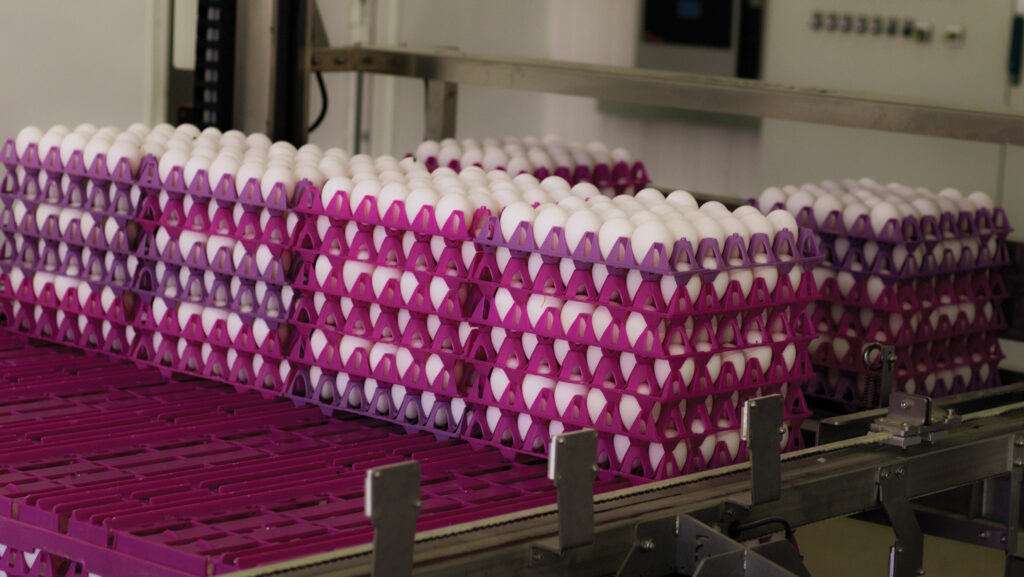
Investment has included an egg packing room © Rhian Price Media
White hens deliver great results
The Joneses initially housed commercial brown birds before running two flocks of Burford Browns. They have since switched to Dekalb White hens and have been impressed with their performance and longevity.
The current flock is 90 weeks into its production cycle and is still achieving 85% lay. The birds are on course to remain in production until 104 weeks and produce in excess of 500 eggs a bird. By comparison, the Burford Brown birds were depleted at 74 weeks.
Extending the laying cycle has significant benefits for the business. Gareth calculates that over five flocks, the greater longevity effectively removes the need for one complete turnaround and cleanout, saving time, labour and money.
Mortality at 90 weeks has also fallen to just 4% from more than 10%. “The birds are more resilient and have better longevity,” he adds.
Poultry manure replaces purchased fertiliser
Integration between the poultry and beef and sheep enterprises has helped reduce the Joneses’ reliance on bought-in fertiliser, too. About 75% of poultry manure is exported off the farm, providing an additional income stream.
They apply the remainder to grassland at around 2.27t/ha in spring. They grow about 8ha of spring barley for wholecrop and establish a cover crop of turnips or rapeseed as a break crop to provide autumn/winter forage for finishing lambs.
They have purchased only 1.2t of nitrogen over the past two years, down from 18t.
A Welsh government grant was secured for new covered manure stores, which they will use for the first time this year. This will give them greater flexibility to store poultry manure through the winter rather than having to export it.
Reflecting on their journey, Gareth and Rhianon say working with experienced people and listening to their advice has been crucial. Neither had any experience in commercial egg production before investing in the new unit and relied heavily on advisers.
“Sarah Williams from Wynnstay and Jim Turner from Stonegate have a wealth of knowledge and held our hands for our first flock, and they still provide support,” says Gareth.
Their progress was recently recognised when the business was named the British Free Range Egg Producers Association’s Medium-Sized Producer of the Year.
The couple say it is also a testament to the dedication of their two full-time employees, Tammy Smith and Romas Venys. They have now applied some of the learnings from the egg enterprise to their sheep and beef operations.
The daily monitoring and attention to detail required by the laying flock have encouraged them to intervene earlier when problems arise in their sheep and cattle.
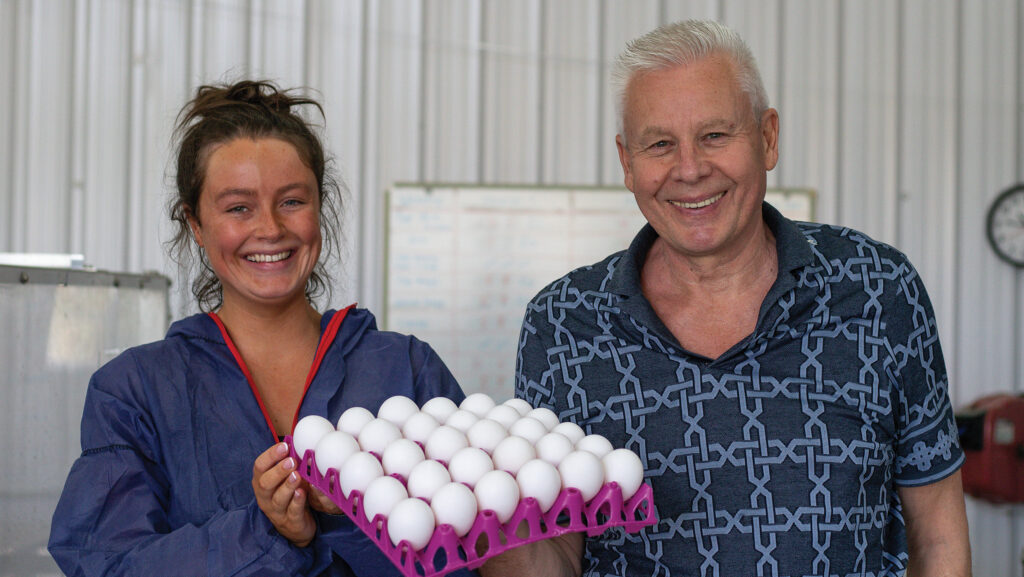
Full-time employees Tammy Smith and Romas Venys © Rhian Price Media
Building a business fit for the next generation
Most significantly, the poultry business has given the family renewed confidence in the farm’s future.
They have recently bought an additional 8ha smallholding and plan to increase the land base further. With Brian and Bedo due to leave school next year, investment has centred around making the business resilient for the next generation to take over.
However, Gareth and Rhianon are encouraging all three boys to first gain experience away from the family farm before considering returning home.
“At that point, the twins will be 20, and I’ll be 60, but, importantly, there will be a business here worth taking over,” says Gareth.
Further expansion of the egg enterprise remains the long-term goal. The experience, however, has made the couple acutely aware of how quickly fortunes can change in agriculture – something that is now driving their focus on reducing costs.
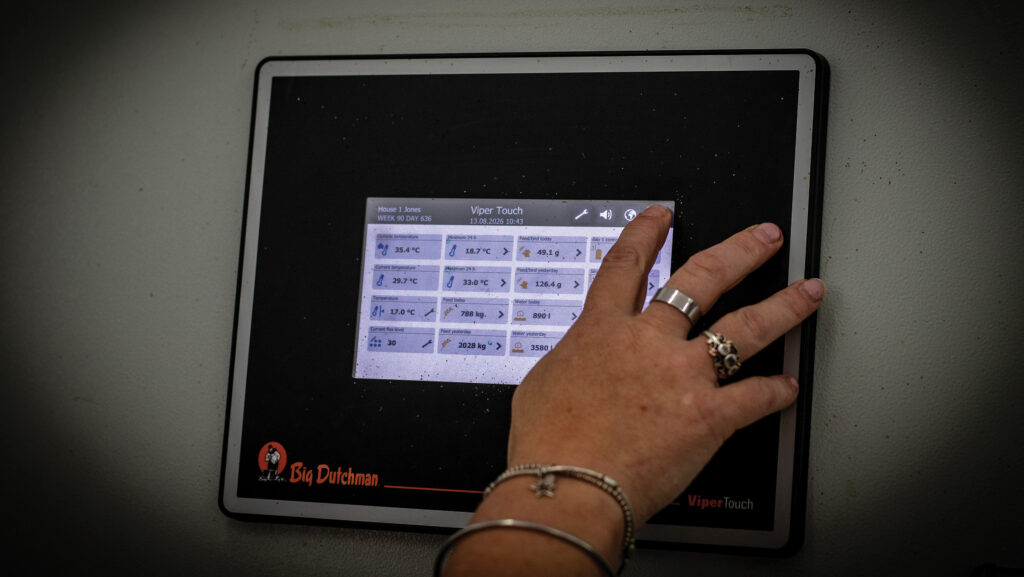
The houses are fully climate controlled and intakes are monitored daily © Rhian Price Media
A 100kW roof-mounted solar array has saved them £25,000 annually in electricity, and the Joneses are considering installing battery storage within the next six months to capture surplus energy for use overnight.
They have also signed a contract with a local biodigester to connect to its local energy network to reduce their standing electricity charge.
Feed is another area under scrutiny. With the birds consuming about 4t of feed a day, they are investigating whether to source raw materials directly, to mill and mix feed on farm instead of buying expensive compound feed.
“At the moment, the job is making a nice return, but when the price drops, we need to look at ways to streamline it even more,” explains Gareth.
“We have ridden the crest of a wave, and the price will fall, but diversification has been the right move. It has enabled Rhianon to come home, secured the future of the farm and enabled us to go again.”