

How lung scanning is leading to healthier dairy calves
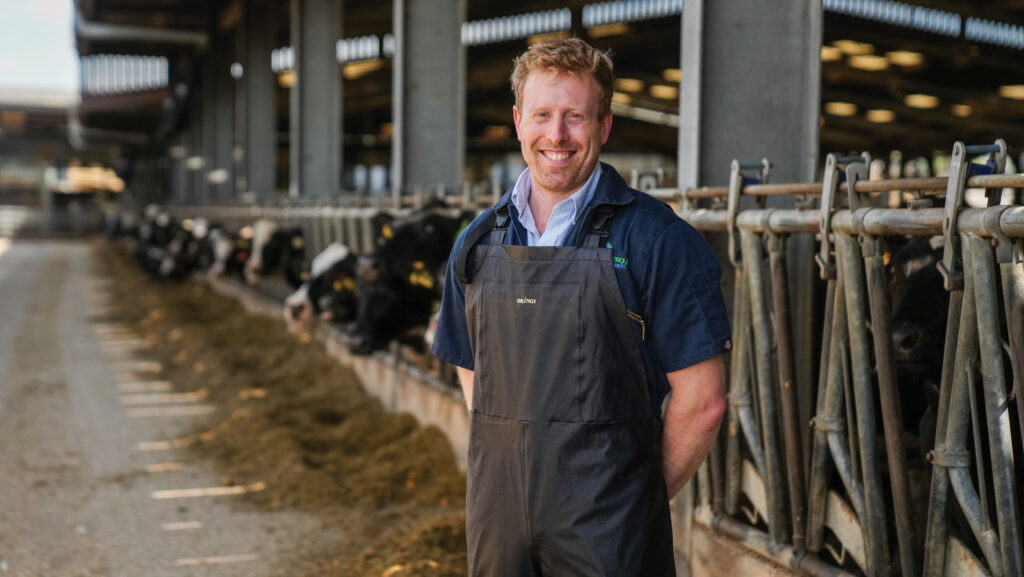 © Emily Fleur
 A growing commitment by his dairy farming clients to improve calf health is keeping vet Peter O’Malley busier than ever.
See also: Benefits of lung scanning for respiratory disease in calves
Since winning Farmers Weekly’s 2025 Livestock Adviser of the Year award, many of his clients across Somerset are eager for him to do more calf lung scanning.
The result is that catching cases of pneumonia early is seeing a very high cure rate after just one treatment course of antibiotics.
Picking up on the disease early – which can be difficult to detect from just visual symptoms – can lead to healthier dairy cattle with better growth rates, which get in-calf earlier and see better health throughout their lives.
“Existing clients are looking to do more work with us looking at every single step of their calves’ progress, from colostrum feeding to weaning, and especially pneumonia prevention,” says the Synergy Farm Health vet.
Fact file
- Peter O’Malley has worked for 15 years as a vet in south-west England
- He has been with Synergy Farm Health for seven years where he is north team regional lead, and academic lead for the Synergy team, delivering clinical veterinary teaching for the Royal Veterinary College
- The group has 59 vets in the practice with 289 dairy clients
- The practice covers Devon, Dorset, Somerset, Hampshire and Wiltshire
Intensive intervention
Peter is now lung scanning more calves, typically at three to four weeks old. Those with more than 1cm of lung consolidation will be treated with antibiotics.
Scanning is repeated a week later on those treated, and further treatment given if needed, with this weekly cycle continuing as necessary.
“Using this approach, we are seeing a cure rate of over 90%, which means with this early and intensive intervention we are actually using fewer antibiotics overall,” he says.
The typical visual signs of bovine upper respiratory disease – such as running noses, streaming eyes, coughing and high temperatures – can often be missed by even the best stockperson.
This is because the calves either fail to show any symptoms, or more likely because, despite any initial antibiotic treatment, they have progressed to a bacterial bronchopneumonia.
This condition often appears completely symptomless even though the calf is suffering with a worsening condition. For this reason, scanning is proving more and more popular.
Long-term benefits
At one of his farming clients, the FAW Bakers business, near Crewkerne in Somerset, with 2,500 milking cows, he has been scanning 30-50 calves a week and is now looking forward to seeing the full effects of early pneumonia detection.
“Soon, we will see cows on the farm finishing their first lactations that have been treated according to lung scanning results as calves, so we will be able to see the full benefits of scanning in terms of longer term health and yields,” he says.
The farm is already seeing reductions in heifer attrition rates and improved heifer fertility.
Heifers are served when they reach 60% of the adult body weight average for the farm, and that means starting at about 400 days old, with heifers coming into the milking herd sooner than previously and showing good health.
Lung-scanning app
The increased interest in calf health has prompted the vet practice to develop a lung-scanning app to record a calf’s lung scanning results, treatment and housing location.
This data is then analysed using Power BI software to make strategic calf health management decisions from scanning ages, treatment protocols, vaccination plans and housing adaptations.
The 2026 Farmers Weekly Awards
The 2026 Farmers Weekly Livestock Adviser of the Year Award is open for entries.
Enter or nominate now on our Awards website.