

How natural lighting simulator cut broiler unit’s feed bill
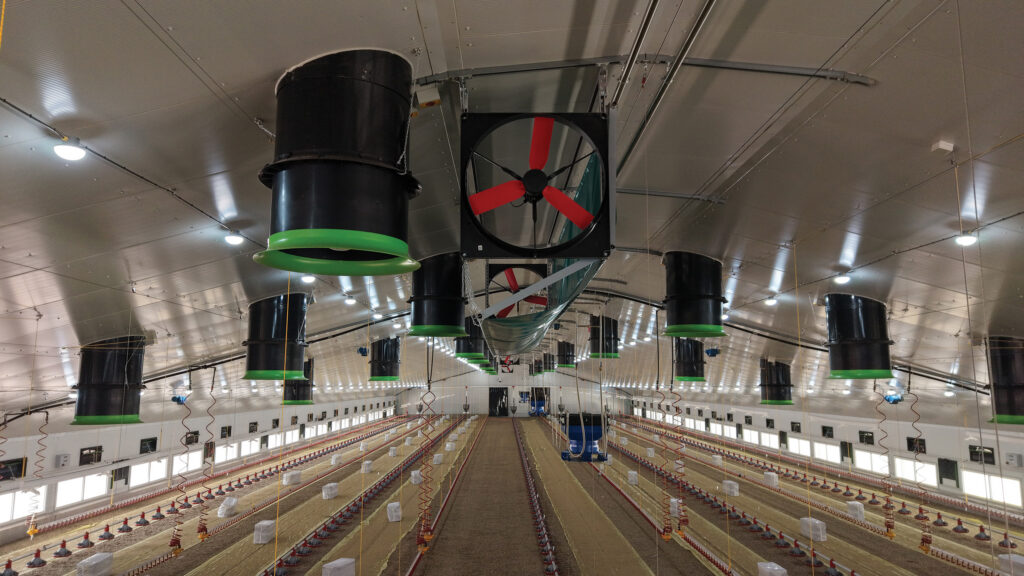
© JF McKenna
A 2% improvement in feed conversion ratio has saved an average £3,580 a crop across four broiler houses on a Shropshire farm since installing a lighting system that mimics natural daylight.
See also: 4 ways to achieve a low feed conversion ratio in broilers
IEC Poultry grows 380,000 Ross 308 broilers across eight houses near Market Drayton under contract for 2Agriculture.
Dynamic daylight simulation lighting, which can be adjusted according to the stage of production, was retrofitted in the older houses in 2025 and has been incorporated into the design of four new buildings.
IEC Poultry technical specialist Chris Wright says lighting options have historically been a weakness in broiler production.
“Progress in the broiler sector was held back for years by poor lighting, fluorescent tubes or just one colour of LED, for example. We had to work with what we had to manage bird activity.
“The introduction of windows helped, by providing greater light intensity early in the day, at a time when fluorescent systems gave us very little control over lux levels,” he explains.
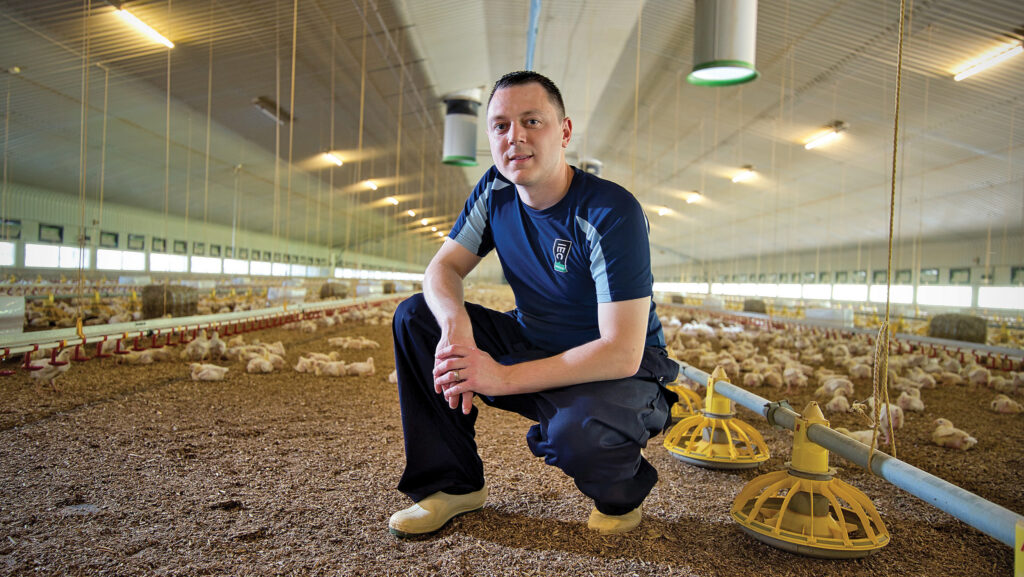
Chris Wright © Richard Stanton
Dynamic control of spectrum and intensity
In the 15 years he has worked professionally in broiler production, Chris has trialled different approaches to lighting to support bird welfare and performance.
These include gradual dawn-and-dusk transitions, alongside changes in colour spectrum and intensity at different stages of the crop.
He has also used timed feeding, increasing the light intensity to a cooler white shortly before the feeding system runs, to stimulate activity and encourage the birds to eat and drink.
More recently, the development of lighting systems that offer dynamic control of spectrum and intensity, combined with a design that provides uniform light distribution, has given him greater control.
“I like to tinker and look for the extra 1%, so when I was presented with a data sheet showing cool white, warm white and UVA within the lighting range, I immediately saw the potential,” he says.
Cooler-white light can encourage activity, while warmer spectra can help create a calmer environment. UVA allows the lighting environment to include wavelengths visible to poultry and more closely reflect the birds’ natural visual environment.
“Lighting for me has always been about how we can bring the outside in and take the environment back towards what the bird would naturally experience,” says Chris.
Cooler and warmer whites
Each 24.4m-wide house has four rows of lights, with 48 lights in each row and 192 lights in total, with the fittings positioned according to a site-specific lighting design.
Chris says the system was marginally more expensive than other current lighting options, but it provides much greater control throughout the crop.
The light spectrum and intensity can be adjusted as the birds move through their typical 37-day growing cycle.
“We use a cooler white early in the crop to encourage activity, achieve good crop fill and get the birds eating and drinking quickly. It’s about establishing a routine for the birds,” Chris explains.
Establishing that routine early is important because it helps create consistent feeding, drinking and resting patterns throughout the crop.
During the more challenging period of vaccination and rapid growth, a warmer-white setting is used to moderate activity and help the birds move calmly through this stage.
Towards the end of the crop, the programme can be adjusted in response to bird behaviour, development and parent-flock characteristics.
Balance of welfare and efficiency
“Birds from a younger parent flock may be capable of giving a little more, so we may move them back towards a cooler white to encourage activity.
But this will all be done on a crop-by-crop basis, on what story the data is telling,” says Chris, adding that for him, the system allows a better balance to be struck between bird activity, controlled growth, welfare and feed efficiency.
As well as the 380,000 birds he manages at IEC Poultry, he oversees 350,000 at other sites, some which also utilise dynamic daylight simulation.
Across the four older houses included in the IEC Poultry comparison, which accommodate about 190,000 birds, the average improvement in feed conversion ratio is 0.03 – from 1.5 to 1.47.
Feed represents one of the largest costs in broiler production, so even a small improvement in conversion can generate substantial savings.
“The saving will vary according to bird numbers and final weight, but across these houses we are using approximately 8-12t less feed per crop.
At a feed cost of £358/t, that represents a saving of about £2,864-£4,296 per crop,” says Chris.
Maintaining bird weight while using less feed can also support drier, more friable litter.
This, alongside good ventilation, water management and stockmanship, can help reduce the risk of pododermatitis and hock burn and create a better welfare KPIs and a better working environment for staff.
Bespoke design
The lighting and dedicated dual controller installation at IEC Poultry was designed by equipment supplier JF McKenna in conjunction with light supplier Hato, and Fancom.
Brian Moxon, commercial sales director at J F McKenna, says every lighting design will differ according to the height to the shed, the equipment in it, and even the colour of the lining, because this will dictate how reflective it is.
Where feeder and drinker lines, heaters, nests and slats are located is part of the consideration on where light lines are placed.
Using this data, a plan is developed with computer software to establish how many rows and individual lights are needed.
“Red Tractor dictates a specific number of hours the birds should have light, and that is all planned in through the design programme,” says Brian.
Return on investment
In the past 12 months, 80% of the company’s new builds and retrofits – a total of 60 houses – have used dynamic daylight simulation lighting.
Only a minority of Brian’s broiler customers now request a more standard dimmable lit LED light, as the return on investment in the new technology is swift, he says.
He calculates an upgrade could result in savings equivalent to less than a month’s worth of feed.
Those returns are all centred on influencing the biological clock of a broiler to stimulate growth and to optimise feed conversion rates.
Light stimulates feeding activity – and the higher the photoperiod, the higher the feed intake, says Pieter Hanssen, of Hato.
“Uniform light distribution is essential for the growth, health and performance of chickens, and it also helps to prevent mortality and asynchronous mortality,” he explains.
Poultry have intense photosensitivity and visual systems, which means they process light differently to humans and react to light according to its colour, intensity, distribution, and duration.
Pieter says lighting distribution and intensity have a considerable bearing on how poultry perform – how lighting lines are placed and spaced significantly affects light distribution, for example.
“By using a combination of spectrum and dimmability, it is possible to gently keep birds active when they come into the house for the first time.
“As they develop skeleton and body, the white can be warmer and calmer; then we build up on the cooler white towards the end of the crop to push the birds on and to develop protein more rapidly.”