Far from sheepish returns prove prime numbers can add up
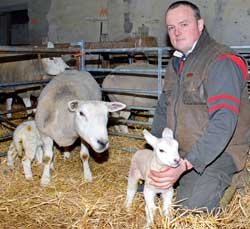
Stronger prices for prime lambs mean that John Scott is seriously considering increasing ewe numbers at Fearn Farm – if he can find the right system to let him stretch his season.
The main flock comprises about 750 commercial females, mainly Texel-cross ewes, lambing indoors from late February or early March. There are also some 30 pedigree Beltex and 70 Texel ewes.
So far, 731 head of prime lambs have left the farm since 19 May, contributing some £50,000 to spring and early summer cashflows.
Lambs are run through the farm’s race and selected by eye at first, and then run again through a weigh-crate. “My children James and Izzie are old enough to push them through the crate now. They’re a great help.”
All lambs so far have gone to Woodhead Brothers at Turriff, Aberdeenshire, achieving carcass grades of U and R, and fat classes of 3L and 4H. Target weight is up to 21kg, with most weighing somewhere around the 19kg mark. “Some would say I’m sending them a bit light with an average of 19.7kg,” says John. “But I don’t get paid for weight over 21kg.”
Lambs have gone in batches every Tuesday, and John places great value on knowing payment will follow three days later by bank transfer, “although I could do with getting the grading information back a little quicker.”
On average, prime lambs this season have returned £72.80 a head after deductions, but lambs in batches sent earlier in the summer were regularly achieving £100 a head.
“Physically, there’s no way I could get lambs to that weight and condition within that time frame if I was lambing outdoors in May. Our current system allows this and gives the cashflow a much-needed boost early in the season.”
Lambs are finished on grass with a bought-in creep from Harbros, which replaced the home-produced ration used last year.
Extending the season
But John is keen to find a way of extending his prime lamb marketing season further into the summer and autumn, provided it does not place too much additional demand on management time.
“On our current system, we rely on lambing indoors with seasonal labour and I’d like to expand numbers. We could probably cope with another 500 ewes, lambing outdoors in May, which would give me lambs to market right through into the autumn. But in terms of management I would probably need some easycare principles.
“I know a lot of people don’t like the term ‘easycare’ but to increase numbers on a May-lambing system I’d need a much less hands-on type of sheep. And with the right grassland management and health management I don’t foresee too many problems.”
To this end, John is keen to explore the potential of New Zealand Suffolk genetics with Easyrams breeder Robyn Hulme. While UK Suffolks were exported to New Zealand nearly 100 years ago, the modern New Zealand Suffolk is taller, longer, with finer shoulders and should lamb outdoors and unaided.
Prized assets
But prime lamb production is only one part of the sheep enterprise at Fearn. And despite a smaller gross margin – about £40 a ewe compared to £76 a ewe in the commercial flock – the Scott family see great potential to improve their prize-winning Beltex nucleus flock.
“I suppose the Beltex flock is very much the marketing and PR arm of our sheep enterprise,” says John. “They’re run on a conventional system, focusing on the main breed sales at Carlisle and Lanark and local sales at Dingwall. And we’ve had some show success this year with Buckles Masterpiece, which we half-own with Rachel and Kevin Buckle at Kirkby Stephen. He was first-placed aged ram at this year’s Royal Highland Show and champion Beltex at the Great Yorkshire Show.”
Passing on the showing bug is proving a rewarding way to bring on the younger generation. “My son James is now eight and he’s really starting to get involved in taking stock to local shows, and preparing sheep for showing. And he’s growing in confidence too, speaking to people he doesn’t know, and learning more about the industry,” says John.
The Scott family’s Beltex venture started 15 years ago. “It was a breed that was obviously going places, and the speed it has accelerated in popularity has been tremendous. You only have to look at the breed journal – it’s gone from a 20-page leaflet to a 150-odd page book.”
Commercial success
But while breed popularity can come and go, it was the commercial potential that first caught the eye of John and his father James. “There’s just nothing to touch them for carcass attributes, and that’s really why we got into them, as we were doing a lot of primestock showing at the time and carcass competitions.”
A small nucleus flock of a single ram plus a few ewe-lambs and gimmers has since led to a reasonably consistent strength of 30 ewes. “To move up from that would take quite a bit more management and 30 is a number that suits us. I’d be keener on continuing to improve the quality of our 30 than pushing up numbers for the sake of it.
“There’s room for our pedigree sheep to get better and we’re still in the process of building up a flock. But the Beltex side of the sheep enterprise isn’t driven solely by profit – we’ve met a lot of good friends through the breed.”
The Scotts sell about 15 Beltex tups a year, mostly shearlings, straight off the farm or through local breed sales, and Texel rams too. “I think there’s more benefit to the seller and buyer in buying directly off-farm, but I do also recognise that many buyers want to go to the auction marts.
“We don’t have big, showy Texels – we’ve moved away from that. Instead we’re trying to produce commercial, stretchy tups on a forage-based system – a tup that will last at least five years and cover a lot of ewes.”
Although the Scotts are optimistic about prospects for the sheep sector in general, they are conscious that skilled shepherds are becoming harder and harder to find.
“The ageing labour force is probably the single biggest thing threatening the Scottish sheep industry, because young people don’t want to work with sheep. Even with cattle there’s more tractor and machinery work, but sheep farming means being out in all weathers handling them.
“And I can see that people will continue to get out of hill sheep farming because the returns just aren’t there for the inputs required.”
But for lowland flocks, despite a tough export season not helped by sterling’s recent strengthening against the euro, better market returns mean prime lamb production is delivering a convincing net margin per acre. “I can see profitability in the job. I would love it if more people were prepared to let me take 50 acres of arable ground for short-term grass.”