

Advice on testing big bale silage to optimise feed decisions
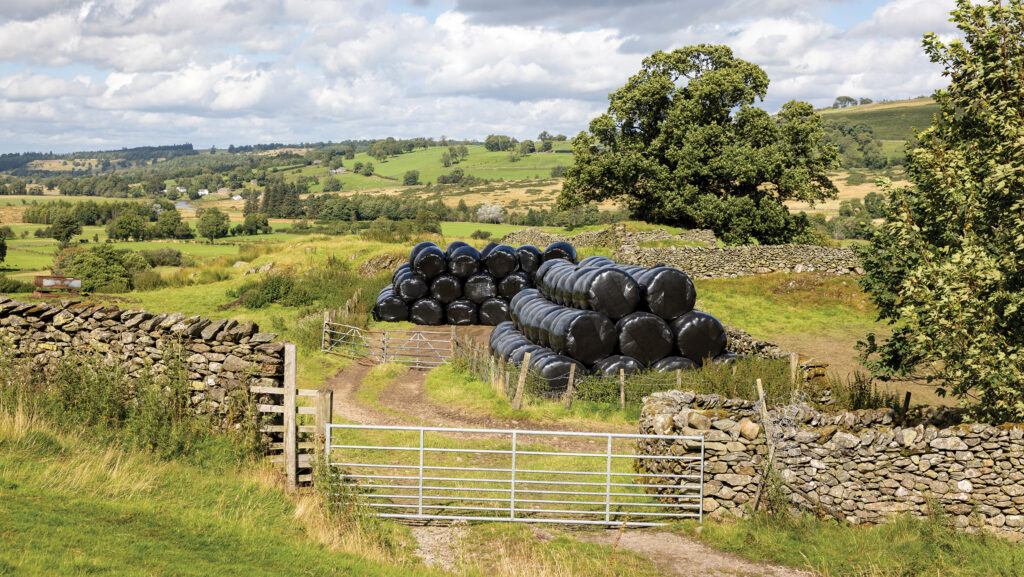 © GNP
© GNP Farms relying on big bale silage to feed cattle should have an idea of its nutritional value – and ideally get some feedback on their field management.
The simplest way to do both is to take a sample from a selection of bales for laboratory analysis.
As input costs escalate, this could be the year to no longer accept whatever silage the farm produces, and instead take steps to manage the yield and quality of forage required.
This is where a silage analysis represents value for money: results provide “very useful” information and justify the cost of sampling, says silage consultant Dr Dave Davies.
See also: 6 tips on producing grass silage at optimal dry matter
1. Analyse silage to match nutritional quality to need
Payback from using the data more than covers the £20-£60 cost for one analysis.
“As a decision-making tool, an analysis cost is insignificant,” says Dave. With lower losses between field and feed-out, compared with clamped grass, plus better anaerobic conditions from film wrap (as opposed to bags), big bales make high-quality silage, he says.
But only by testing the quality of what is in the stack – and accounting for differences between bales and fields – can the right nutritional quality of forage be fed to the appropriate livestock.
t also helps to make better, cost-effective decisions about supplement purchases.
A dry suckler cow, for instance, can end up overweight and with calving issues if fed the same type of top-quality forage as a growing heifer.
“Growing or finishing cattle need high nutritional-quality silage, and it pays dividends to know what your silage quality is. You can have a better liveweight gain from every kilogram of silage fed and reduce concentrate inputs and/or have a shorter time to finishing,” Dave explains.
“You can also push field yield more if you require forage of the lowest nutritional analysis, such as cutting stemmy seedheads to make a fibrous silage for dry cows. You can also begin to monitor bale analysis year on year, as it gives feedback on your growing methods.”
2. Use skilled operators for silage sampling
Sampling techniques, and how the sample is handled before it reaches the laboratory, will influence the results.
And the two big variables on farm to consider when sampling are field-to-field differences and those within the stack.
Rather than buying a silage corer, learning some sampling techniques and faffing about with sample bags and the postal service, it is more effective to delegate the job to someone with expertise and the right kit.
“The feed rep or local farmers’ co-op is the place to ask,” Dave suggests.
3. Time silage analysis to inform decisions about later cuts
Farms taking more than one cut of grass (or grass and clover – multispecies swards are still too difficult to analyse, says Dave) for silage are advised to send their first sample for analysis four weeks after harvest.
This way, results are back in time to make any management decisions before the next cut.
“You can adjust your forage quality accordingly, depending on what you need. You know your best and worst fields by gut feel, so analyse the bales they produce separately,” he says.
Otherwise, Dave suggests testing just before making feed purchases, to reduce bale losses in the event the bales are not resealed properly.
Once the results are back, he says it is important to get “independent advice from someone you trust” to use those results to make a nutritionally complete diet.
In addition, an analysis can also reflect whether muck/fertiliser applications have been effective in growing grass, or indicate that a field needs reseeding.
What to look for in a silage analysis
A standard silage analysis returns data on dry matter (DM), digestibility (D-value), crude protein (CP) and metabolisable energy (ME).
A separate minerals test costs more and Dave advises this where a deficiency is suspected, or on the advice of the farm vet.
Targets for silage quality
The target silage quality for growing and finishing livestock needs to be at least 11MJ/kg DM of ME, a D-value of 72% and ideally 15-16% CP.
“A dry cow silage needs 10 MJ of ME, 11-12% protein and D-value of 63-65%, reflecting a stemmy fibrous forage.
“Ewes in late pregnancy and early lactation require 11.5ME and 16% protein. If you get a high D-value silage of lower fibre, it is more degradable in the rumen, which increases intakes.
This means you are less reliant on concentrates, and the rumen is not so full, and this reduces the risk of prolapse in pregnant ewes.”
What the silage analysis reveals about grass management
Feedback on the energy and digestibility of the silage also reveal the stage of grass growth at cutting.
“Some ballpark figures are: 75%-plus D-value, 11.5ME-plus, is all leaf; 65% D-value and 10.5ME means lots of seed stems and seeds forming; and 60% D-value with 10ME is full seed heads visible,” he says.
“Crude protein is slightly more complex. As the seed stem and head develop, the protein in the grass is diluted by the higher yield of the more mature forage, so with a 10.5ME silage it’s very hard to get a CP greater than 13%.
“However, fertiliser nitrogen and sulphur applications also play a role. So if a silage is high for digestibility and energy, but low in protein [for example, 75% D-value and 11.5ME, but 14% CP], that indicates insufficient nitrogen, sulphur, or both, have been applied.”