

How US dairies are using drones to measure clamp tonnage
 © Cody McCary
 Using drones to measure silage stocks in maize clamps is replacing estimates on US dairy farms.
Farmers can now plan their storage requirements before harvest and better organise feeding – creating smoother transitions between clamps – to make both physical and financial savings.
See also: Advice on dealing with high mycotoxins in silage
The technology was borrowed from the mining industry, where it had been used to calculate the tonnage in a pile of rock, says Cody McCary, a forage account manager for Vita Plus.
He works with drones across the Midwest and says most major silage inoculant distributors in the US now use them.
It is proving valuable on super-large dairy farms, where feed storage is often the last area of investment as herd size grows, he says, pointing out that five US states now have herd averages greater than 2,000 cows a farm.
© Cody McCary
Accuracy and safety
“It is common to see odd shapes and overfilled clamps, which makes it hard to track inventory accurately, or transition between clamps,” says Cody.
“[A drone] is the eye in the sky and easier than trying to probe the face for a sample and calculating a density, then making multimillion-dollar decisions based on core samples.”
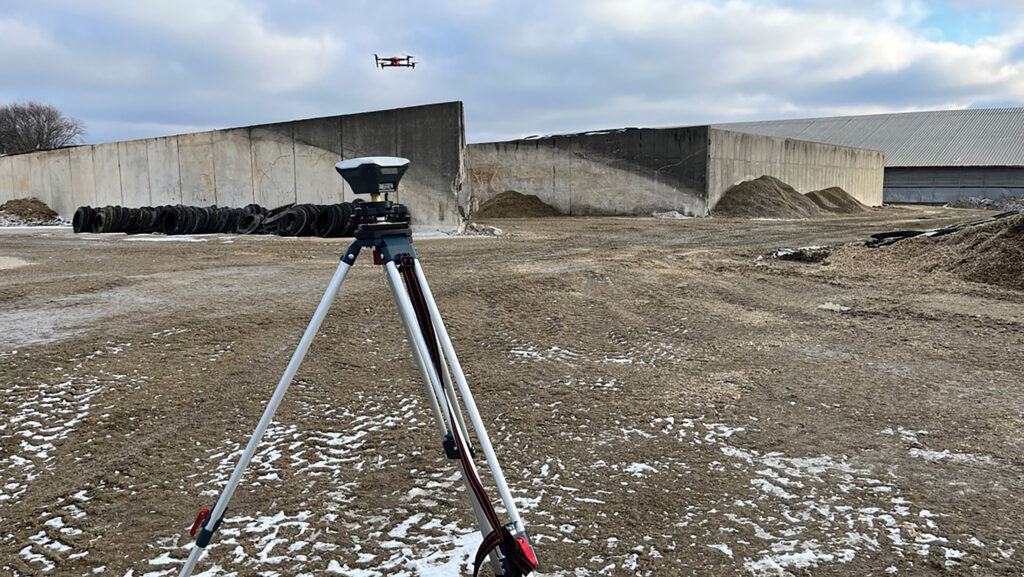
Using a drone is also safer because it avoids anyone having to climb on the clamp to take measurements, he adds. Drone technology is now helping with building new clamps and expanding existing ones.
Drone images and feed data
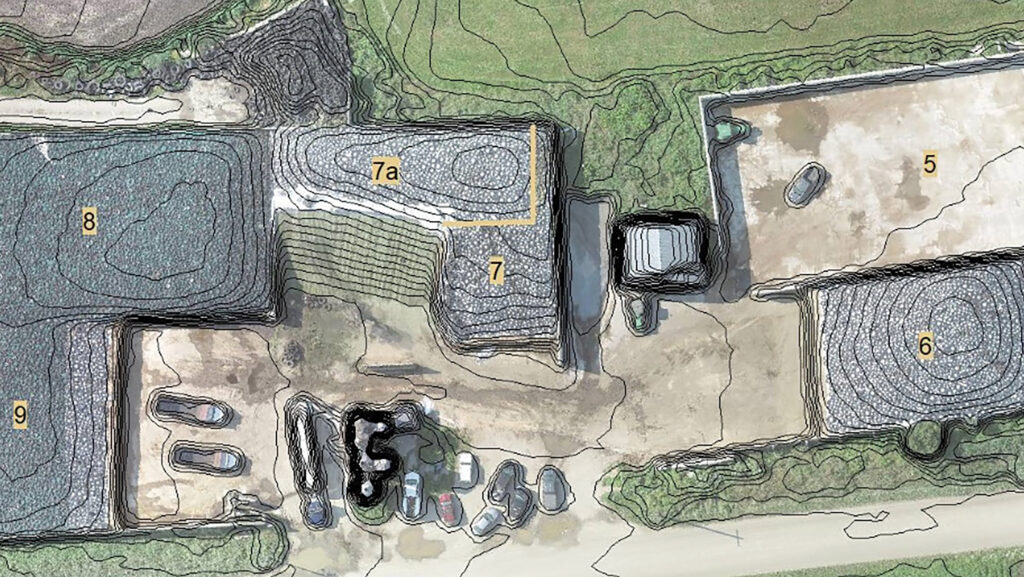
In the first flight, Cody uses the drone alongside survey equipment and flies the farm in 15 minutes, taking about 300 pictures.
This produces images of the maize clamp with contours, similar to an OS map, where the closer the lines are together, the steeper the gradient. He then stitches pictures together to make a 3D model.
Thirty days later, a second drone flight of 10 minutes updates the pictures. This is information is combined with the farm’s feed software data.
Calculations based on tonnes fed through the mixer wagon, density and dry matter are then used to work out the amount stored in the clamp.
Farmers get an online dashboard that shows current and historical forage stocks.
There are projections for when individual clamps may run out of silage (based on current usage) and alerts for when to start transitioning between clamps.
Forage stock predictions
“The nutritionist and farmer can then make diet adjustments and purchase additional feed options. [This means] they do not run out of maize silage prior to the next year’s harvest and can avoid feeding green maize,” says Cody.
Being able to predict when clamps may be empty means that nutritionists can better pinpoint when old and new clamp should be blended in the diet.
Cody explains this alleviates sudden changes and reduces the effect of diet change on cow production.
“We’ve also had situations where we have identified that farms have more feed in stock than they realised.
“[Correct inventory of] maize stock allows for greater flexibility in the storage area and opens up land for additional crops that would have otherwise been tied up with maize.”
Other uses for the drone include evaluating clamp settlement and quality conditions from the air.
This identifies losses, allowing the farm to alter management to reduce or prevent them in future. Cody has found that 60% of the shrink in silage volume occurs within the first 60 days after sheeting over.
“Some is natural settling, but then comes some dry matter loss. We can see where plastic has blown off, or is flapping, or tyres are not meeting, and see where spoilage is from the brown colour.
“There might be pooling of water, bird or wildlife damage. Early identification saves tonnes, quality and money,” he says.
Cody McCary was speaking at the Volac 2026 Maize Symposia Harper Adams University College, Shropshire on 9 July