

FW Awards: Meet the 2026 Pig Farmer of the Year finalists
 Finalists Fred Allen, Molly-Anne Grimson, and Todd Baker (right) and Matthew Wilton-Baker © Tim Scrivener, Phil Weedon and Jason Bye
 This year’s finalists run very different systems, but all focus on high-welfare, sustainable businesses to optimise productivity.
See also: FW Awards: Meet the 2026 Mixed Farmer of the Year finalists
The finalists
- Fred Allen, Newark, Nottinghamshire
- Molly-Anne Gimson, Bury St Edmunds, Suffolk
- North Farm Livestock, Holt, Norfolk
The judges
- Katie Jarvis – Independent judge Katie is senior policy adviser at the National Pig Association
- Mike Durrant – Last year’s winner Mike runs 1,700 sows across two outdoor breeding units in Norfolk
- Hayley Chapman – Freelance journalist Hayley is a former Farmers Weekly deputy livestock editor
Fred Allen, Newark, Nottinghamshire
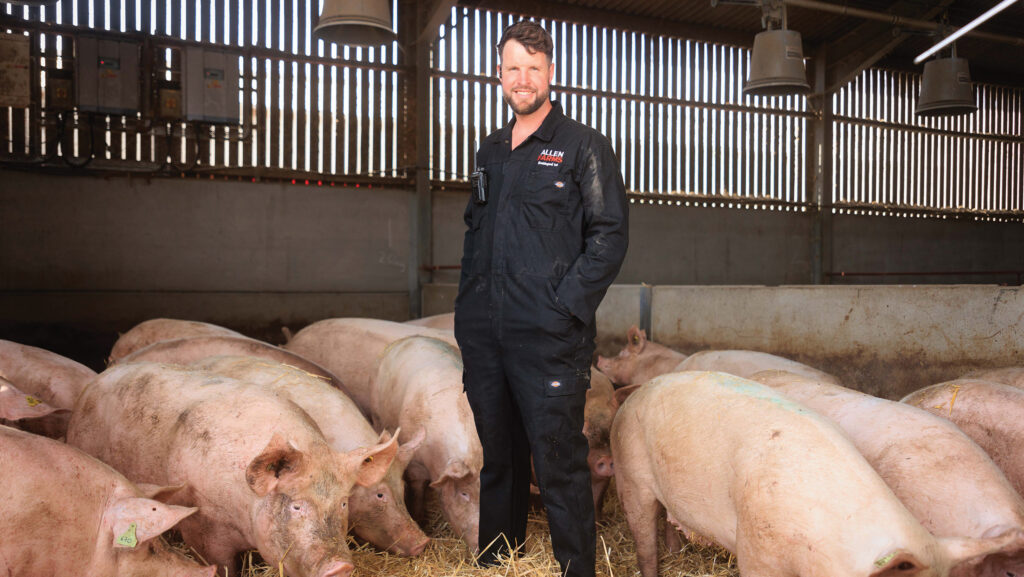
Fred Allen © Tim Scrivener
Resilience and bravery have been key to Fred Allen’s successful transformation of the pig unit at Allen Farms in Coddington, Nottinghamshire.
He previously ran 550 sows, farrowing outside, but made the decision in 2018 that it was no longer working. “We were struggling with staffing, vermin, predators, weather extremes – it was becoming a bit demoralising,” he says. And they were “burning through straw” in the winter to keep everything dry and well bedded.
He decided to “roll the dice” and move everything indoors. Now, with a closed herd, and a focus on strict biosecurity, Allen Farms now runs an 850-sow farrow-to-finish pig system.
Progress to date
Farming 405ha of arable land, 50% owned and the rest on tenancies, allows the family business to produce all their own cereals for feed and all their own straw, including that for bed-and-breakfast finishing units. Home-grown beans now replace soya in some of the diets.
Very self-sufficient, the farm also mills and pellets all its own feed and carries out all haulage in house too. With new buildings currently going up, and longer-term plans to expand to 1,200 sows by 2030 and 2,000 by 2035, Fred is currently selling more than 400 pigs each week.
Continuous investment in improving older buildings and erecting new ones allows Fred to pursue high-welfare systems, with enrichment and strong growth paramount. Fred has engaged in many trials to improve performance and welfare.
Environmental targets are also high, with the aim of achieving net zero. Water is sourced from a borehole, and the farm further reduces reliance on external suppliers by using solar energy and a heat exchange system.
Fred says he likes the fact he gets a “harvest every three weeks”, which allows him to review the data and continually make informed tweaks to the system.
Technical performance
Collaborative working with the vet and nutritionist is key to the high health status and efficiency. No blanket medication is ever given, and antibiotics use is very low.
Housing is a mixture of slats and straw beds with sows farrowing in crates and underground slurry storage. Feeding is a 12-stage diet and from 4-22 weeks, daily liveweight gain is 0.85kg. Finished carcasses weigh in at an average of 88kg, with backfat important to local abattoirs supplying schools, hospitals and butchers.
A strict vaccination programme and controlled environment keep any health or behaviour issues minimal and mortality in the nursery at about 1%.
Fred makes sure piglets are not left behind by using foster sows, manufactured milk where needed and separating out smaller animals at weaning to offer a different diet before they go to the bed-and-breakfast finishing units.
Ethos and approach
Staff are key to the success of the operation and Fred knows they need looking after to keep retention levels high. The longest serving team members have been there 30 and 40 years. As well as annual appraisals and salary increases, rewards are key, which may take the form of financial bonuses or bacon sandwich breakfasts.
An electric scooter helps staff save a few hundred steps when they need to pop to the other side of the yard, and radios have been a “gamechanger” for ease of communication.
Fred is involved in the wider sector, especially though his involvement with the National Pig Association and NFU. He is also active in visiting local schools to speak about farming and participating in the “Ask a farmer” program with schools.
The numbers
- 2,000 – target number of sows by 2035
- 2030 – the targeted date for net zero
- £1.78/kg – cost of finishing the pigs
- 29.5 pigs sold a sow a year
- 8 full-time staff on the farm
Farm facts
- 850-sow farrow-to-finish unit, run alongside 405ha arable, 81ha permanent pasture and a 500-ewe sheep enterprise
- Indoor unit, selling to independent butchers as well as on contract
- Duroc cross Large White cross Landrace sows, crossed with Danish Duroc
- Bed-and-breakfast finisher units located off site
- Finishing 400 pigs a week
The judges liked
- Ambitious plans and a positive approach
- Production of home-grown feed and integration with arable business
- Impressive pig performance, with high herd health
- Variety of outlets, with direct sales to local butchers, schools and hospitals
- Involvement with local schools and NFU
What the judges say
Fred has managed a successful transition from outdoor to indoor production, done well to spread risk with a mix of contracts and customers, and he has big environmental ambitions to achieve net zero.
Molly-Anne Gimson, Bury St Edmunds, Suffolk
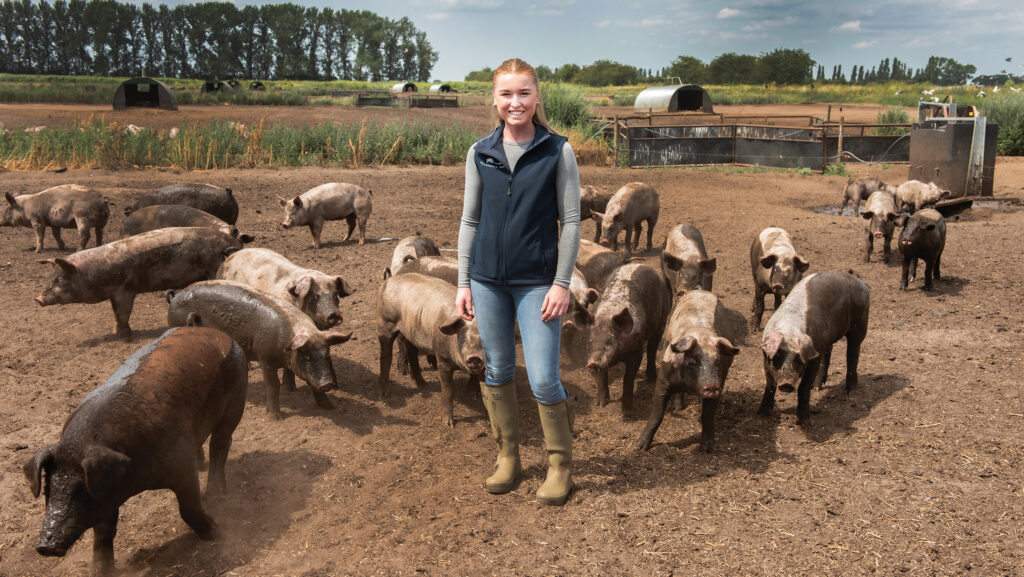
Molly-Anne Gimson © Phil Weedon
Molly-Anne Gimson entered the family business shortly after a full herd repopulation. Fresh out of college, she was thrown straight in at the deep end. Since then, she has invested hugely in improving performance in the pig business, trialling new ideas and diversifying.
Instead of going to university, she decided to set up a mobile catering diversification to run alongside the outdoor breeding unit she runs with her mother, Susannah. One food van became two, and Molly-Anne now sells a variety of British pork dishes direct to consumers at events throughout the year.
Back on the farm, they run 1,100 sows, in contract with Pilgrims Europe, producing 1,100 five-week-old piglets every two weeks.
Progress to date
Molly-Anne says the repopulation caused the unit “significant challenges in regaining productivity” with poor performance and low output. Through a lot of hard work and monitoring, performance has steadily improved.
Farrowing sows are all hand fed, with a focus on regular contact and stockmanship to maintain high welfare. Pens are adapted throughout the year, depending on weather pressures, to allow access to increased water for wallowing and shades in the hot weather. One of the first Pilgrims farms to trial shades, they have managed to keep sows comfortable throughout this year’s heat pressures.
Molly-Anne collaborates with the farmers who include her pigs in their arable rotation in a cycle of two years pigs, two years crops – usually potatoes and maize. Straw is secured from another farm and stored there.
New perimeter fencing adds to other high biosecurity measures with all deliveries managed at the farm gate to minimise risk.
Technical performance
Molly-Anne credits lots of the improvements to the shift to a fully home-bred gilt system, carefully selecting for mothering ability, litter size and robustness.
Dry sows are run in radial paddocks with artificial insemination done Monday-Thursday only when animals are on heat, with gilts synced for their first service. Sows and gilts receive two to three inseminations and run with a boar before and after service.
Pigs a sow a year have increased from 25.7 two years ago, to 26.8. They are now regularly weaning more than 12 piglets a litter. The focus now is on improving fostering and ensuring constant sizing and fostering before weaning.
They feed larger rolls of concentrate to try and avoid sand colic, on their light, easily dug land.
Ethos and approach
“Our greatest strength lies in our team,” says Molly-Anne, who acknowledges that she had to prove herself to the existing team when she joined the business. Staff are well looked after, with rewards, facilities and pay.
Molly-Anne employs relief staff at busy times of year or holiday periods, to ease the pressure on the rest of the team.
She is keen to take part in trials and is currently part of a University of Oxford and Pilgrims Europe advisory group looking at environmental sustainability.
On the farm, wild bird seed plots and grass margins form part of their Sustainable Farming Incentive agreement. Additionally, vehicle sharing is encouraged wherever possible, they have a water borehole, solar panel, and buffer strips next to ditches.
Molly-Anne is passionate about education, regularly speaking in schools and getting involved in many sector events, groups, podcasts, publications and awards. She also welcomes apprentices from Easton College and vet students to work on the farm.
Earlier this year, she welcomed her local MP to talk about farming and, through in-person events and social media, she is always spreading the word about pig farming.
The numbers
- 3 – level of agricultural qualification Molly-Anne studied at Easton College
- 2023 – the year she returned home and started the first food van
- 12 piglets weaned a litter regularly
- 87.7% farrowing rate
- 4 full-time staff working alongside family members, each with an individual focus
Farm facts
- Owned and tenanted land, with arable contracted out
- 142ha of arable and pig land, half-owned, half rented from county council
- Pilgrims Europe contract
- 1,100 Landrace cross Large White sows, farrowing outside and weaning at five weeks
- Diversification with “Pigs in” mobile catering business
The judges liked
- Huge improvements since challenging repopulation
- Enthusiasm for spreading the word about the pig sector and involvement in Ladies in Pigs
- Successful mobile catering diversification, adding value to the finished product
- Dedication to constant improvement on the farm and involvement in trial work
- Participation in environmental schemes and research
What the judges say
Molly-Anne approaches change with an open mind, constantly trialling new ideas to make improvements on the farm. She is entrepreneurial and ambitious, and invests lots of time in promoting the pig sector.
North Farm Livestock, Holt, Norfolk
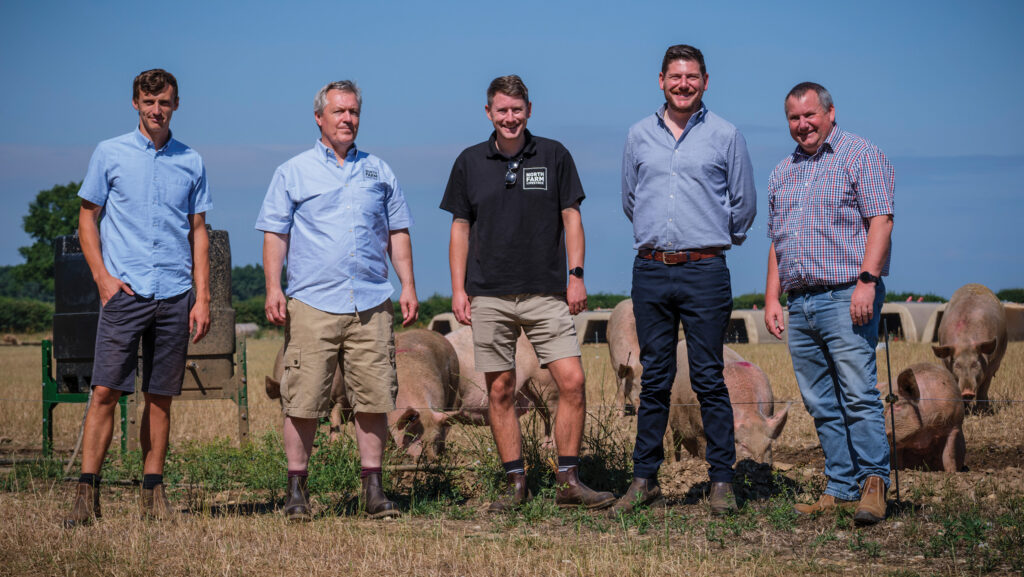
Todd Baker (second from right) © Jason Bye
Family-owned and run North Farm Livestock is the sole supplier of free-range pork to Waitrose. When the supermarket committed to sourcing all its own-label pork products from free-range farms by the end of 2027, the Norfolk pig producer got the contract to supply the pork through Pilgrim’s Europe. With it came the huge task of rapidly growing the business.
By the end of next year, North Farm Livestock (NFL) will be farming 85% of the free-range pigs produced in the UK. Masterminding this is a management team including owners Michael and Ian Baker, respective sons Matthew and Todd, finishing director Ashley Hewitt and business development director Steve Furniss.
Progress to date
Weaners from PIC arrive at one of two gilt mating units run by North Farm Livestock, weighing 7kg. They will then go onto one of the outdoor breeding (ODB) units, where single-parity herds typically produce six litters before a full repopulation.
Piglets are weaned at four weeks, split-sexed and vaccinated on the ODB farms before being moved to a free-range farm on the same day.
Breeding managers are responsibly for a “cluster” of farms, which could be managed day-to-day in-house or be part agisted or wholly agisted. Free-range farms are similarly managed in clusters, operating on an all-in, all-out basis with a “chessboard” grazing setup. There are two tents in each pen, with each housing 100 pigs, and solar-powered fencelines between paddocks.
Dedicated teams and machinery for each cluster helps keep biosecurity high – very few staff move between units. And haulage is done either in-house or by vehicles dedicated to NFL.
Currently producing 4,000 pigs a week, the aim is for that to grow to 7,500 pigs a week.
Technical performance
Sows are artificially inseminated with Hampshire boar semen from PIC. They average 12.14 piglets weaned in the single parity herds. Piglets are fed creep from about 10 days before weaning and the priority is “health, health, health”, to deliver a strong, high-quality pig to the finishing team.
They see minimal health challenges, with porcine reproductive and respiratory syndrome and flu vaccination managed in conjunction with a Pilgrims’ vet. However, like all outdoor units, they have had to adjust to the very hot weather this year. Sows have stayed comfortable with insulated huts placed in pairs, with big shades between them. Feeding has been adjusted too – moving sows to a dry ration rather than lactation ration when necessary.
This year, the finishing team are targeting a feed conversion ratio of 2.4 or below and daily liveweight gain of 800g. At submission, these numbers were sitting at 2.39 and 820g, respectively.
Ethos and approach
NFL only owns three fields – these are dedicated to the purebred herd of Gloucester Old Spots, producing 60-80 animals a week for Waitrose. Beyond these fields, NFL secures two-year contracts with landowners for breeding and finishing units, and hopes these relationships will become long term.
The management team work collaboratively with arable farms to benefit the land they farm, including subsequent crops. They often work on a muck-for-straw arrangement and this year they have started soil sampling before and after pigs have grazed to assess their impact. They are trialling different grazing mixes and looking into how buffer strips can reduce run-off using an independent consultant.
They also place a big emphasis on people, valuing staff and ensuring NFL is a good place to work, with elements such as decent stock-to-people ratios and keeping kit modern. And they place a big emphasis on supporting other local businesses, events and organisations.
The numbers
- 110 members of staff at North Farm Livestock
- 13,500 – target number of sows for spring 2027
- 820g – average daily liveweight gain during finishing in past 12 months
- 40-50sq m of space a pig on free-range units
- 50 landowners and farmers hosting NFL pigs
Farm facts
- UK’s largest free-range pork producer
- Contracted through Pilgrim’s Europe to supply Waitrose
- 7,900 sows on outdoor breeding units, increasing to 13,500
- Sows are a second cross of a Large White cross Landrace and White Duroc
- 27 free-range farms, increasing to 44 by spring 2027
The judges liked
- Using local businesses and contractors
- Partnership with Easton College to set up a breeding farm for students to benefit from
- Proactive approach to partnership with farms, focusing on long-term relationships and soil improvement
- High-welfare setup across breeding units and free-range farms
- Focus on staff development, progression and social responsibility
What the judges say
North Farm Livestock has managed a successful expansion in a short space of time, supporting other businesses in the local economy, with a focus on sustainability and constantly investing to improve conditions for livestock and staff.
A word from our sponsor

“Pilgrim’s Europe has built strong partnerships with pig farmers since 1979, working with them to produce high-quality, sustainable food from farm to fork. We are delighted to sponsor FW’s Pig Farmer of the Year.”
Fábio Brancher, operations director agriculture