

Feeding calves colostrum: Focus on quality over quantity
 © Tim Scrivener
 The industry must develop a new blueprint for colostrum and transition milk feeding that aligns vets and nutritionists to give calf rearers clarity on early-life nutrition.
The industry standard has been to feed calves 10% of bodyweight in colostrum (testing 22% or more on a Brix refractometer) within the first two hours of life.
But there is a growing body of evidence to suggest that feeding less, higher-quality, colostrum is better (see “What North American research says about colostrum feeding”).
See also: 7 ways to prevent colostrum contamination
Top tips for feeding colostrum
- Feed 3 litres of high-quality colostrum within two hours (measuring more than 25% on a Brix refractometer); if colostrum quality is not measured, feed 4 litres
- Ensure the colostrum is clean – use lids on buckets to prevent contamination
- Tube-feed the first feed, if necessary
- Thereafter, use bottles and buckets with teats
- Do not force calves to drink subsequent colostrum feeds
- By days two to five, the aim is for calves to be drinking 6 litres/day
Source: Laura Tennant, Trouw Nutrition
Dr Laura Tennant, young animal feed technical senior adviser at Trouw Nutrition, believes too much colostrum is being fed at the first few feeds and is calling for standards to be refreshed.
“One vet group said post-mortem results showed calves had been fed too much using a tube feeder,” she says.
She adds that some farm protocols have become overly focused on colostrum volume. This can limit subsequent milk intake and compromise health.
Colostrum – not the whole story
She highlights one farm with high calf mortality between seven and 10 days of life – the key transition period when the protective “colostrum coat” fades and their own active immunity kicks in.
The cause? Tube-feeding colostrum for three or more feeds made the calves reluctant to drink from the teat thereafter.
Total protein in calves, typically measured in serum using a refractometer at one to seven days of age, assesses the success of passive immunity transfer from colostrum.
Analysis of total protein at this farm suggested colostrum management was good, but Laura advises looking at the bigger picture.
“Sometimes, so much focus is placed on colostrum that we lose sight of what’s needed.
“Total proteins and colostrum are just the first part of the story,” she says.
“We also need to focus on making sure we are getting enough calories into the calf for the first week to help them support their own immune system.
“If calves have been tube-fed excessively and they’ve incurred pain or discomfort from tubing, they are going to take two to three days to train to the teat.”
Dangers of excessive tube-feeding
Laura stresses that, sometimes, tube feeding the first colostrum feed is necessary and most practical.
But she warns that the danger of excessive tube-feeding is that it can make calves reluctant to drink voluntarily.
This delay leads to a calorie deficit, because calves use colostrum for energy, depleting their passive immunity. They then succumb to environmental pathogens, she adds.
Recommended colostrum and early milk feeding protocol
She advises feeding 3 litres of higher-quality colostrum (with a Brix reading of more than 25%) within the first two hours of life, and 4 litres only where the quality is unknown.
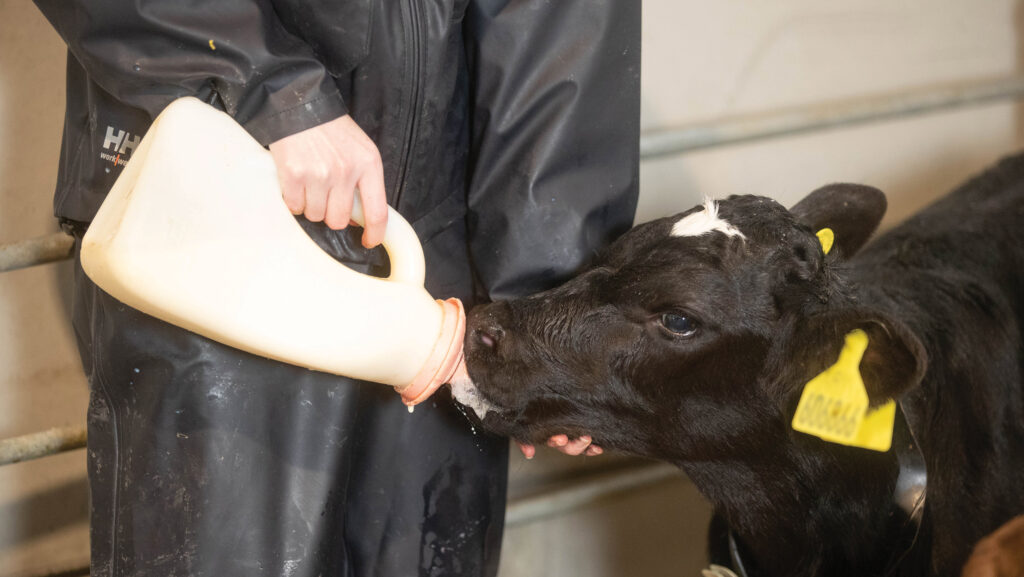
This can be tube-fed if necessary, but thereafter, she advises switching to teats to get calves sucking as quickly as possible.
“Calves may be born a bit sleepy, or, if they’ve had a bad calving, sometimes tube feeding is the best way to feed colostrum.
“The first feed is the most ethical time to do it, but you want to get calves drinking by themselves as quickly as possible; voluntary intake is key,” she advises.
If calves do not drink the full amount at the second feed, Laura says rearers should not rush to tube-feed them.
“You must offer colostrum, but don’t be surprised if the calf won’t drink, and don’t tube it.”
She highlights that although rearers may feel the need to skip a feed or reduce volumes for small calves, this should not be done.
“Sometimes, the smallest calves have the biggest energy demands and will drink more than others,” she explains.
By day two to five, calves should be comfortably drinking 6 litres/day, she advises.
“In the first two weeks of life, milk is the only thing they can digest. We need to focus on feeding for immunity and resilience.
“If we only give the calf 4 litres/day for the first two weeks and she gets sick, that’s our fault.”
Studies from the University of Guelph, Ontario, have shown that extending transition milk feeding to one week can reduce scours, but Laura emphasises that, above all, feeding must be practical for farmers.
How long calves stay on colostrum before moving to transition milk will depend heavily on availability, disease burden and facilities, so there is no one-size-fits-all, she points out.
Instead, she encourages farmers to work with their vets and nutritionists to design bespoke protocols.
Importance of industry alignment
Above all, she believes there is a need for clearer, updated guidelines for calf rearers that encompass the latest thinking.
“Although every farm is different, a blueprint on colostrum and transition milk feeding would be beneficial as a guideline,” she adds.
What North American research says about colostrum feeding
© Tim Scrivener
A study at Cornell University evaluated how different colostrum volumes at first feeding affected immunoglobulin (IgG) absorption, apparent absorption efficiency (AEA), gastric emptying and calf behaviour post-feeding.
IgG absorption refers to the total mass (grams) of IgG that passes from the gut into the calf’s bloodstream.
In contrast, AEA is the percentage of the ingested IgG that enters the bloodstream.
For the study, 88 Holstein calves were tube-fed colostrum within two hours of birth at one of four rates: 6% of bodyweight, 8%, 10%, or 12%.
All calves received adequate passive transfer, although larger volumes delayed gastric emptying.
Calves fed the highest two volumes had the lowest absorption efficiency 24 hours after feeding and experienced greater discomfort, noted by abdominal kicking.
Authors noted that although larger colostrum volumes (4 litres) may enhance IgG intake, they do not necessarily result in a proportional increase in serum IgG concentration owing to a decline in absorption efficiency.
Quality is more important than quantity
A second study by the University of Montreal found the biggest factor affecting IgG absorption was colostrum quality, not quantity.
Researchers studied 818 calves across 61 Holstein herds in Quebec to identify what practices led to adequate passive transfer immunity (TPI).
Calves fed colostrum with a Brix reading of more than 24.5% were nearly three times more likely to achieve adequate TPI.
And calves fed at least 2.5 litres (which may still be less than the recommended 10% of bodyweight) at their first feed were 2.6 times more likely to achieve adequate TPI compared with calves fed less.