

First impressions: Isuzu D-Max gets torquier 2.2-litre engine
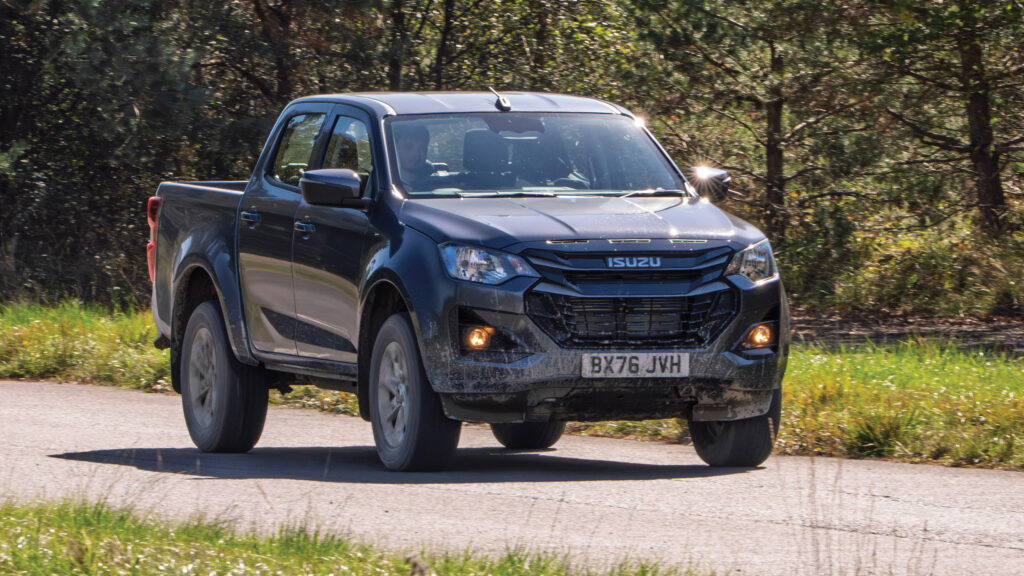 © Isuzu
In an unsurprising turn of events, a root-and-branch review of Isuzu’s diesel D-Max pickup concluded that there is, indeed, no replacement for displacement.
Having surrendered 25% of its cylinder space in the move from a 2.5- to 1.9-litre engine nine years ago, it has now reinstated half of that lost cubic capacity in the latest generation.
As such, the new “2.2” slots neatly between its forebears. It’s no V6, but neither does it feel like it should be in a hatchback.
See also: On test: Toyota Hilux gets better looks but same old drivetrain
The firm is also at pains to point out that it is an evolution of the previous design.
Isuzu D-Max spec
- Engine 2.2-litre, four-cylinder
- Max power/torque 163PS/400Nm
- Transmission Eight-speed auto
- Quoted consumption 32.4mpg
- 0-62mph 12sec
- Top speed 112mph
- Weight 2,045kg
- Max payload 1,055kg
- Towing capacity 3,500kg
“Nothing revolutionary here” is the word from Japan via Isuzu’s UK importer, International Motors – mainly because it hopes to have retained the D-Max’s impressive reliability through a series of modest tweaks while delivering much-wished-for extra torque.
It’s up by 40Nm to 400Nm. Still a shadow of Toyota’s Hilux (500Nm) and its most direct competitor, the Mitsubishi L200 (470Nm). But, crucially, it is served generously at low revs, with 255Nm available from 1,000rpm.
Thus, it feels more responsive, especially when saddled with 3.5t’s worth of trailer and cargo. Output remains as was: 163hp.
To achieve the extra performance without harming fuel consumption or heating up the cylinders, Isuzu’s engineers have taken the Brailsford Marginal Gains strategy.
With the 300cc increase in displacement comes a larger turbocharger that spools up a tad faster and delivers boost slightly sooner.
Rapid it is not, but shaving one second off the previous 13sec 0-62mph time is a decent result, despite some rivals remaining quicker and most still quieter.
Meanwhile, larger pistons with redesigned bowls are said to improve fuel mixing and combustion efficiency, and the new cylinder block keeps bores more evenly cooled – down by 30C in the hottest spot.
Both help maintain the previous generation’s passably economical 32mpg average on a mixed driving route.
Though this is par for the course, several of the competition have introduced hybrid elements to their powertrains that will improve frugality – something Isuzu says it has no intention of pursuing anytime soon.
Instead, it has committed wholly to its battery-electric D-Max EV platform.
Slicker transmission
Six-speed manuals are still available on all but the top model. But to get the most from the new engine, Isuzu has slotted a couple of extra cogs into the more popular automatic transmission.
The eight ratios are, naturally, nearer neighbours, so shifts are noticeably slicker and matched to suit the extra torque.
That said, they’re far from imperceptible – particularly compared with a Ford Ranger – and the agricultural grumble that accompanies a heavy right foot is still there.
The four-wheel-drive system remains a selectable affair. Unlike the L200, it lacks a centre differential so can’t run in four-high on the road, but a rear diff lock is standard and useful backup for the stickiest situations.
Features include hill start assist, hill descent control and “rough terrain” mode that enhances traction control to brake spinning wheels harder – something that can also be used in two-wheel drive.
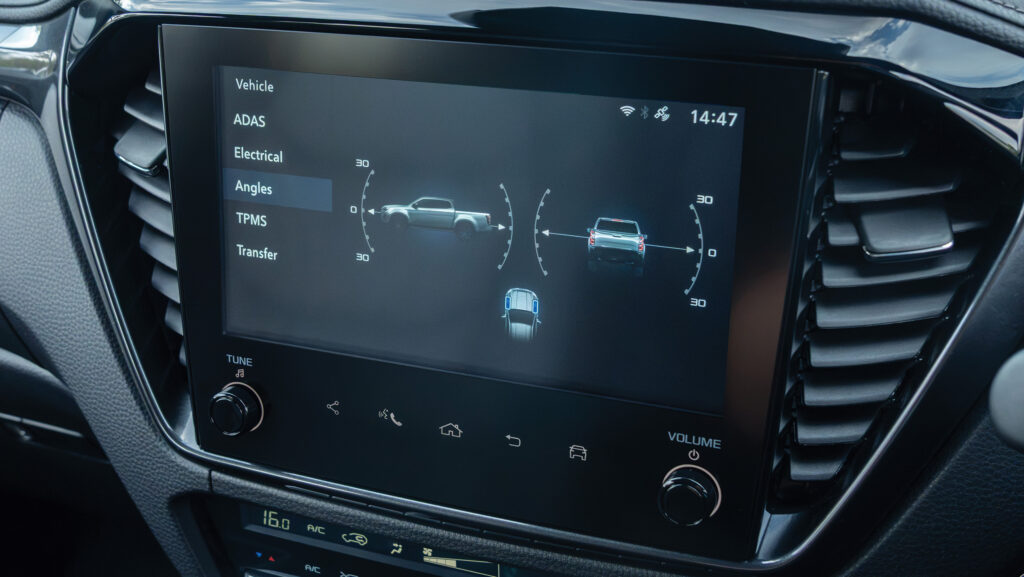
Other key stats are unchanged: 800mm wading depth, 220mm ground clearance, and decent 30.5deg approach and 24.2deg departure angles. So too, the 12.5m turning circle, though, as with previous iterations, the steering lacks a bit of weight.
Low-rolling-resistance 265/60 R18 Dunlop tyres are a new option.
Likes and gripes
Likes
- More low-rev torque
- Slicker eight-speed transmission
- Competitively priced
Gripes
- Modest power output
- V-Cross not as plush as the competition
- Driver aids too intrusive
Inside and out
Little to report on the styling front, apart from some new 18in alloys, subtle changes to the fog lamp bezels and plastic or chrome radiator grille, and wider side steps for the top two models.
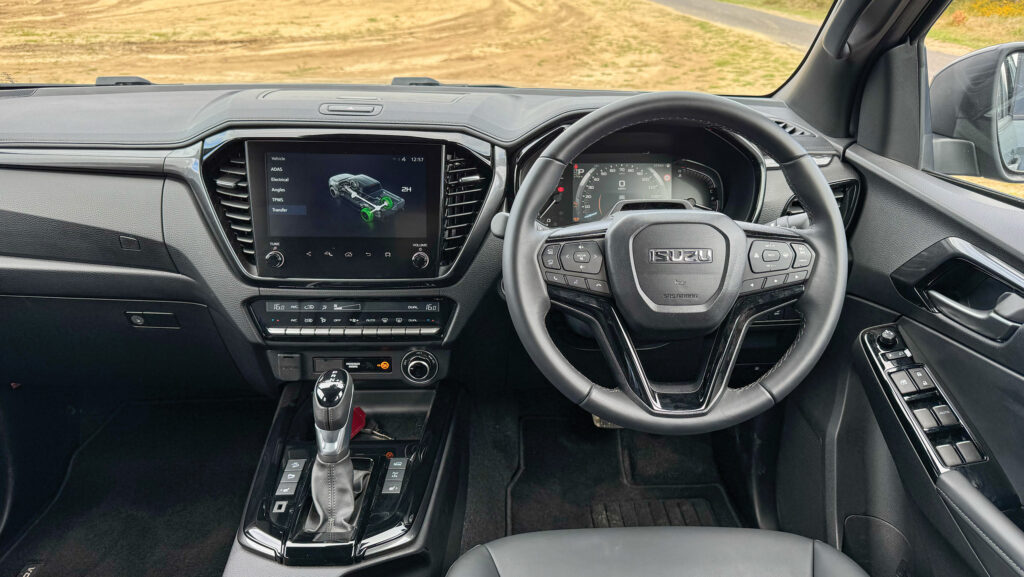
So, while some other pickups feel more like an SUV inside, Isuzu sticks with the workaday vibe that emanates from its mix of generally harder surfaces. Cheeringly, there’s also a good spread of physical controls.
However, it has succumbed to all the now mandatory manifestations of Big Brother.
These include a new driver-distraction warning that chimes in with irksome frequency, and a speed-limiter function that could be useful but, during our time in the seat, seemed to read road signs with a bleary eye. Lane-keeping assist is, at least, less intrusive.
As for spec, Isuzu offers four flavours, starting with the steel-wheeled, single- or extended-cab Utility, which comes with niceties such as Apple CarPlay, lumbar support and a reversing camera.
© Isuzu
DL20 double-cabs gain 18in alloys, carpet, heated front seats and an 8in infotainment system.
Meanwhile, the DL40 – now available in extended- or double-cab form (the former has a circa 300mm longer load bed) – adds leather upholstery, a 360deg camera, Bi-LED headlamps and keyless entry.
Plump for a top-spec V-Cross and in come dark grey alloys, a larger 9in infotainment screen, better speakers and a new “urban moss” (muted green) colourway.
Prices range from £33,495 for the six-speed manual Utility single-cab to £42,995 V-Cross for the double-cab auto.
Extended- and double-cabs are also available in “commercial” spec, where the rear seats are replaced with a flat floor behind a solid bulkhead grid.
These qualify for 100% plant and machinery tax allowance and a flat £4,020 benefit-in-kind rate.
Farmers Weekly verdict
Isuzu has refined rather than rewritten the D-Max recipe. Although the key ingredients have changed, the driving experience is much the same, so there’s no reason to rush to your nearest dealer.
As for model choice, most buyers seem to favour the better-trimmed DL40 and V-Cross when, frankly, the DL20 would do just as good a job.
Choice abounds beyond the Isuzu stable too, notably with new models from Toyota and Mitsubishi – albeit without the same choice of single-, extended- and double-cab variants.
Pickup market woes
The new D-Max 2.2 enters a market in the doldrums, with pickup sales down 55% year-to-date. Isuzu has suffered more than most, though its 69% drop can be partially explained by production hold-ups as it segued from old to new.
UK importer International Motors expects a modest bounce-back, though not to pre-tax-change levels. It has plenty of skin in the game: as well as Isuzu, it represents Mitsubishi and GWM, and will have another as-yet-unnamed, truck in its portfolio by the end of the year.