Agricultural Buildings Show: New dairy on a greenfield site
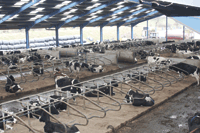
A couple of years ago dairy farmer Richard Knowles was faced with a big problem – the rented land on which his cows were housed and milked was to be sold for industrial development.
“The news came as a bit of a shock,” he says. “We were milking about 120 cows and, despite the low milk prices, we were managing to make a reasonable go of the business.”
He had three options. One was to get out of milking altogether, another was to find and rent a fresh set of buildings and the third was to build a whole new dairy unit back on the home farm.
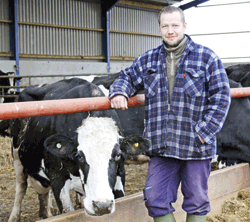
Based at Rossett, near Wrexham, Mr Knowles farms 220ha (550 acres) of which about a half is six miles away near Chester, a third is at home and the remainder in smaller blocks.
“Giving up milking was to give up all the work we had done in building the herd to the quality it was,” he explains. “And finding a suitable set of buildings was not going to be easy. Even if we had managed to find somewhere there would probably have been a lot of money to spend in achieving the standard of housing and parlour we needed.”
Daunting as it seemed at the time, the way forward was to build a completely new set of buildings on a green site at home.
“It was a decision that both excited me – because we now had the opportunity to have a fresh start with buildings, silos and milking equipment just how we wanted them to be – and also filled me with some dread at the prospect of months of building work,” he says.
“However it would also enable the cow numbers to be increased, in time, to 350 cows.”
Given 18 months by his landlord to vacate the existing site, Mr Knowles set about the task with some gusto. But before anything could be done, an agreement needed to be made with milk purchasing company Wiseman that it would collect from the new site which, though having moved just half a mile, was now in Wales.
With this agreed, the next task was to obtain planning permission for the proposed site, so a plan of the buildings had to be prepared and presented to the council.
“It all went reasonably smoothly and, with only a month’s delay due to a single objection from a ramblers group, we were ready to start in March 2006 – the project needed to be completed before 31 January 2007.”
The chosen site was about a quarter of a mile off the village road so a roadway had to be created that could carry the building traffic and, eventually provide a route for the milk lorry and farm vehicles.
“A bulldozer pushed off the topsoil and then levelled and compressed tonnes of hardcore to create an all-weather surface,” he explains. “Within just three days, we had our roadway.”
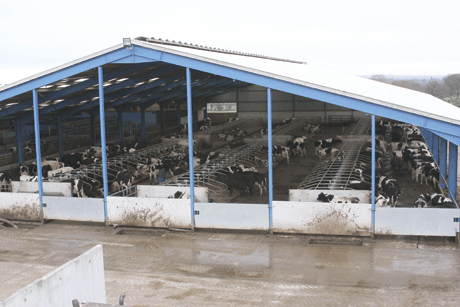
The site itself was on quite a severe slope so one end of it had to be reduced by about 4m and the other raised by a similar height.
Working on ground that was predominantly sand, the earthmoving machinery made good progress. The downside came when the concrete pads had to be laid to support the building stanchions. On such light soil, these had to be larger and deeper than normal to provide sufficient support.
Mr Knowles had already ordered the sheds – subject to receiving planning permission. The main cubicle shed, which held 220 cubicles, had a span of 34m and was 60m long, and the shed with the parlour and collecting yard was the same length and 18m wide. A third shed, currently used for the loose housing of 50 cows, measured 30m by 15m – the plan is to fit cubicles at a later date.
The steel erectors moved in and, in what seemed to be a very short period of time, had the three sheds built and clad.
But then the job slowed and it is at this time that Mr Knowles felt what he describes as “the rapid onset of old age”.
“I was let down by no less than three builders – each of whom had agreed to do the internal groundwork within the sheds,” he says. “One just didn’t turn up, another rang to say he had too much work on and the other simply disappeared.”
In the meantime concrete channels for the slurry to flow through had been ordered and delivered from Ireland and concrete wall panels had also arrived on site.
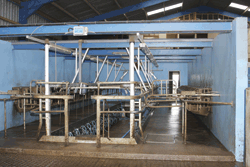
The parlour, a Fullwood 30/30 herringbone was in the process of being installed by a subcontractor and there was an anxious wait for a 10,000 litre bulk milk tank.
“At this time I was trying to manage the requirements of the cows at the old unit, attempting to keep the new site going forward by making sure the parts needed were present and having regular site meetings to decide how things should be done,” he says.
A good, reliable builder was eventually found but several weeks had slipped by and the expected completion date was looking perilously close to the agreed vacation date – and the bulk tank had still not yet arrived.
The cubicles arrived as a flat pack and were placed one by one and had their dividing metalwork bolted together – over 3000 bolts, he says.
And while this was being assembled a water supply was trenched in across half a mile of fields and three-phase electricity arrived at the buildings.
“We also had a borehole sunk to help with the water supply,” he says. “While we still use mains water, the borehole supply helps to reduce the overall cost of the water.”
Outside, the three 1000t-capacity silage clamps had been erected in time for them to be filled with grass and maize silage in readiness for the cows’ arrival.
“I was getting seriously concerned about the bulk tank,” he says. “It needed to be in situ before the building could be completed. In desperation we left a gap in the wall so that we could slide it in – when it arrived.”
October slipped into November and the main jobs were nearing completion. Slurry was to be scraped out into channels which took it out of the sheds to an underground reservoir from which it can be pumped and spread on the fields. Mr Knowles says he intends to have a slurry lagoon installed this year to provide extra storage capacity.
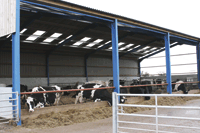
“There are one or two things that still need to be done,” he explains. “The priority was to get up and running with the dairy and out of the old site. The next stage is make provision for herd expansion by linking the three sheds together with a fourth to create another 200 or so cubicle places. We will also need extra silage clamp capacity.”
Cows are bedded on sand – there is an abundant and free, local supply only yards away – a move which, once in place, resulted in a dramatic improvement in cell counts.
And then came the really good news. The 10,000 litre bulk tank was delivered and, with its agitation equipment removed along with its legs, gently squeezed through gap in the wall with just inches to spare.
So on 20 January, with just 10 days remaining, the cows were loaded up and transported to their new home and introduced to the as yet, untried milking parlour.
“The first concern was whether they would take to the cubicles – they had always been in loose housing before,” he explains. “It took a couple of days but they sorted themselves out – even if one of them still insists on laying the wrong way round.”
The new parlour is reported to have been working well with just a few teething problems and, after an expected initial drop in yield, the herd is now averaging about 8500 litres.
A key part of cow traffic organisation is the shedding gate which the cows meet on exiting the parlour. This automatically allows the high and low yielding groups to be re-grouped after milking so that they can be fed their appropriate rations. It can also be programmed to isolate a cow that may be bulling or need some attention.
“All in all, while it’s been a pretty demanding time, I feel quite proud of what has been achieved,” he says. “There are a few things I would have changed – the distance from the shed to the silage clamps is too short when loading the clamps, for example, but overall, it’s not too bad.”