Anatomy of a speed record racer – JCB’s 1,600hp Hydromax
© JCB
For all its high-tech functions and the modern digital tools used to create it, there is something comforting about the use of a “retro-tech” feature created in an analogue era to help the aerodynamic performance of JCB’s speed record-chasing, hydrogen-fuelled Hydromax.
Engineers at JCB and its technical partners such as Ricardo, Xtrac and race team Prodrive say the project is benefiting hugely from digital technology advancements made during the 20 years since JCB set a new diesel speed record on the Bonneville Salt Flats.
See also: JCB Fastrac obliterates world’s fastest tractor record
Yet a distinctive air duct design invented in 1945 has alone contributed a 4% improvement to the “slipperiness” of the new challenger versus the old diesel.
Two of the delta wing-shaped “NACA duct” recessed air inlets are set into the left-hand flanks of the Hydromax body to channel air efficiently and with minimal drag into each of the car’s two engines.
The duct was invented at the National Advisory Committee for Aeronautics, predecessor of the current US space agency, NASA, for use on streamlined aircraft bodies.
But it was soon adopted for circuit racing and rally cars, and also for road-going sports cars, in the latter case as much for the duct’s “performance” aesthetic as for its low-drag characteristics.
Overall, though, it is the latest in computational fluid dynamics and modelling technologies that have helped shape the bright yellow and black bodywork of the Hydromax such that the aerodynamic performance has been improved by some 10% over its predecessor.
A more chiselled nose profile cuts through the air more effectively, the front of the cockpit canopy has been moved forwards by 45mm to allow a 20% reduction in rake, and the shape of the diffuser channels on the underside of the bodywork at the front has been further refined.
These channels perform the important task of guiding salt-laden air away from the car’s underside to minimise the significant drag otherwise caused as the front wheels crunch the friable surface and the airflow coming under the nose sucks up the salt.
Project chief engineer Lee Harper explains that unlike other aspects of the design work, refining the diffuser channels is more difficult because of the unpredictability of the salt flats surface.
“It changes from day to day, so it’s much more difficult to model; we just have to wait and see how the diffuser performs.”
Lighter and longer
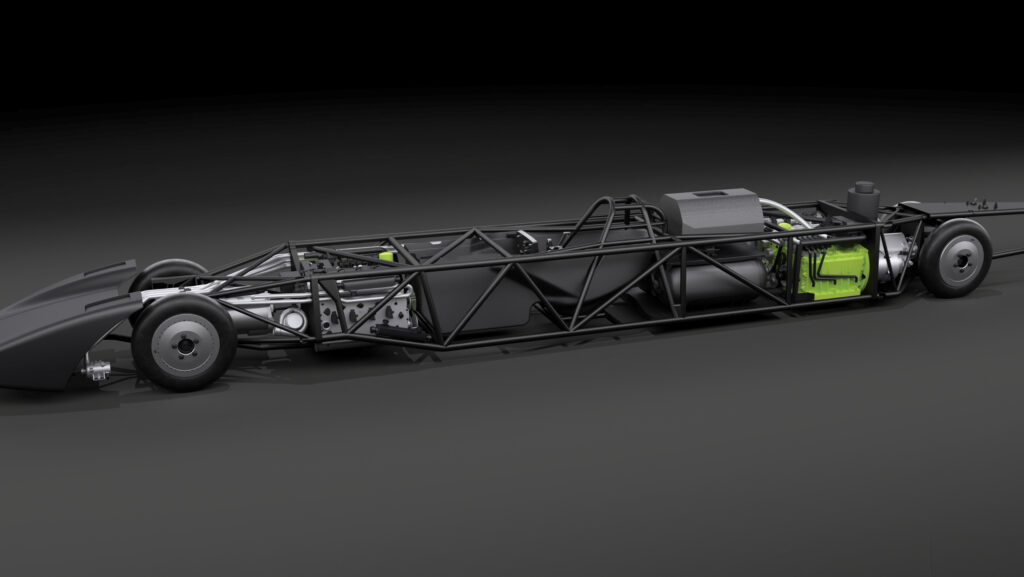
The Hydromax’s bodywork fits ever so snugly around a strong but light tubular steel chassis that’s 560mm longer than on the Dieselmax, largely because it has to accommodate bulkier fuel tanks.
There are separate fuel systems for the front- and rear-mounted engines – positioned at the car’s extremities to contribute to straight-line stability at high speeds – each comprising an aluminium tank wrapped in a substantial carbon fibre protective casing.
Mounted amidships between the driver’s tub and the rear engine/gearbox combination, the tanks are pressurised to 700 bar to contain as much hydrogen as possible for maximum space efficiency, with each holding 4kg of the gas – enough for a single run.
© Peter Hill
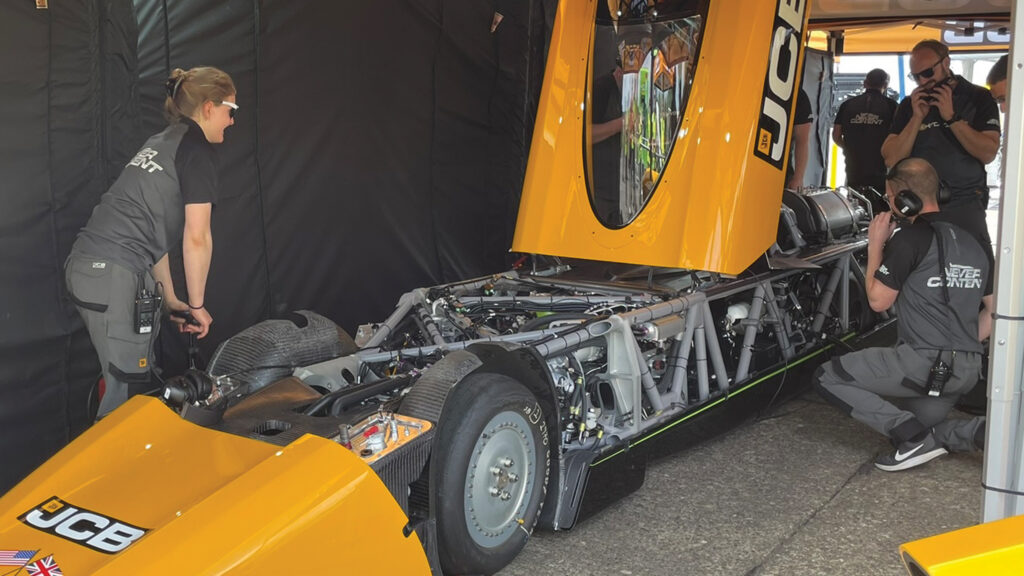
When each of the 4.8-litre JCB engines is fired up, the gas is regulated down to 30 bar for direct injection into the combustion chambers as a large volume of turbocharged and inter-cooled air is pumped in through the inlet ports.
To ensure consistent four-wheel drive down on to the salt, a master digital engine control unit shares data with each engine’s individual ECU to keep them running at precisely the same speed and power output.
While a four valves per cylinder inlet/exhaust package is retained, a new pent-roof cylinder head accommodates high-precision fuel injectors to replace indirect injection via the intake manifold on the standard engine.
Twin overhead cams
Another key feature of the new head, points out principal engineer Mark Richards, is a pair of belt-driven overhead camshafts – cue nods of approval from fans of the Ford Escort Mk1 Twin Cam and other rorty 1970s/80s rally cars.
This set up provides more efficient and accurate precision valve activation than the standard pushrod mechanism, especially at the max power rated speed of 3,800rpm, up from the usual 2,200rpm.
And because the engines are canted over on their side for tight packaging, they are each lubricated by a dry sump system pumping a litre of oil every second.
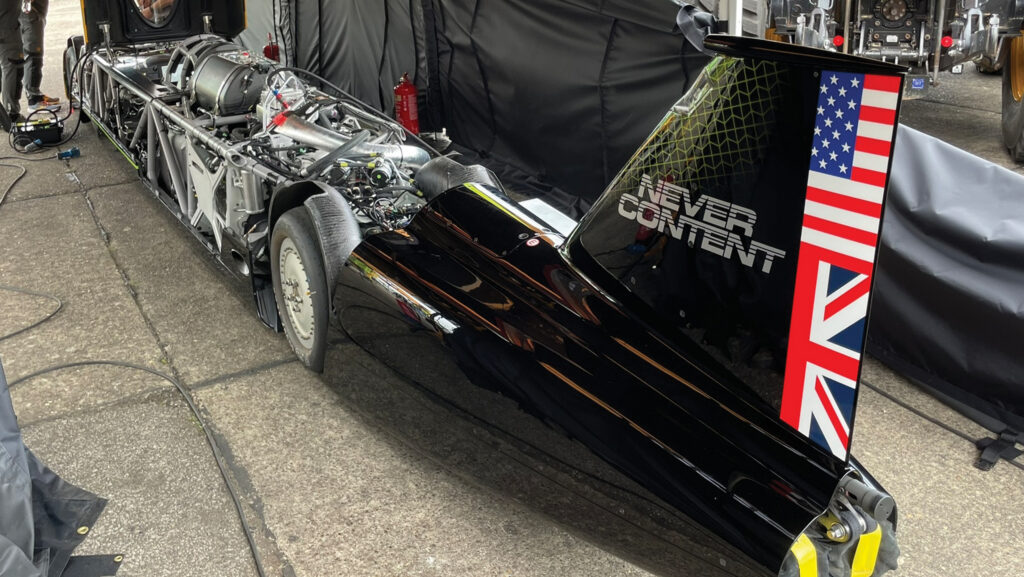
Heat is extracted from the engine coolant, which also passes through the turbo inter-coolers, by ice held in tanks in the nose and above the hydrogen containers – conventional inlets and radiators create too much drag.
© Peter Hill
Between them, the tanks hold about a quarter tonne of the cold stuff, enough, hopefully, to sustain the powertrain during each run in very high ambient temperatures before it all melts out.
Based on essentially the same block as used for JCB’s new 75hp/440Nm hydrogen-fuelled engine, these upgrades for the racing version take maximum outputs to an astonishing 800hp and 1,762Nm.
That gives the Hydromax a potential 1,600hp and 3,524Nm for its runs at the iconic Bonneville SpeedWeek competition in the first week of August, and for an official two-way speed record bid – with a target of at least 351mph to beat the Dieselmax – the following week.
From behind the wheel
Andy Green, the fastest man on earth thanks to his 763mph ultimate land speed record achieved in 1997 with the jet-powered Thrust SSC, is JCB’s chosen pilot.
“From an engineering point of view, this is an extraordinarily ambitious project, especially given the incredibly tight timescale,” he says.
“It’s showcasing some great British engineering and underscoring the potential of hydrogen as a combustion engine fuel made from sunshine and water, and what you can do with it.”
Cocooned in the Hydromax cockpit with the engines fired up and first gear selected, Andy’s chariot will get a gentle but fast-accelerating push off the line to get it under way.
Drive clutches plucked from the JCB backhoe-loader parts bin automatically engage both powertrains at 45mph, and from then on it’s hard acceleration and snappy up-shifts as the car gets going under its own steam.
Which, of course, is all that’s emitted from the exhaust pipes; no carbon in, no carbon out.
During a week and a half of dynamic testing along RAF Wittering’s main taxiway in early June, methodical checks of individual systems and fine-tuning of the engine ECU set were combined with progressively higher power outputs and faster speeds.
By the end of the session, the Hydromax achieved 207mph before a parachute and the car’s carbon aerospace brakes had to be deployed to stop it disappearing into the next county.
This was the first time the car had run on its new Goodyear tyres; larger, stronger and using more sustainable materials than before.
And, most importantly, with a higher maximum speed rating than the tyres that prevented the Dieselmax from being run any faster on its record-breaking runs back in 2006.
The refuelling challenge
© Peter Hill
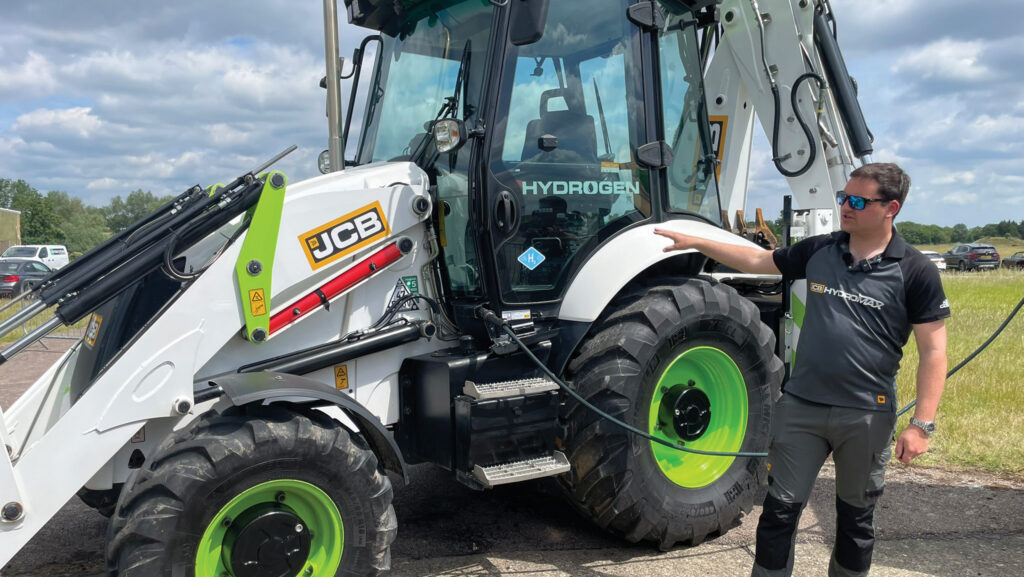
For each of its preparatory and competitive runs, the Hydromax’s two fuel tanks are refilled by the mobile fuelling rig that new manufacturer HyKit has developed for replenishing JCB’s 3CX Hydrogen backhoe-loader and future H2 machines.
Enabling these vehicles to be refuelled wherever they are working, the trailer-mounted MHR-X75 holds 75kg of hydrogen and takes 10-15 minutes to fill the 3CX’s 9kg capacity roof-mounted storage tanks – enough for a full day’s work.
The single delivery hose plugs into a receiver positioned at the bottom of the front-left cab pillar and once the vehicle’s tanks are brimmed, excess hydrogen is automatically vented back to storage.
A touchscreen panel is used to set up refuelling events and there is live performance monitoring, cloud-connected diagnostics, and safety systems including leak detection and emergency shutdown.