

On test: HiSun Stryker looks credible as electric farm UTV
 © James Andrews
 If you’ve just had to dig deep for some exorbitantly priced red diesel, the prospect of a vehicle that refuels via a plug socket may suddenly seem more appealing.
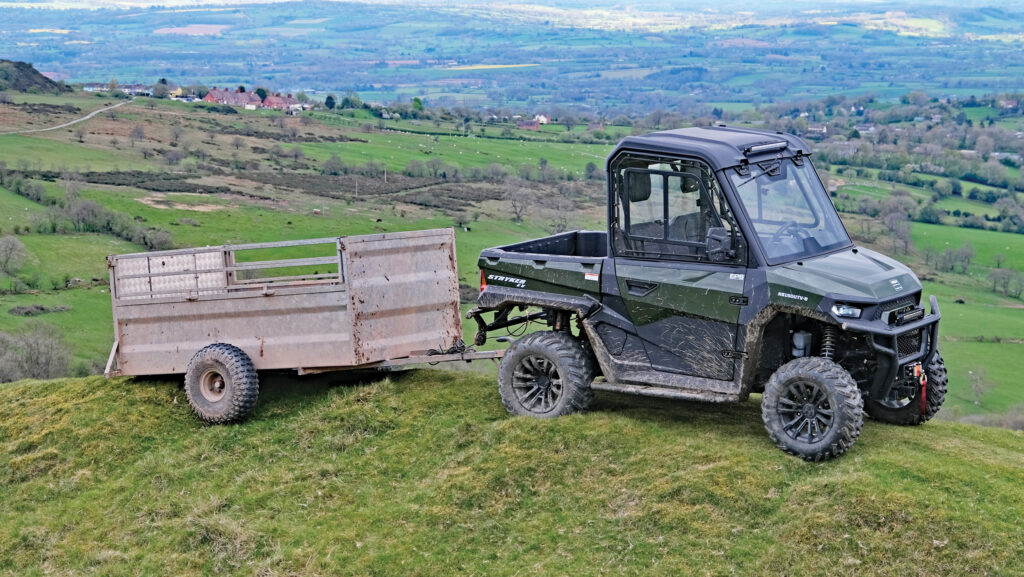
One firm hoping to capitalise on any newfound amiability toward electric vehicles is Chinese manufacturer HiSun, which recently pulled the wraps off its Stryker UTV.
See also: On test: Battery-powered Polaris Ranger XP Kinetic
Powered by a 15kW (20hp) motor and 17.9kWh of lithium-ion batteries, this newcomer promises a top speed of 60kph and a range of up to 120km on a single charge.
The latter figure may prove optimistic in real-world conditions (more on that later), but it still represents a significant step forward from the Sector 15 it replaces.
On top of that, designers have jettisoned the old retrofit DFK cab in favour of a far smarter in-house offering.
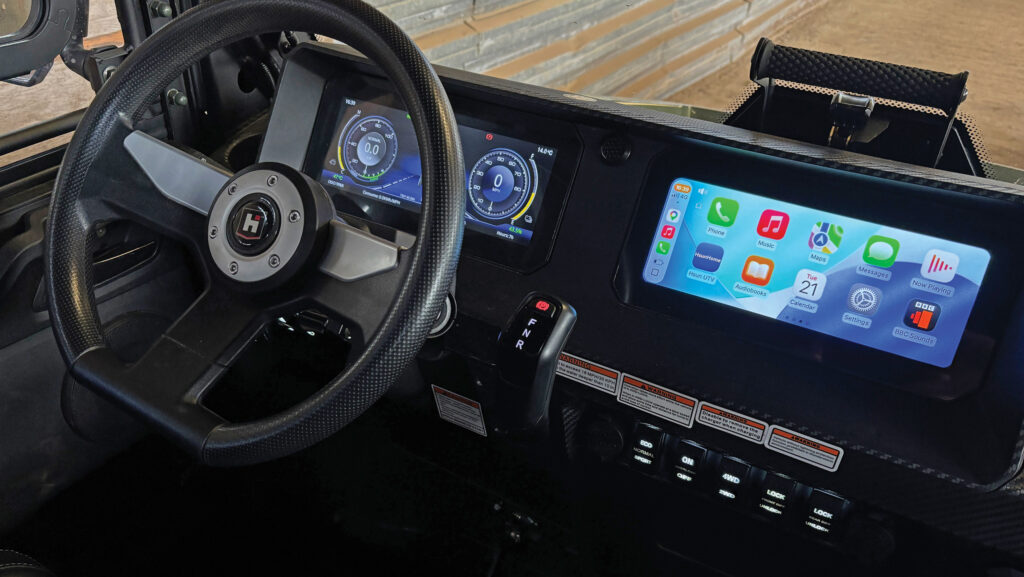
This moulds seamlessly into the bodywork, rather than fitting where it touches, and indulges drivers with dual 10in screens and a radio geared up for Apple CarPlay and Android Auto.
HiSun Stryker EV
- Motor 15kW (20hp)
- Battery pack 72V lithium-ion 17.9kWh
- Transmission Direct drive
- Top speed 60kph
- Claimed range Up to 120km
- Towing capacity 300kg (1,000kg braked)
- Cargo bed capacity 200kg
- Starting price £19,995 (half cab)
- Price as tested £20,645 (full cab)
Keener pricing
Adding more kit generally means there’ll be a bigger hit to the wallet.
However, HiSun has managed to roll out the Stryker with a £19,995 starting price, some £5,500 less than its predecessor.
It’s a strategy reminiscent of China’s car industry, where aggressive pricing has driven a surge of new brands onto UK roads.
A few years ago, no one had heard of BYD, Jaecoo or Omoda and MG was little more than a nostalgic badge.
Now they’re peppered across the landscape, with scores of buyers lured by the substantial savings that can be had when stepping away from the mainstream brands.
In UTV land, the Stryker’s closest rival is the Ranger EV Kinetic Premium from Polaris, reviewed back in 2024.
The American is far quicker but has a smaller battery, a lower range and costs about £10,000 more.
So, is the Stryker good enough to tempt hordes of agricultural UTV buyers away from their diesel and petrol buggies?
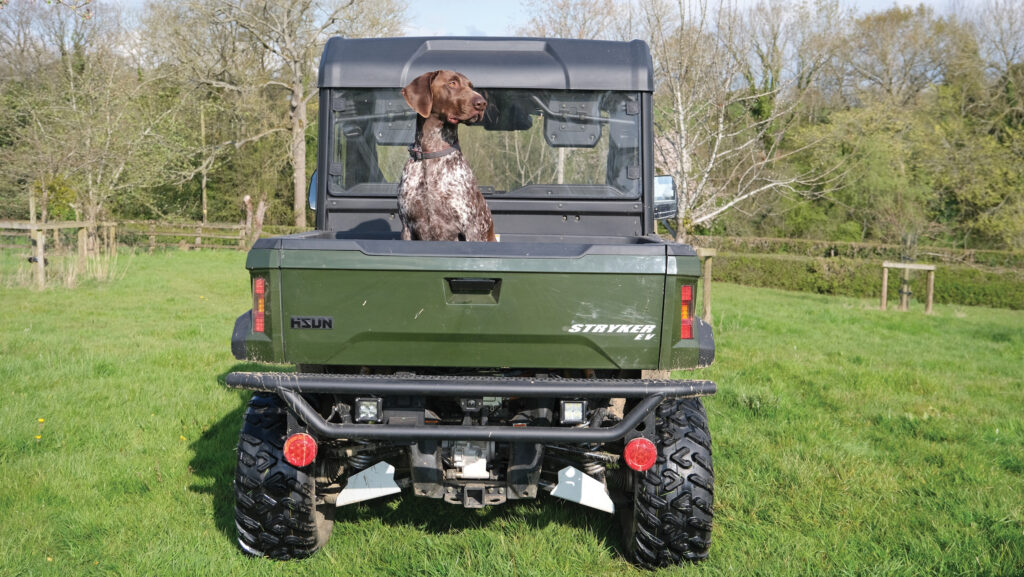
It certainly isn’t for everyone, but of the electric options we’ve driven to date, it’s arguably the most credible option for farm use.
© James Andrews
Balancing act
The key lies in its balance of performance and efficiency.
It’s easy to make electric vehicles quick, but dishing out too much power soon drains the battery. HiSun has instead opted for a motor that’s big enough to get the job done without going overboard.
The result is brisk acceleration from standstill and respectable performance under load.
While speed inevitably drops on steep inclines or when towing, it still feels livelier than most diesel UTVs, which typically hover around 25hp.
© James Andrews
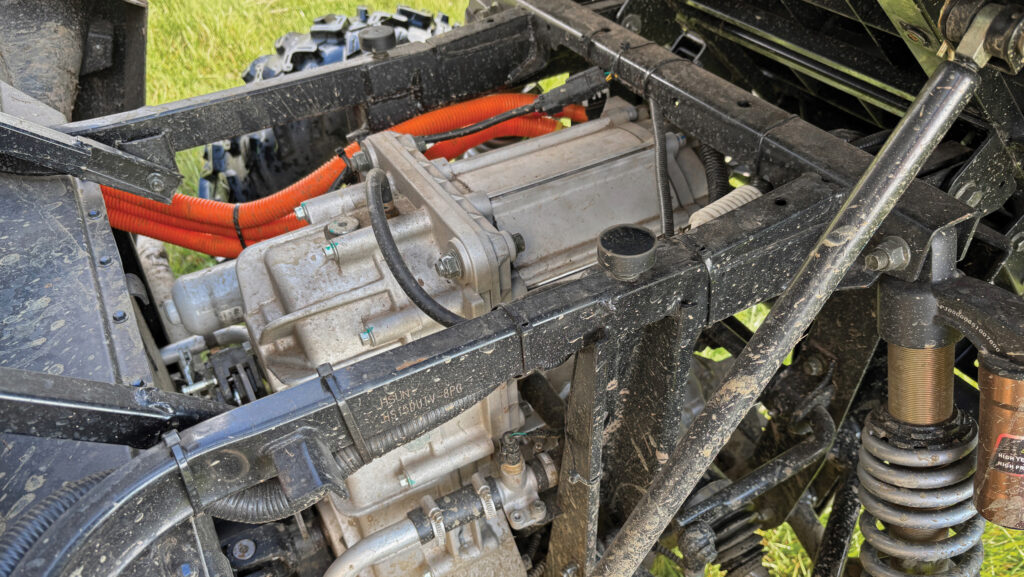
Part of this is down to the instant availability of torque, but the direct drive transmission also plays its part. With no CVT belt or mechanical range box, there are far fewer components to sap precious power.
In fact, other than the motor, which is housed under the tipping rear load bed, the only other transmission component is an enclosed chain to transfer drive to the prop shafts.
Reasonable range
All this means the demands on the battery are comparatively modest.
When doing our darndest to drain its reserves – razzing around at high speeds with a trailer in tow and poking it up as many steep hills as we could find – it still managed to travel 50km before asking us to plug it in.
Even then, there was still 20% charge remaining and it derated the power a little so that there was enough to get home.
© James Andrews
In normal use, the range is likely to be considerably higher, though it would require a very light foot to eke out 120km.
Another feather in the Stryker’s cap is the fact that the battery gauge seems to deliver an accurate estimate of remaining charge, which isn’t always the case.
This means operators should be able to make use of the full capacity without needing a friend on standby with a tow rope.
Lengthy recharge
Less impressive is the time it takes to recharge the cells.
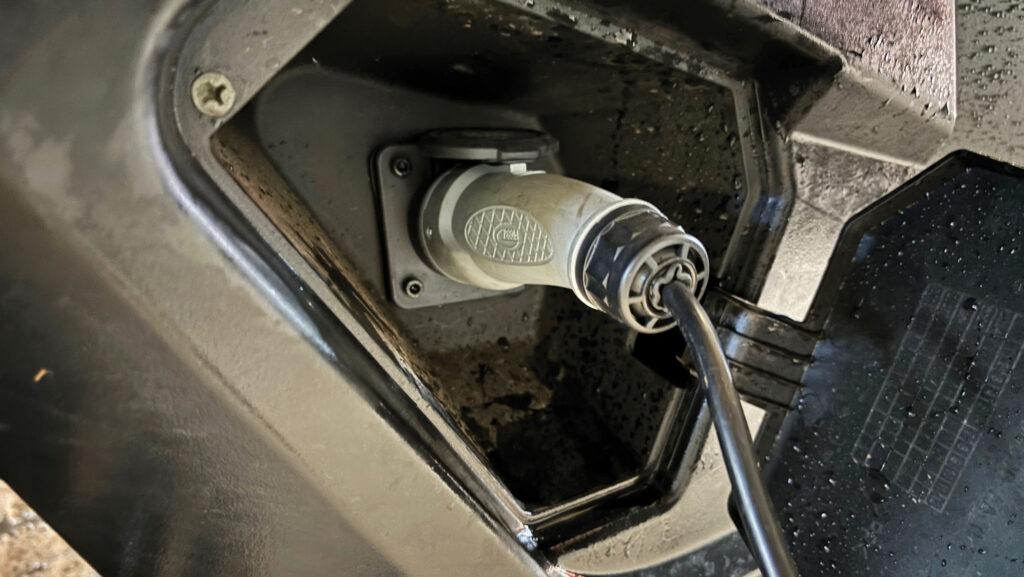
The only current option is to plug it into a three-pin socket and it’s then out of action for six to eight hours as the electrons do their thing.
Realistically, this is an overnight job, although range boosting top-ups can be performed during the day whenever it’s parked up.
To be safe, any prospective buyer needs to make sure the batteries have got adequate juice for their daily needs – something that only a lengthy demo can really confirm.
Charging costs are minimal, though, and potentially free for those who have invested in solar panels and battery storage.
© James Andrews
Driving it
One marked improvement over its fossil-fuelled cousins is the lack of noise.
At slow speeds it’s whisper quiet and even when barrelling along at full chat there’s just a moderate whine from the motor and a whoosh of wind noise.
On hard surfaces, the hum of the tyres adds to the symphony, but none of it is particularly intrusive.
As there’s no traditional transmission with high and low ranges, HiSun has included a so-called “overload” function. This does roughly the same job, by halving speed and doubling the torque, thus improving hill climbing and towing ability.
Operators also get switchable four-wheel drive at their fingertips, as well as manual locking front and rear differentials.
Leaving both of these open allows for tight scuff-free turns, while having both engaged delivers true four-wheel power.
On rough terrain, the coil shocks make a valiant attempt at soaking up the bumps, though they lack the plushness offered by more premium brands.
© James Andrews
In-cab comfort
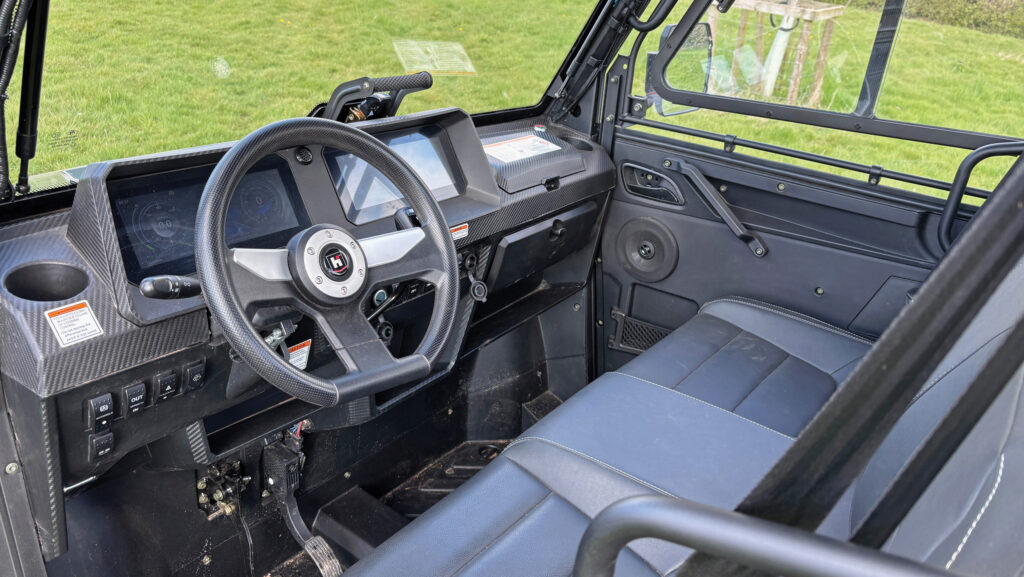
The new cab is a substantial upgrade over the old setup and helps contribute to the machine’s far sleeker silhouette.
That said, it’s easy to see where money has been saved.
The door windows are simple sliding affairs and when you shift the bench seat forwards the backrest stays pinned to the rear frame. This isn’t a problem for loftier operators but it’s pretty uncomfortable for the vertically challenged.
There aren’t any ventilation fans either, but the windscreen does open fully to give a blast of fresh air on a hot day.
It would be handy if this had a latch to hold it slightly ajar, so that air could waft in without the driver getting a face full of midges.
Winter is more of a concern as there’s no option of adding a heater, for the simple reason that it would milk the battery. UK importer EP Barrus says HiSun is looking at options, so it may well be possible to add one in the future.
The 10in touchscreen and radio is a nice touch and because there’s no engine noise you can actually hear it.
However, because every function is touch activated, including volume, it’s not the handiest when you’ve got wet, muddy fingers.
FW verdict
We’ve tested several electric UTVs over the years and none of them has really been suited to hard graft on a farm.
But the Stryker might be the model that starts turning the tide.
It’s got just enough power, there’s sufficient battery capacity to do a decent amount of work and it’s competitively priced against a petrol or diesel machine.
That said, the six- to eight-hour charging time means forward planning is essential. Forget to plug in overnight, or tackle a particularly energy-sapping job, and it’s out of action for most of a day.
Then there are the bits we can’t judge on a short-term test, such as reliability and battery degradation over time.
To find that out, we’ll have to call on the experiences of those first customers who are willing to take the plunge.
Likes and gripes
Likes
- Decent power
- Battery lasts surprisingly well
- Smart cabin
- Reasonably priced
Gripes
- Six- to eight-hour charging time
- No cab fan or heater option
- Strange seat adjustment
- Screen glare in bright sunlight