On test: Much to like about Can-Am’s Outlander Electric ATV
 © James Andrews
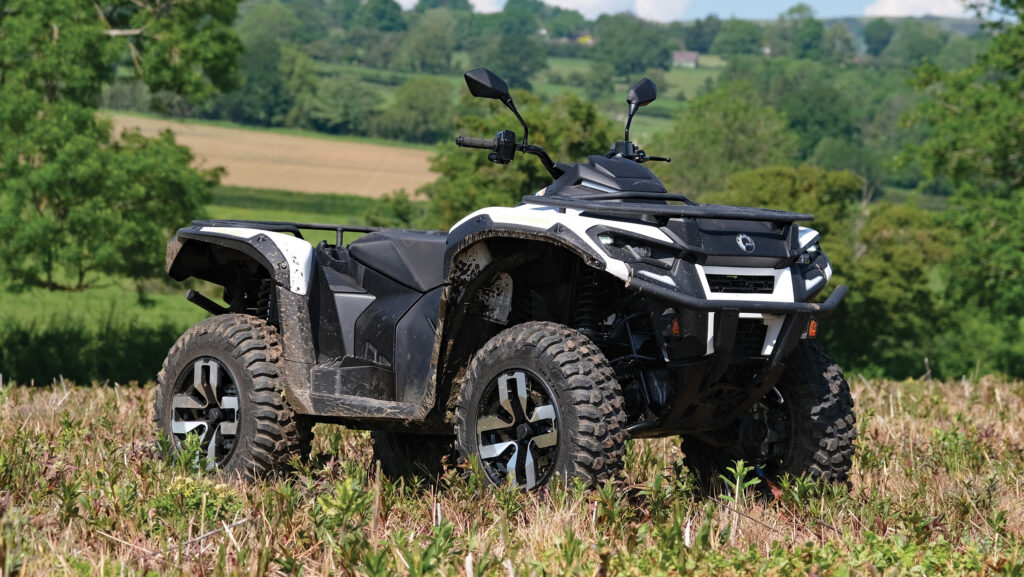
 The steady thump of a single-cylinder petrol engine has long provided the soundtrack to a livestock farmer’s day. Now, Can-Am is offering to turn down the volume.
By ditching internal combustion in favour of batteries and a motor, its new Outlander Electric delivers a near-silent whoosh.
Other perks are promised too, including swift acceleration, lower maintenance and no more jaunts to the petrol station with a pickup full of jerry cans.
See also: On test: Kawasaki back with keenly priced Brute Force 450 ATV
Like most electric vehicles, battery capacity will be the clincher. But with a maximum quoted range of 47 miles from its 8.9kWh battery, the Canadian company reckons it’s got the needs of many farmers covered.
Plenty of other brands have dabbled with electric quad bikes over the years, so Can-Am certainly isn’t launching into virgin territory.
However, it is the first of the mainstream makers to get in on the action. If successful, it could pave the way for others to follow.
© James Andrews
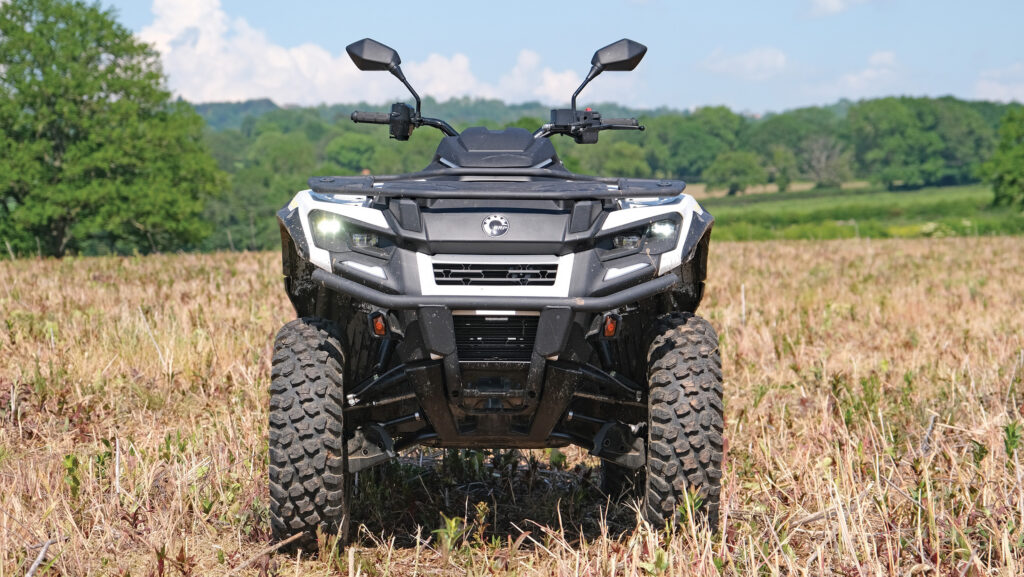
Can-Am Outlander Electric
- Motor Rotax E-Power
- Power/torque 47hp/72Nm
- Battery capacity 8.9kWh
- Transmission Two-speed
- Claimed range Up to 47 miles
- Range achieved in test 20 miles
- Charge time (20-80%) 50min with a wall box
- Towing capacity 830kg
- Weight 398kg
- Starting price £13,333 (£14,083 for Max version)
How fast is it?
It’s blisteringly quick off the mark, so much so that riders need to brace themselves before giving it the beans.
Act too casual when mashing the throttle and there could be a dramatic unseating on the cards.
The reason for this is that the 35kW (47hp) electric motor delivers its 72Nm of torque in an instant – there’s no build-up like there is with a combustion engine.
Performance is impressive at higher speeds too, though it does lose its advantage over petrol bikes of a similar power output, which are just getting into their stride at this point.
Even up steep hills with a trailer in tow, it can maintain a decent speed and it continues to pull strongly until battery life nudges into the red.
When it comes to slowing down again, Can-Am has fitted three-stage regenerative braking. It works to an extent, but even in the highest setting there is minimal resistance when lifting off the throttle lever at high speeds, particularly with some weight behind.
This puts a little more reliance on the disc brakes. These are plenty sharp enough, although it is possible to get the tyres to skid when anchoring up quickly on hard surfaces.
© James Andrews
Is there enough battery range?
That is a hard question to answer. For many, it’ll be more than adequate, but it certainly won’t cut it for those who are on the move all day or who regularly tow heavy loads.
During testing, it was pushed hard with a mix of high-speed driving and some towing. The batteries were rinsed after about 20 miles of this treatment, which is less than half the range Can-Am advertises.
Few will give it this much grief on a daily basis, though it’s fair to say that 47 miles is an ambitious claim. For typical driving, the range is likely to be somewhere between these figures – say 35 miles.
© James Andrews
Can-Am has already sold some of these bikes to farmers and we’ve had reports that they are managing to travel this sort of distance.
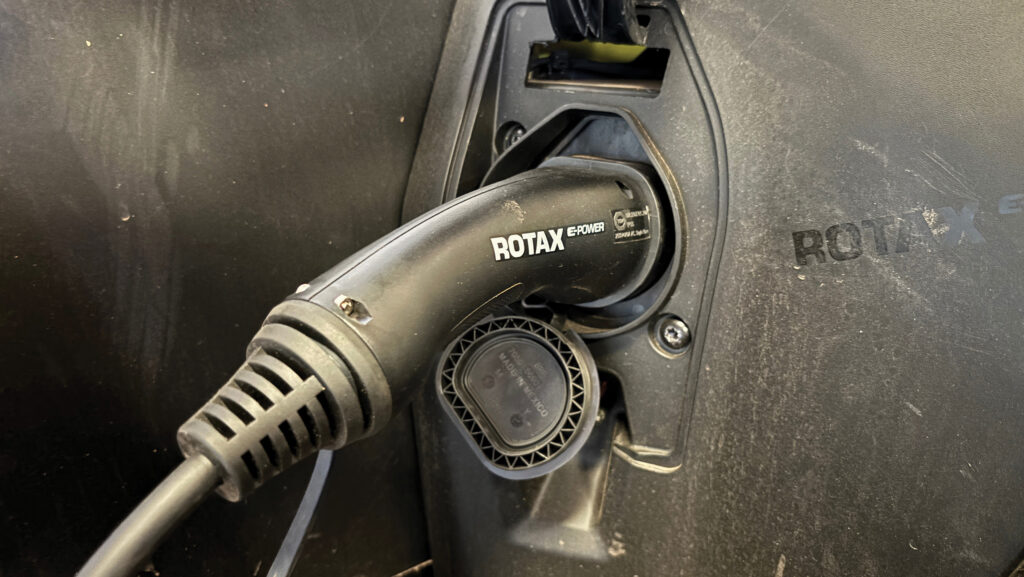
Thanks to a built-in 6.6kW fast charger it’s also easy to top up the battery part way through the day.
Plug the bike into a suitable wall box and the cells can be pushed from 20% to 80% in as little as 50min. When connected to a regular 13A socket, a full charge takes about six hours.
Arguably, this is more convenient than running around with petrol cans, and it’s considerably cheaper too – about £2.30 for a full charge.
© James Andrews
Likes and gripes
Likes
- Rapid acceleration
- Smooth ride
- Fast charging
Gripes
- Not enough range for heavy users
- Big frame
- Minimal regenerative braking
What’s it like off road?
Off-road, the electric model performs just as well as its petrol siblings, with a switchable four-wheel-drive system and an auto-locking front differential.
Ground clearance is decent too, and the wishbone suspension does an admirable job of soaking up bumps, even at speed.
Some will say water and electrics don’t mix, but the components on this bike are suitably well sealed that it can wade deeper than the petrol models.
In fact, there are videos online of them being driven fully submerged and they’re still working well after the ordeal – not that it’s recommended.
In true Can-Am fashion, the Outlander Electric is a big lump of a bike that can be cumbersome in certain situations.
However, the tight turning circle and featherlight power steering make it easy to handle for its size.
It isn’t as heavy as you might think either, coming in at roughly the same weight as a regular combustion model.
The lack of transmission resistance is noticeable off road as the bike will run away down steep slopes, even in low range with the highest regenerative braking setting engaged.
© James Andrews
How quiet is it?
Many electric vehicles boast near-silent operation, but few get as close to soundlessness as the Outlander Electric.
Other than the motor, which produces the faintest of whines, the drivetrain is entirely mute.
This means the tyres are among the loudest parts of the machine, along with a slight rattle from the tow bar.
You wouldn’t notice this on a petrol bike, but the lack of noise elsewhere means it can get annoying. Wedging in a bit of packing material soon hushes it.
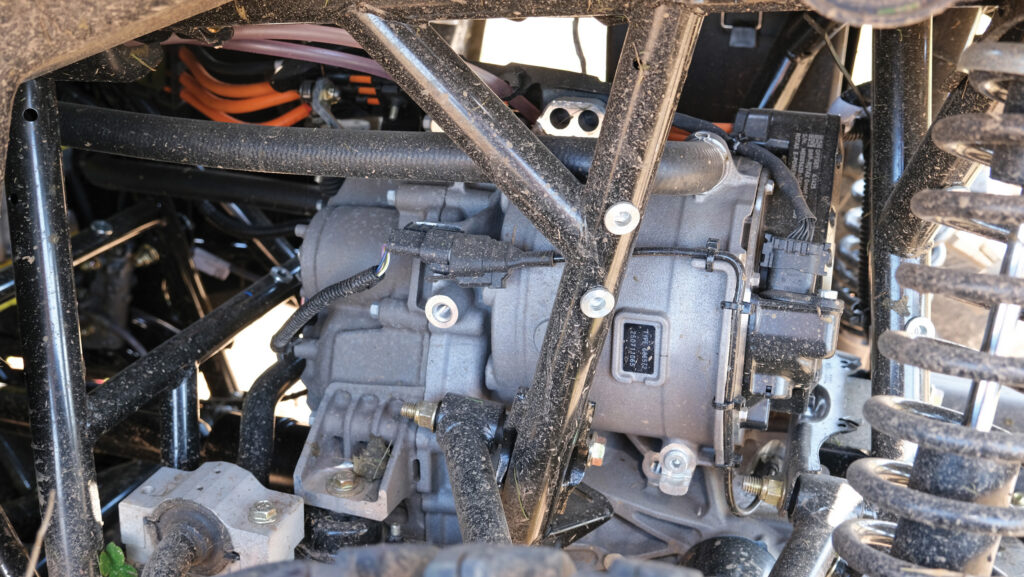
One of the secrets to the bike’s refinement is the fact that Can-Am has fitted a dedicated Rotax E-Power electric drivetrain, rather than adapting a petrol one.
There is no CVT belt as a result – just a motor attached to an enclosed unit with two ranges. The rear wheels are driven directly from this, while a prop shaft sends power to the front differential.
Rotax E-Power unit © James Andrews
What’s it like to drive?
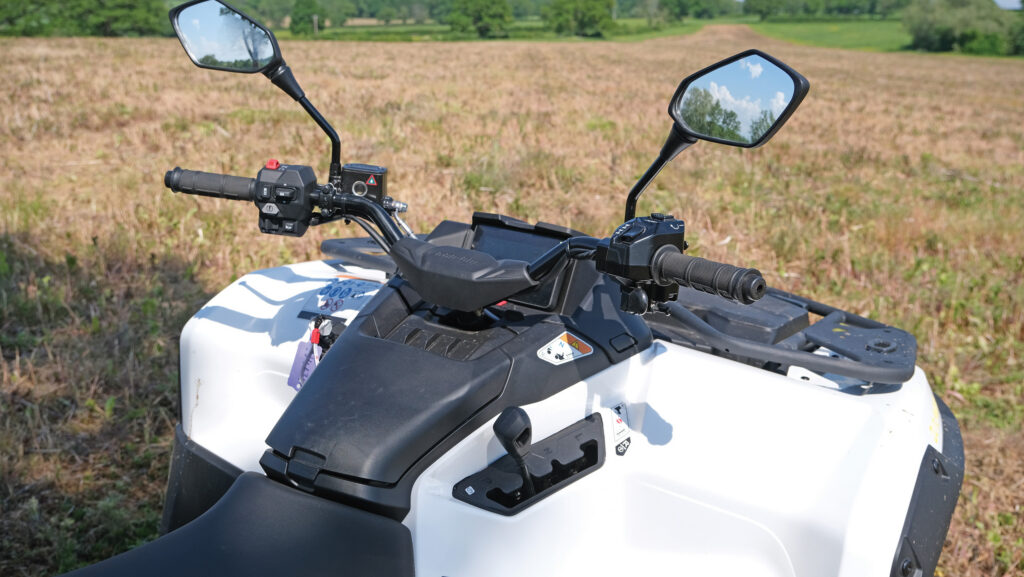
The biggest change from a regular ATV is that there’s a button to toggle between forward and reverse. This is easy enough to use, but the rider needs to make sure it’s engaged properly before reaching for the throttle.
If changing direction in a hurry, it’s possible to fudge the process and lurch off in an unexpected direction.
Another quirk of the drivetrain is that it switches off after a period of inactivity and there’s a delay between turning the bike on and being able to move.
It’s only slight, but can be a bit irritating when wanting to get going in a hurry.
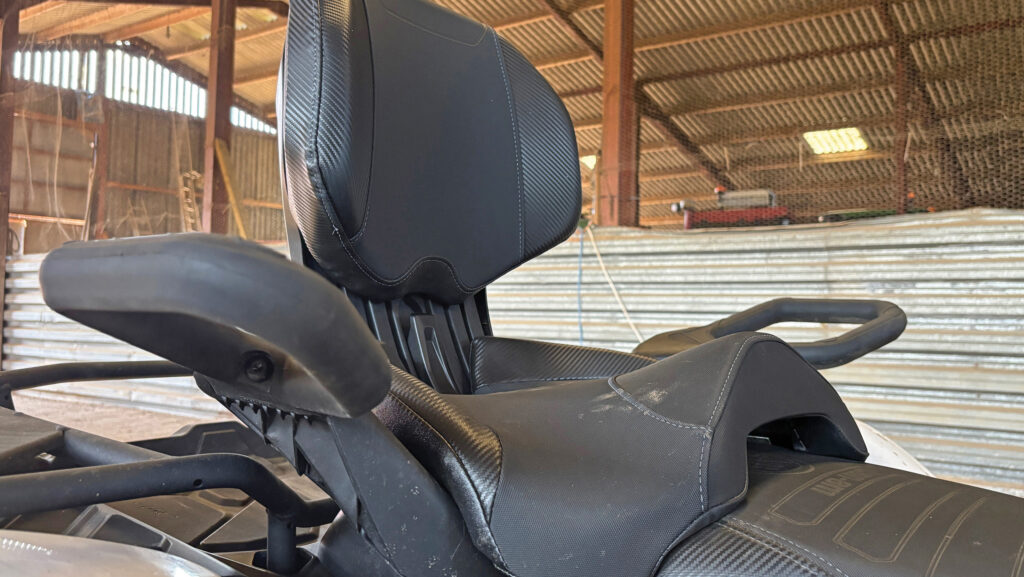
Can-Am offers the Outlander Electric in two versions: one is a regular single-seater and the other is the two-seater Max, as seen here.
This comes with a throne-like perch at the rear that allows a passenger to be carried in relative comfort.
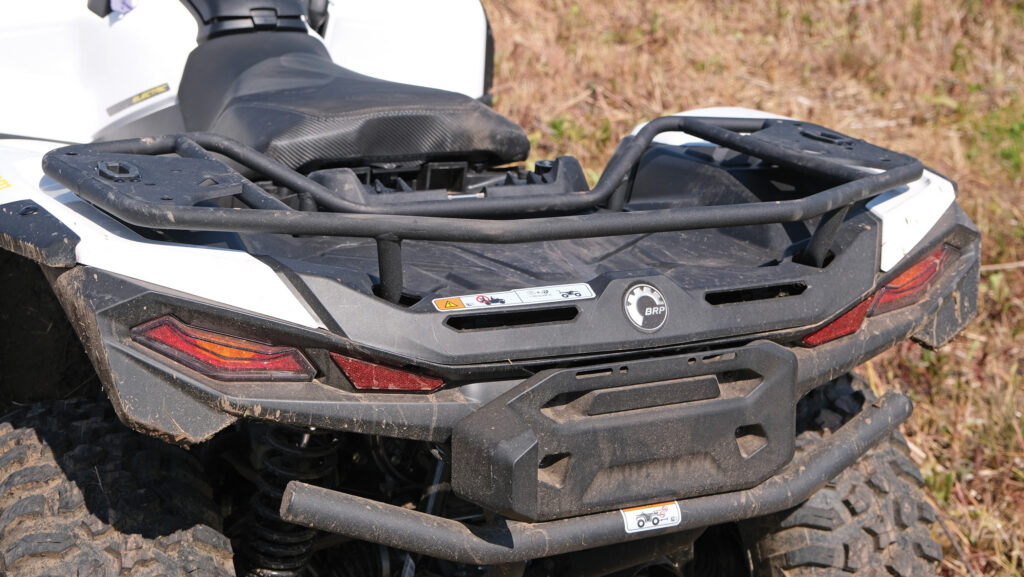
It’s a bulky thing that gets in the way when there is no need to carry an extra person. However, with the flick of a lever it can soon be removed, creating another area for storing gear.
This space isn’t particularly useful on its own, but Can-Am makes a handy storage box that slots into place.
Verdict
The Outlander Electric is the slickest battery quad bike we’ve driven to date and it will be a credible option for some farms.
Its near-silent drivetrain is a welcome break from a thrumming petrol engine and the acceleration is genuinely impressive.
Range is decent too, and the quick charger allows top-ups to be completed during the working day.
That said, the battery capacity will still be a stumbling block for those who are on the bike all day, regularly travel at high speeds and tow heavy trailers.
Clearly, there’s a price premium over a regular petrol bike, but the fuel savings will help offset the difference.