Home-made toolbar drill adds versatility to contracting fleet
 © MAG/Oliver Mark
 Whether conditions are wet, dry or Goldilocks-perfect, Warwickshire farmer and contractor Lawrence Trivett has a drill to fit the bill.
Stung by several soggy autumns in succession, he has been busy refreshing Trivett & Sons’ establishment armoury, alongside his father Andrew and brother Alistair.
Their aim was to assemble a more versatile range of implements to handle whatever a sowing season throws at them, without having to soften on their dedication to late drilling that has kept grassweeds at bay.
See also: Mounted Horizon toolbar drill proves versatile option
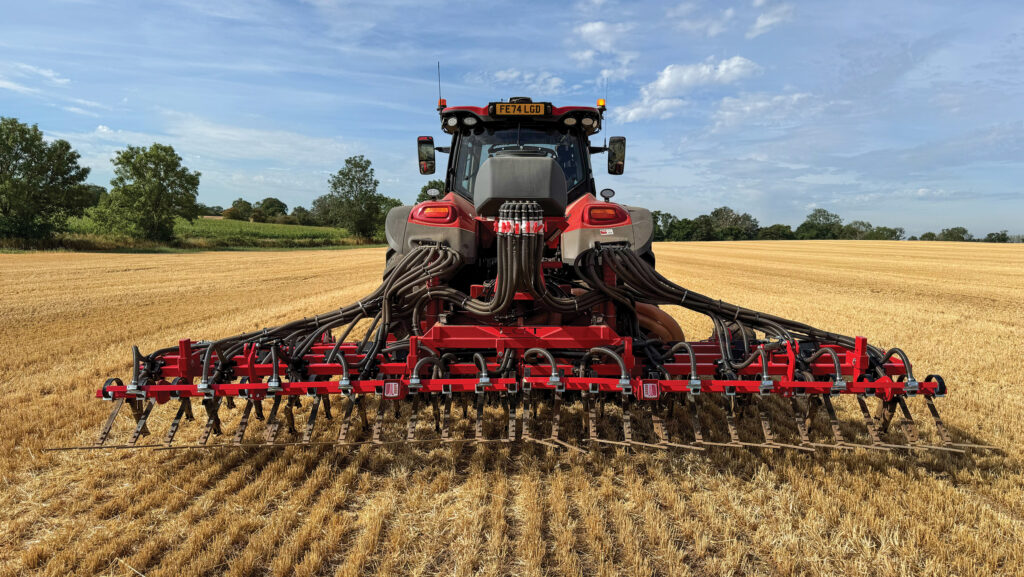
They now have three 6m drills: a long-serving Vaderstad Rapid, recently joined by a Horsch Avatar SL and Lawrence’s workshop-built tine toolbar drill.
The latter brings a load more options into play. It can be run on its own, behind a new Kuhn HR power harrow – bought with a rear linkage to form a convention combi – or mounted to an Agriweld Assist subsoiler.
As the law of Sod dictates, drilling campaigns have been devoid of rain since the drill was built last summer, but Lawrence is confident it will come into its own.
“The idea is that we can keep going no matter what, and without mauling the seed in,” he says.
“We don’t mind whether that’s with the Rapid, Avatar or tine drill – we just cultivate accordingly and, where necessary, change the toolbar configuration to suit the ground conditions. Every season is different.”
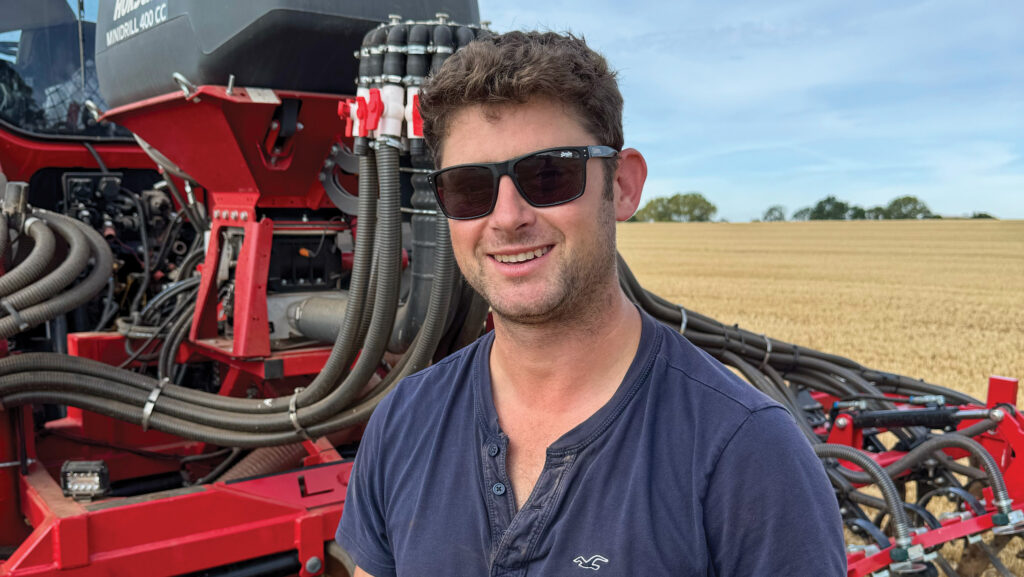
Lawrence Trivett © MAG/Oliver Mark
Fleet rethink
The business drills 600ha across its own and four contract farms near Atherstone, plus another 40-160ha on an ad-hoc basis. In a typical year, the Rapid will take care of half the work.
Previously, it was supported by a 6m Amazone power harrow combination with front tank and a Weaving Tine Drill. But their shortcomings – and lack of versatility – eventually spurred the purchase of the Avatar and build of the toolbar drill.
“We needed a second power harrow as our 6m Brevi couldn’t keep up,” explains Lawrence. “When it’s dry, we want to be drilling right behind to conserve moisture and it wasn’t possible to quickly remove the sowing kit from the Amazone combi, nor run the front tank separately.
“Though we could hinge the coulters up, it was incredibly heavy, which wasn’t conducive to forming light, fluffy seed-beds.”
The Amazone disc coulters also had a habit of rolling over the top of the heaviest clay, failing to reliably bury the seed. So, they decided to cut it loose, along with the second-hand Weaving that was drafted in on a whim during a desperately wet autumn three years ago and has sat forlornly in the yard since.
In came a 6m Horsch Avatar SL complete with Partner 2000FT twin-tank front hopper and 400-litre MiniDrill; the switch from combi to direct/min-till drill marking a major about-turn on the establishment front.
“We tested almost every direct drill, and the Avatar’s seed placement and depth control was the best,” says Lawrence.
Yet they were reluctant to fully commit to direct drilling, having seen neighbours’ machines shed-bound during particularly soggy campaigns. “We’re not convinced that zero-till is the complete answer, otherwise we’d have gone for a 12m model,” he adds.
“Though it’s great for not disturbing stale seed-beds, our soil is too variable – from sand to cat s**t in the same field – and we need to treat areas differently.” And that’s where the tine toolbar drill comes in.
“The objective was to have a more robust and versatile version of the Weaving – one that could keep going when others stop.” That meant building something that could be quickly adapted to suit the prevailing conditions – whether used solo or in combination with a cultivator.
“The Avatar is great, and we still like the Rapid, but they both have their limitations,” he says. “The Rapid is a sledge in the wet and causes enough headland damage to halve yields. And, given our average field size is 5ha, there are a lot of headlands.”
© MAG/Oliver Mark
Building it
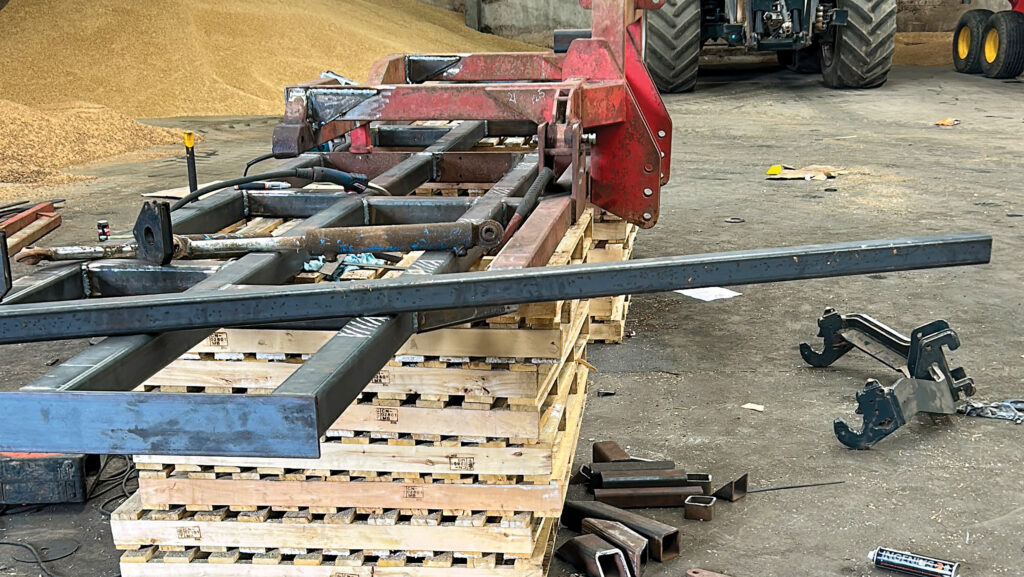
Project Toolbar Drill took place over a couple of months last summer. It started with the salvaging of an old three-point-linkage; its lower link jaws widened, and top link receiver raised to provide the necessary geometry.
Lawrence then knuckled into the box-section frame. Steel was ordered to length and, upon delivery, two 3m beams laid on the workshop floor. This allowed him to mark the coulter positions and, afterwards, establish those of the braces, which differ each side.
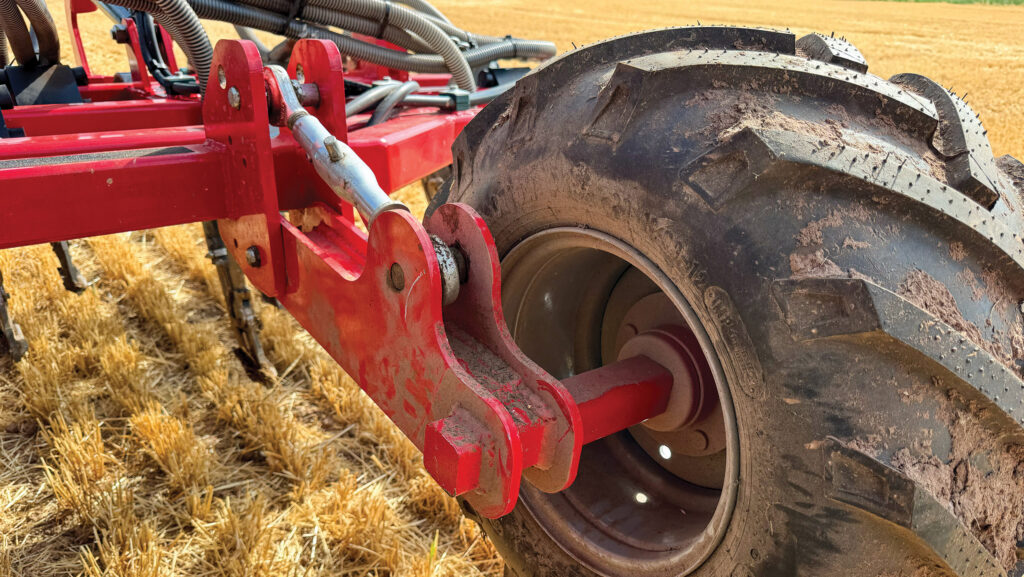
Rams from an old Shelbourne Reynolds rape swather went on next, centre-folding the implement to 2.8m on the road, as did new depth wheels and stub axles on laser-cut mounting brackets.
© MAG/Oliver Mark
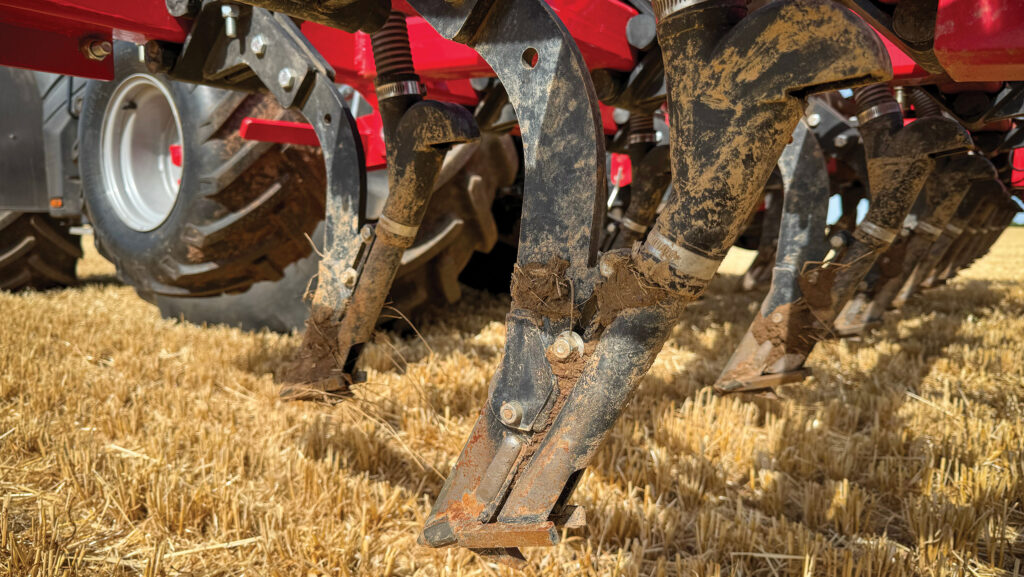
Tine choice took a little more homework, a study tour to Cereals and several phone calls to eventual supplier JJ Metcalfe. “My initial inspiration was Weaving’s toolbar drill,” says Lawrence. “My cousins run one, and we particularly liked the light-duty box-section frame.”
“However, the hook shape of the spring-loaded Suffolk coulters had a habit of rolling the clay without reliably burying and covering the seed, so we ruled them out.”
Instead, he opted for Metcalfe’s dog-legged assemblies with 50mm wings, spread across three rows and, to improve sowing depth consistency, clamped with harder rubber sausages than those of the Weaving. They are set on 176mm spacings – narrower than the 250mm of the Avatar to get the plant population up in wet conditions.
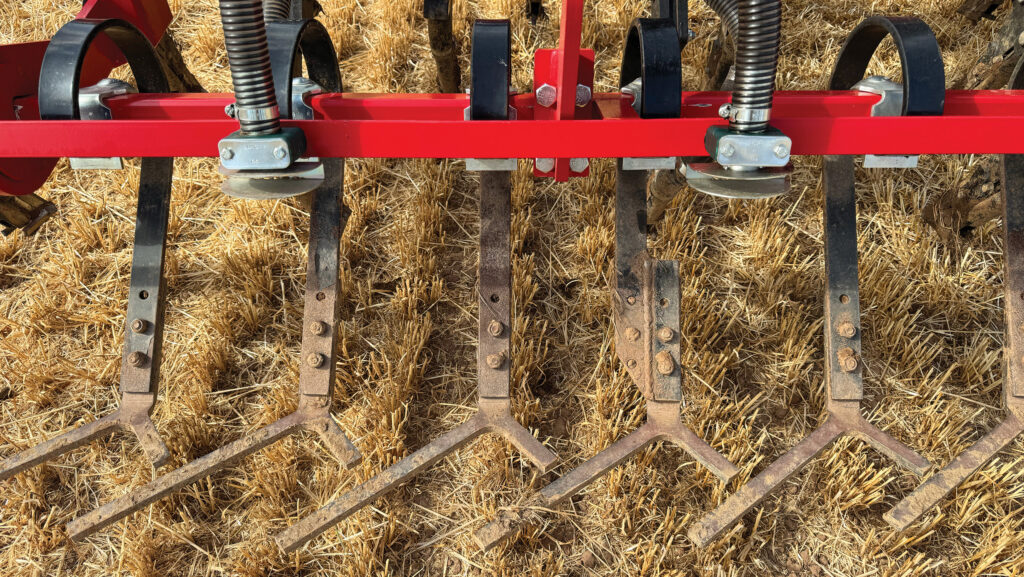
Next came the following harrow. Having been generally pleased with the HD setup on the old Amazone combi – a bank of overlapping, flat-to-the-ground splays – Lawrence used it as a starting point to develop his own.
© MAG/Oliver Mark
“It reliably covered the seed on heavy ground,” he says. “But the 20mm round bar wasn’t heavy-duty enough and wore too quickly.”
So, he made a cardboard cutout to replicate the size and angle, then carved up 25mm Hardox 600-grade plate and bench-pressed it into a “tick” shape.
And it has proved a hit. “It doesn’t doze or smear and works as a light depth control to keep the bob out of the job,” he says. “I just need to fit carbide strips down the edges as that’s the wear point and I don’t want to be stopping mid-season to replace them.”
They are bolted to the paddles of an old Vaderstad Rapid levelling board – procured complete with ram brackets and plastic bushes for the pivots. Hydraulics provide adequate down pressure adjustment without altering the hole-and-pin position.
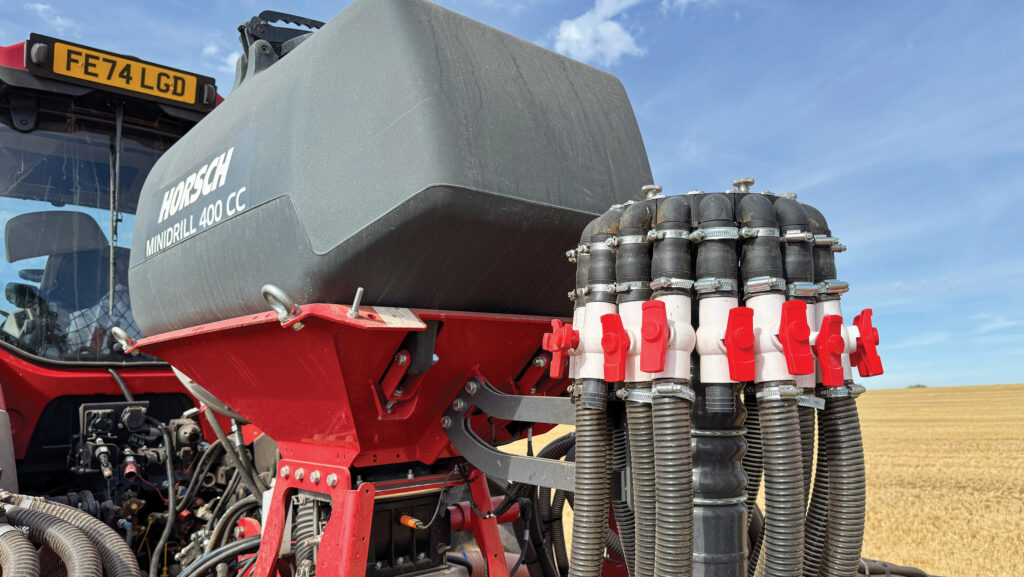
Seeding hardware starts with the 2,000-litre Partner front tank, which feeds two Horsch distribution heads for half-width shut-off on single products.
This is supplemented by the MiniDrill for Avadex or slug pellets, with 50m of hose to rear spreader plates and taps fitted to the distribution head outlets so that it can be hastily set-up on different implements.
© MAG/Oliver Mark
Finishing touches included a sandblast and two-pack paint finish in fetching Horsch red, a zinc dip for the pins and clamps to rid them of the musty Vaderstad yellow, and a set of four LEDs to illuminate the wings.
How has it performed?
The wet weather drill was built just in time for last autumn’s perfect drilling conditions – and this year looks set to be on the dry side.
On that basis, the Vaderstad Rapid and Horsch Avatar will share most of the work, though the Trivetts’ devotion to late drilling means there is every chance the toolbar drill will get a run out.
Stale seed-beds – along with a wheat, oilseed rape, maize and fodder beet rotation, with a double break in the weediest fields – are central to keeping the farms clean.
“It means we have to hold our nerve with the drilling date. Time pressure builds quickly when you’re contracting, but it’s easier when we know we’ve got the toolbar drill as a contingency to keep going.”
For one, there’s the flexibility of fitting it to different implements, including the Kuhn power harrow. It’s also lighter than the old Amazone combi, reliably pulls in and maintains its depth, and, at 12-15kph, can cover the ground quickly when run solo. Combi drilling is typically 6-10kph, depending on conditions.
And it can follow any one of the firm’s cultivators – Sumo Trio, Vaderstad Carrier or plough. There’s the Agriweld Assist subsoiler and a Rexius Twin press in the mix, too.
Lawrence also plans to use it to sow grass, dropping the depth wheels, carrying the tines out of work and running with just the rear harrow and spreader plates.
“It gives us options,” he says. “It only cost £15,000 to build [excluding MiniDrill and front hopper] and, more importantly, it’s incredibly versatile, so we can be reasonably confident of getting a decent crop in the ground no matter the weather.”
© MAG/Oliver Mark