Landwrx develops Varia for drilling, weeding and undersowing
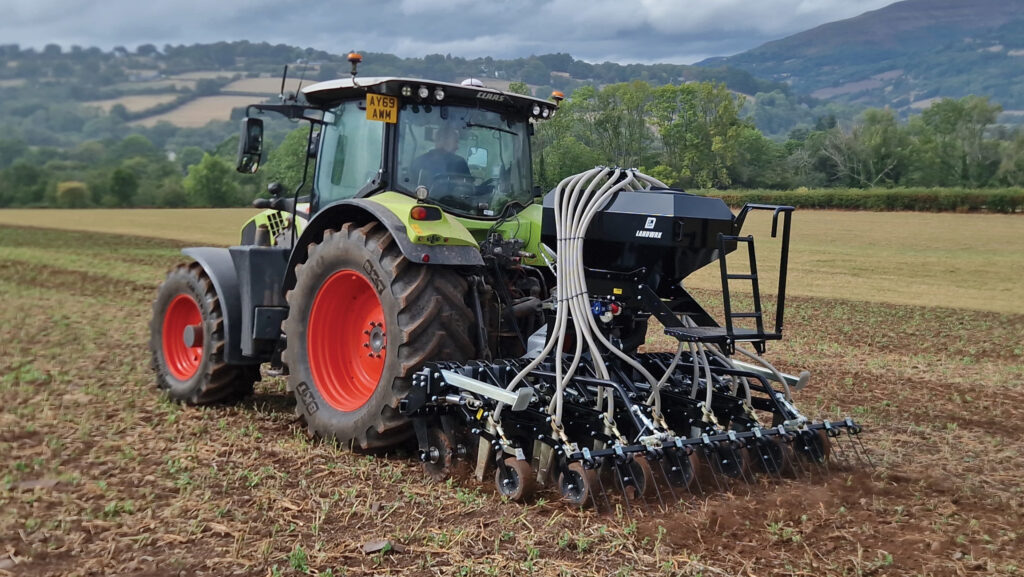 Landwrx Varia 3m demo unit © Nick Fone
 A small Herefordshire firm has developed a cereal drill that can also be used as an inter-row weeder and undersowing rig.
The Landwrx Varia is the brainchild of ex-Mzuri design engineer Tom Land and, as the name suggests, it’s capable of working at variable row spacings for maximum versatility.
Almost a decade ago, he saw an opening for a purpose-made seeder specifically for sowing grass between rows of established maize.
At the time, water authorities around the UK were promoting the practice as a means of limiting soil erosion and nutrient run-off into watercourses, and there were very few implements on the market capable of doing the job.
See also: High-end bespoke builds put Grizzly Trailers on the map
Landwrx Varia Direct Seeder
- Working width 3m and 6m
- Row spacing Variable from 200mm
- Coulters Choice of 15mm knife points, 75mm and 100mm Bourgault or Metcalfe openers, 50mm sub-surface soil looseners, 160mm weeding shares and 380mm diameter double-disc openers
- Hopper capacity 550, 1,500 or 2,000 litres
- Metering Either Accord or Horizon
- Rate controllers RDS Artemis with GPS speed sensor and isobus option
- Power requirement 100hp for 3m, 150hp for 6m
- Base list prices 3m from £24,000, 6m from £46,000
“Here in the Wye and Usk river catchments there was a big push to get cover crops established in maize to avoid leaving bare ground over winter,” explains Tom.
“That led me to build a 6m drill with proper knife-coulters running between each row of maize to lay seed where it needed to be – not too close to the crop to compete with it but wide enough to provide good coverage once the maize was off.”
Those first Landwrx Inter Seeders quickly found favour with water authorities, maize growers and contractors, who liked the way the coulters placed seed into a tilth rather than simply broadcasting it onto the surface.
But there was a problem: like any tailor-made tool with just one job to do, its abilities were limited, not least because the undersowing window is so tight.
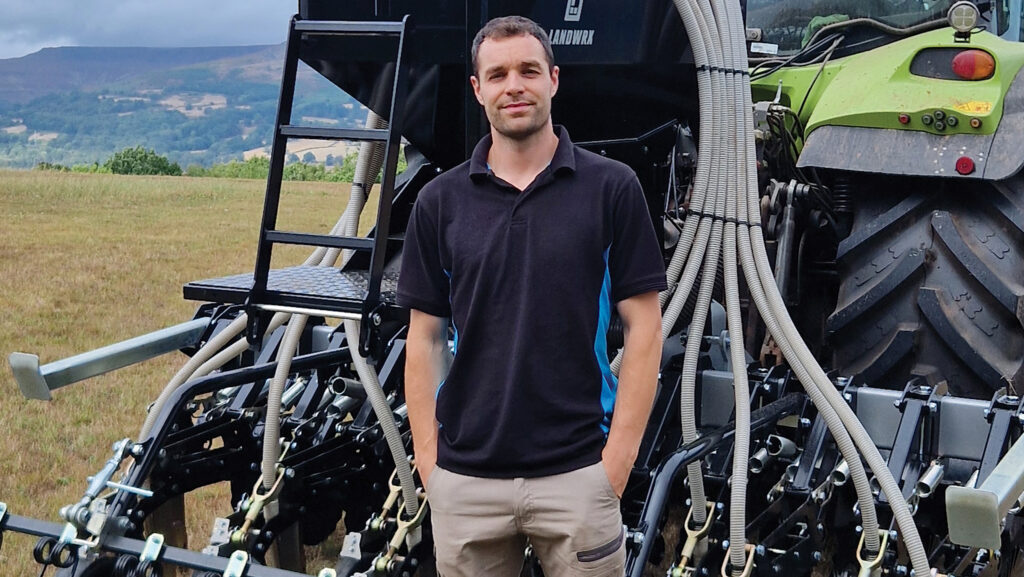
Tom Land © Nick Fone
It can’t be done too early before the maize is properly established, or too late when the crop is tall and susceptible to damage from field traffic.
“The drill itself was a real success, but being fitted with a proper hopper, metering system, toolbar and coulters meant it wasn’t cheap,” says Tom.
“With a realistic working window of two to three weeks, it needed to be worked hard to cover a decent amount of ground and justify the investment.
“I was very aware that it could be viewed as something of a one-trick pony.”
Drill redesign
He already had customers using the Inter Seeder to establish oilseed rape and even cereals directly into stubbles.
This got Tom thinking potential redesigns that would broaden the drill’s appeal.
“Being able to shimmy the coulters along the box-section toolbar to even up row spacings was good, but we couldn’t achieve truly uniform coverage because there were brackets, braces and gussets in the way,” he says.
“I could see that if I wanted to make a more mainstream drill that was still capable of doing the inter-row work then I’d have to return to the drawing board.”
With an engineering degree from Harper Adams, and several years on the design team at Mzuri, he was well experienced in the dark arts of CAD drawing that helped turn that original concept into something more versatile.
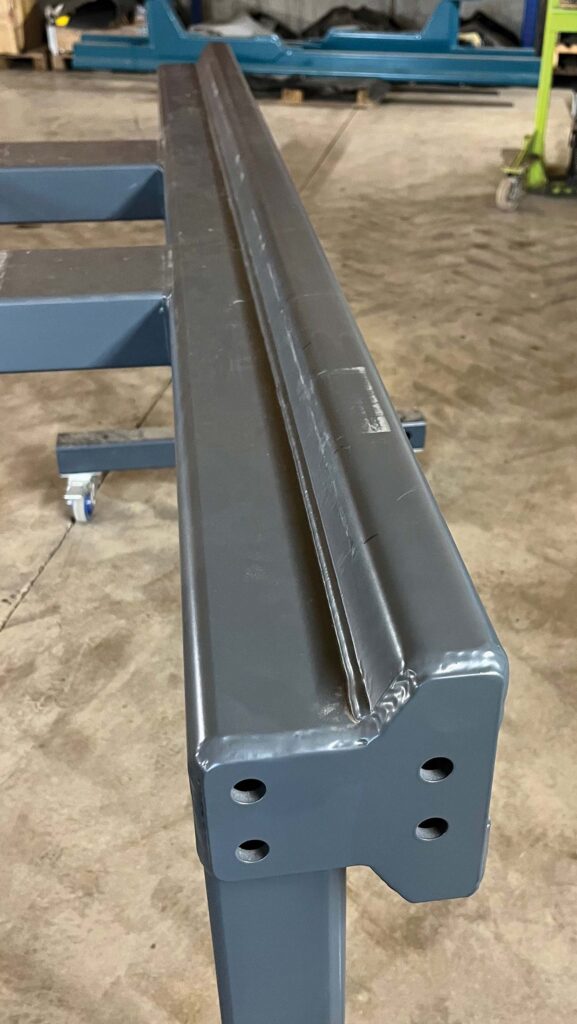
T-profile toolbar forms the backbone of the Varia © Nick Fone
The backbone of the new Varia design is a 6m folding toolbar that, being T-shaped in profile, is strong enough to withstand the forces exerted on it from up to 24 clamped-on coulter units.
This is free of reinforcing metalwork, leaving the whole length uninterrupted so that the seeder outlets can be positioned in any number of formats, whether evenly spaced for broadacre crops or pushed together in threes in inter-row guise.
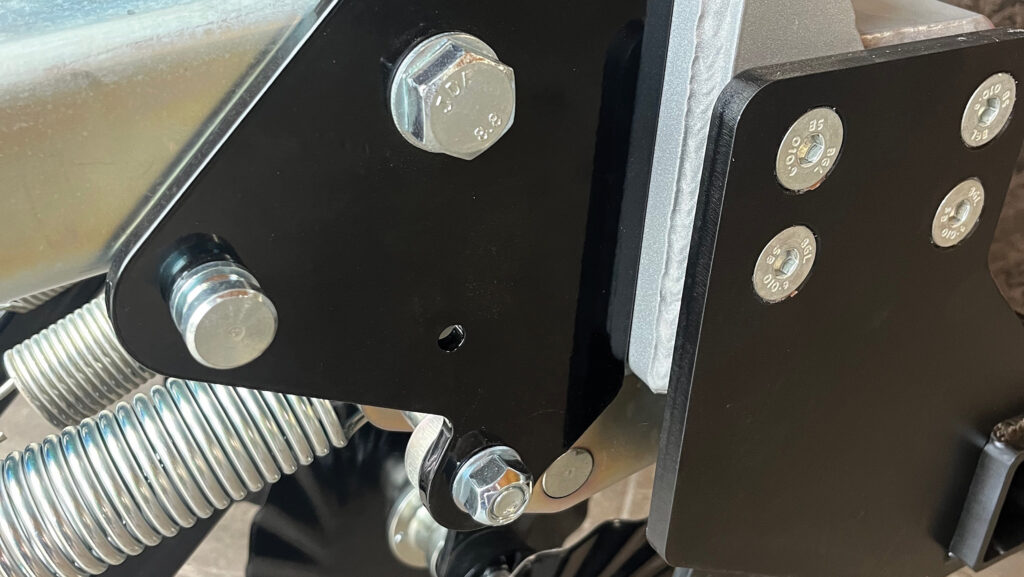
Hefty clamps secure the coulter carriages to the T-profile toolbar © Nick Fone
Key to this are cleverly designed clamps that are each tightened and locked in place by a single hefty M20 bolt.
Simply whip out the windy gun to slacken them off, shift the coulter to the right spot and rattle them back up.
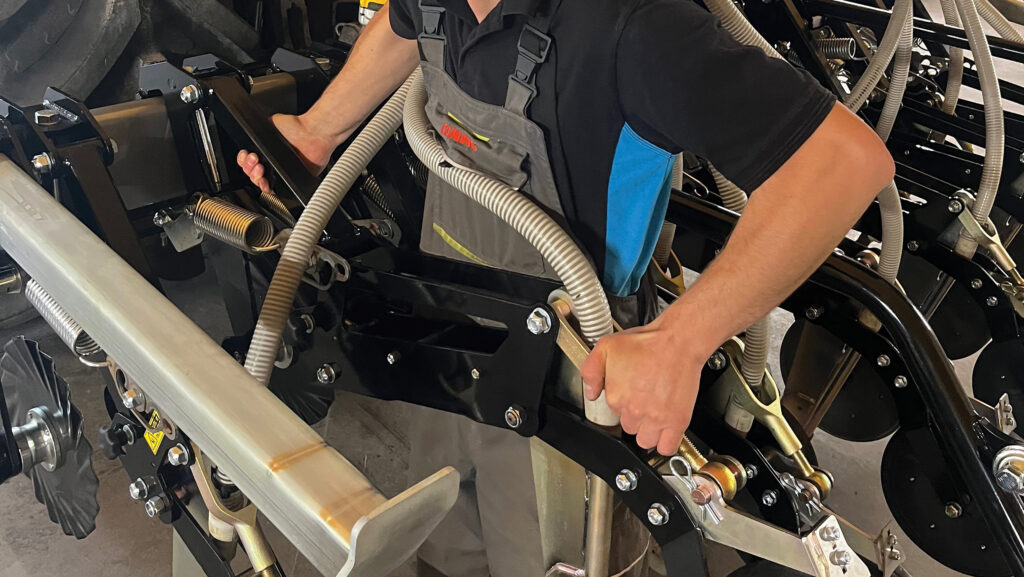
With a single M20 securing bolt loosened off, individual coulter carriages can be repositioned at different row spacings along the toolbar © Nick Fone
The new format includes a leading row of wavy discs running ahead of the coulters to cut through surface trash and minimise disturbance.
These can also be positioned to match the variable row spacings, reversed to generate more soil movement or removed when drilling into tall standing crops.
Independent linkages
Under-frame clearance is a critical feature for inter-row weeders and seeders and this has been retained on the Varia, thanks to long-travel coulter carriages capable of dropping down into hollows and riding up over bumps without skipping out of the ground.
“With the original Inter Seeder I went with a parallelogram linkage because it rises and falls vertically rather than in an arc like a swing arm.
“This means tip angle is maintained and seed is always planted at the preset depth no matter where the carriage is in its range of travel,” explains Tom.
“Having individual coulters carried on their own independent linkages was the right way to go, but the way it maintains downforce has totally changed.
“Originally I used hydraulic rams all plumbed together with a feed from the tractor to maintain pressure in the circuit.”
Though it seemed clever, this arrangement was actually very slow to respond, so the latest version runs with pairs of simple coil springs.
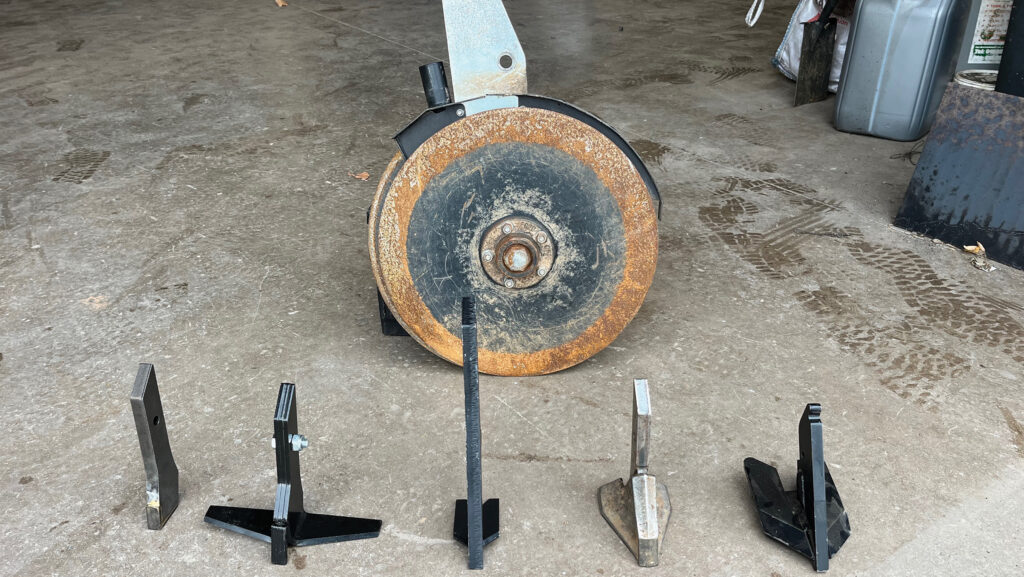
Wide range of coulter choices including double-disc openers and mini sub-soiler legs © Nick Fone
“Not only is it far cheaper, it also responds more rapidly and the oil flow requirement from the tractor is minimised which has a surprising impact on fuel use.”
While coulter depth is adjusted with turnbuckles linked to the individual rubber press wheels at the rear of each parallelogram frame, the pairs of coil springs up front have six different positions to enable between 30kg and 120kg of additional downforce to be exerted on the coulters.
And the same principle applies to the following harrow frame. Its resistance to lift is adjusted by two simple cam-blocks, their position dictating the tine downforce while a pair of turnbuckles varies the pitch.
There’s also a heap of coulter options, including low-disturbance knife points, versions with wings to alleviate sub-surface compaction, double disc openers and band coulters from both Bourgault and JJ Metcalfe.
In addition, 160mm-wide shares can be employed for weeding while undersowing grass and clovers into cereals.
Landwrx expansion
After leaving Mzuri in 2018 and starting his own machinery manufacturing venture, Tom Land’s first project was a subsoiler – and the design has hardly changed since.
“I knew there was a demand out there for robust, well-built kit so I didn’t skimp on anything.
“All my subsoilers have hydraulic auto-reset and the frame dimensions are such that I don’t expect ever to see them come back for repairs,” he says.
“But I felt I could do more – hence the journey with the Inter Seeder and the Varia.
“While the products that I’m building have evolved over time, there have been certain key catalysts along the way, such as seeing the Inter Seeder being used to undersow oats in maize.
“That made me realise that it could do more jobs than just apply small seeds.”
This proved the trigger for the development of a machine with variable row spacing.
Although the initial concept was viewed as a small seed drill, it led to the Varia and its ability to plant mainstream arable crops and weed between rows.
The big change came in moving from the family farm’s workshop to a dedicated manufacturing facility.
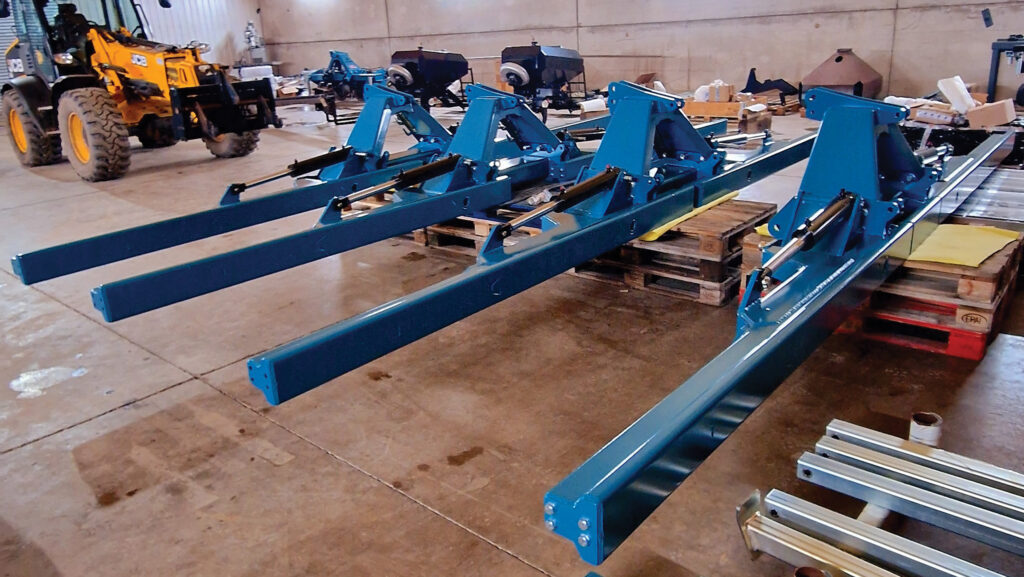
The move to a redundant insulated potato store has revolutionised fabrication and assembly operations, as has the welding robot © Nick Fone
A clean, dry, insulated shed provided the opportunity to invest in better equipment, most notably a welding robot.
“I spotted an auction of kit that had come out of a factory that had been making stuff for Jaguar Land Rover.
“I took a bit of a punt and put in a low bid on a 15-year-old welding robot and I got it.”
Although laborious to programme at first, it’s been a game-changer and, provided it’s kept fed with parts, it will work away doing the same job over and over again without complaint.
“You can see the effect it has had on the finished product – when you look along the drill toolbar, every coulter carriage is aligned perfectly.
“If you were doing the welding by hand that just wouldn’t be possible,” says Tom.
“It’s meant I’m doing less of the actual fabrication myself so I can concentrate on improving existing machines and developing new products. There are already a few in the pipeline…”