

On test: Kverneland B-series gets tougher shear-bolt leg assembly
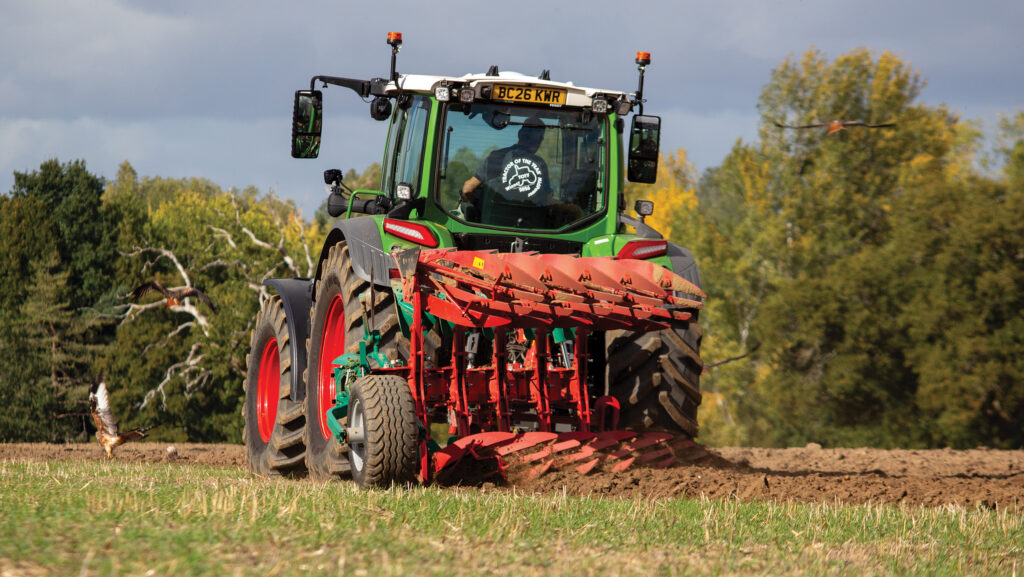 © MAG/Oliver Mark
Say what you like about the merits of the maligned plough, but nothing puts the wreckage of a rubbish season to bed quite like it.
To bury the misery of a second sub-par campaign in succession, we tooled up with Kverneland’s recently updated B-series model. And it had to stick some abuse on furnace-dried October ground.
See also: First impressions: Kuhn Multi-Master L six-furrow plough
A good job, then, that these latest 2300s have been beefed up with a new shear-bolt assembly that has a 500kg higher point load than before. Despite Mother Nature’s efforts, we simply couldn’t breach its 5t limit.
This so-called “sharp shear system” sandwiches the solid leg – hollow, “aero-profile” versions are reserved for the S-series – between steel plates. These are held in place by a precision-engineered bolt.
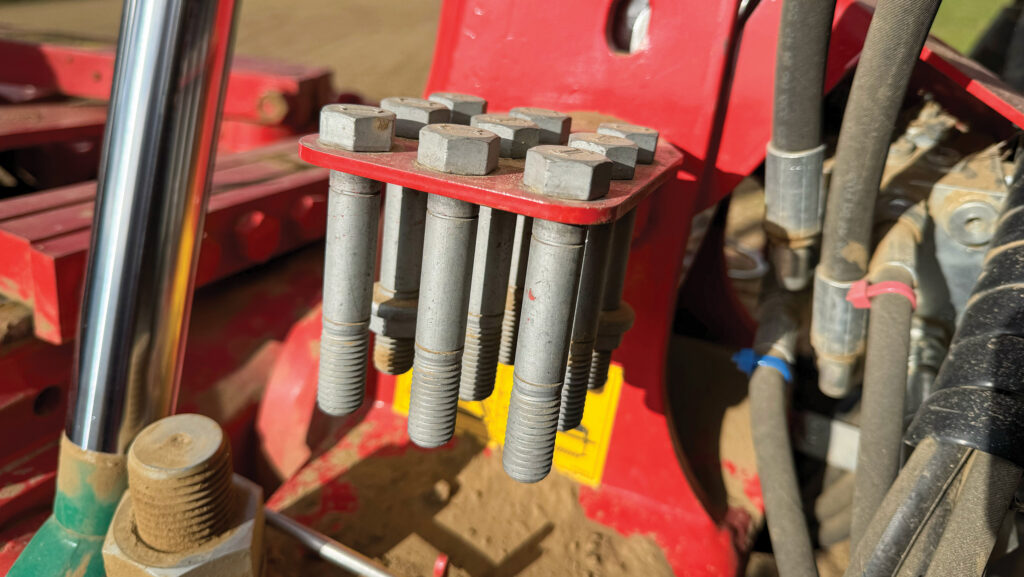
Headstock storage for the newly designed shear-bolts © MAG/Oliver Mark
Hit the body with what we found to be unmusterable force and the two shallow-groove rings along its shear line will, apparently, deliver the sort of crisp snap you get from a bar of fridge-chilled Cadbury’s.
The central section is chopped out as the leg pivots, virtually eliminating any risk of the bolt stretching, twisting and jamming, as occasionally happened with the previous design – a scenario that could cause the leg to deform. It also makes it much easier to replace once severed.
Tale of the tape
The three- to five-furrow (officially a four-plus-one, with plates covering the beam joint) 2300 Bs prop up Kverneland’s reversible plough range.
These come with a choice of 85cm (as seen here) or 100cm point-to-point spacings on the same 100x200mm beam as used on previous generations, with an ample 80cm of clearance underneath.
Up front there’s a 250hp-rated No200 headstock and, out back, a 450mm disc to carve a clean furrow wall. The five-body weighs 1,490kg; required tractor lift capacity is 4,800kg.
Above this range sits the four- to six-body 3300 Bs, rated to 330hp and restricted to in-furrow use.
Then come the five-, six- and seven-furrow versions of the 3400 B, which are reinforced to handle 380hp and can also be operated on-land.
Slat-tastic
The base specification – hydraulic depth wheel excluded – is pretty generous, but one option worth mulling is the firm’s No40 slats.
These bodies are equivalent to the No38 mouldboards, so can just about handle 710mm tyres and will work up to 90mm (3.5in) deeper than a common No28 for Italian-style soil inversion. Those hunting for lava can push it to a maximum depth of 400mm (15.5in).
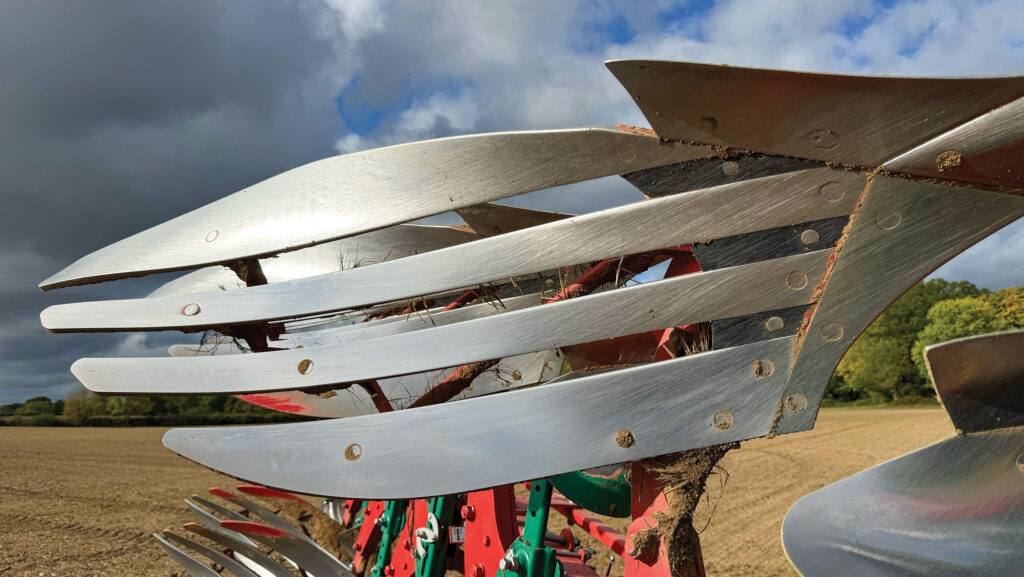
Kverneland’s deep No40 slats are proving popular © MAG/Oliver Mark
Once the preserve of those perennially slithering their way over sticky ground, they’re surprisingly versatile, too.
Though they appear oddly exposed when running at 200mm (8in), they have no problem turning the land over.
This is partly the result of an unusually narrow saddle. It is the only plough of its ilk on the market – from KV or its competition – with a 38deg angle between the landside and body.
That’s the same as full mouldboards and well down on the typical 45deg of a slatted setup.
The twisting action comes from the shape of the body rather than said angle and, consequently, it makes the plough easier to pull than conventional slats.
This motion both crumbles the soil – one of the perks of slatted bodies – and firms it down. Most others struggle in this regard and tend to leave the soil fairly loose.
Skimmer adjustment
One of Kverneland’s stand-out features, especially on these lower-spec ploughs, is the novel 4P (… for “position”) skimmer adjustment system that allows them to be tuned to suit ground conditions, residue volume and forward speed.
The first of these is depth, altered centrally by loosening the clamping bolt on each leg and then moving the left and right pair up or down simultaneously via a nifty mechanism in the middle.
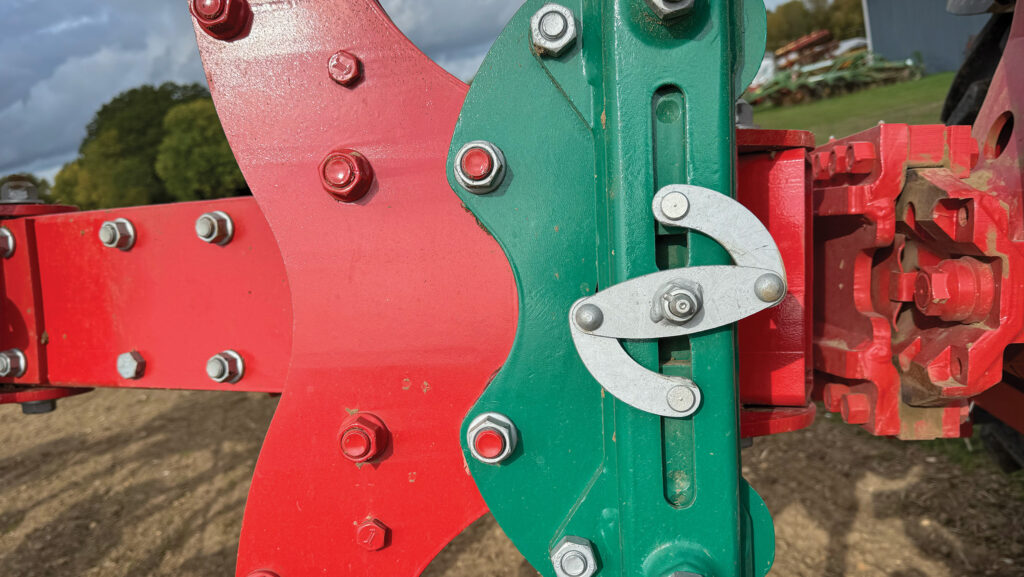
Centralised skimmer depth adjustment © MAG/Oliver Mark
Once set, the bolts are pinched tightly into their corresponding detents. No hole-and-pin rattles here.
They can also be moved forwards or backwards to suit the intended forward speed, with the three positions determining where surface material is flung into the furrow.
Widening the gap gives trash a whisker longer to land in the gutter.
There are a further three pitch settings, altered by turning and reinserting one of two eccentric bolt heads that join the leg to the skimmer body.
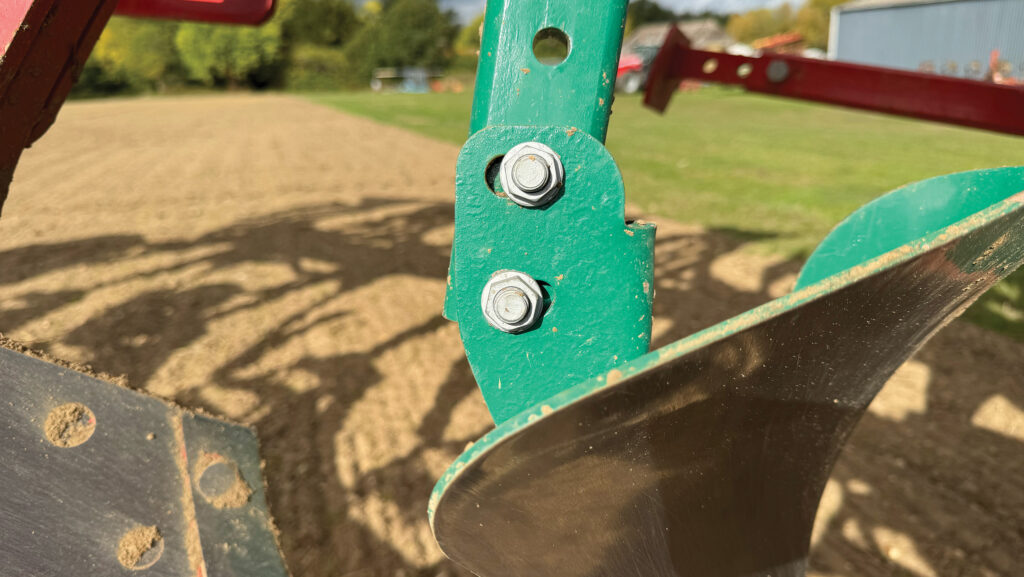
Two bolts for altering the pitch © MAG/Oliver Mark
Depending on their orientation, these locate into a slightly different position in the elongated slot.
The central position seemed a reliable setup – one that few will find a reason to change.
But angling it gently forward (lower bolt) engages more of the share with the soil for a gentler flow; pivoting it back towards the plough body (upper bolt) brings the front of the skimmer close to the landside knife, thereby reducing the risk of stones jamming.
And that’s not all. The final piece of the four-dimensional puzzle is a plate that can be positioned on the inside of the main beam bracket.
This moves the skimmer closer to the unploughed land to stop surface residue evading turnover and remaining on the surface.
Depth wheel
As mentioned, the sole optional extra on this 2300 is a hydraulic depth wheel that can be controlled from the cab.
This comes with a “memory cylinder” that is locked at the desired ploughing depth via taps on the main beam, much like fitting ram collars.
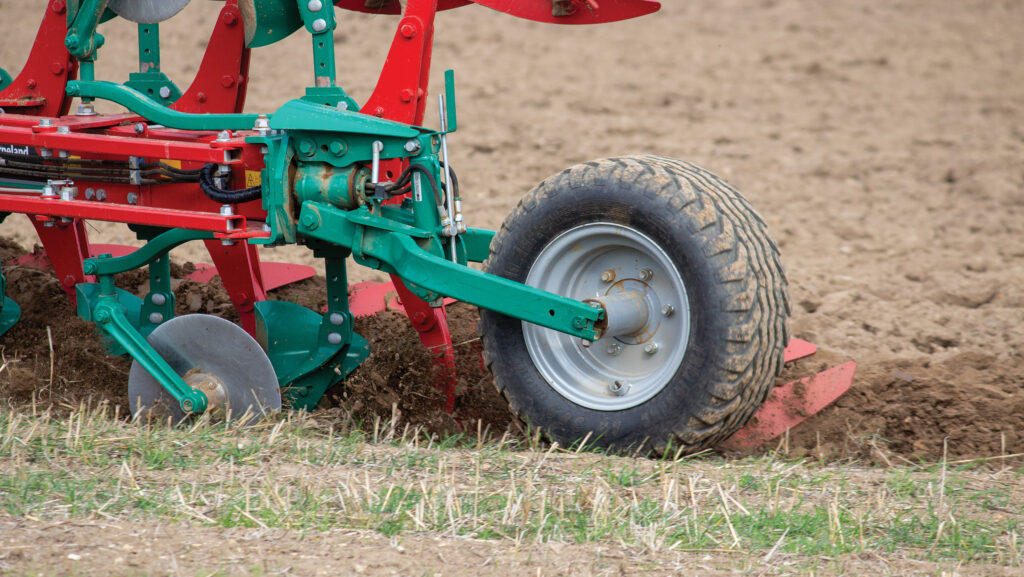
Hydraulic depth wheel is a £2,300 option © MAG/Oliver Mark
If the depth is altered during a bout, it will return to its set position post-turnover. It is particularly handy on the last headland run, especially when turning furrows hedgewards, as the back of the plough can be lifted to avoid leaving a nasty trench for the rest of the year.
It can also be used to hold the rear bodies out of the ground at the start of a run before easing them in, thus leaving a squarer entry and reducing dinghy-in-a-storm choppiness on the final headland laps.
Buyers that initially baulk at the cost but then change their minds can retrofit the hydraulic system. It’s not something KV promotes but, as the wheel frame is identical in both formats, it can be bolted in place of the conventional turnbuckle assembly.
The downside is that it needs a double-acting hydraulic service – along with the front furrow width, vari-width, turnover mechanism and, if you’ve got one, a powered top link.
Easy maintenance
Apart from the fact that the uppermost elongated top link slot can be a finger-crushingly tight fit with a heavy top link, general operation and maintenance is a doddle.
For one, the pipes have colour-coded handles – and a sticker to remind operators of what’s what – putting an end to strategically positioned cable ties.
Given that there are eight to plumb in, this labelling gives half a chance of locating them in the desired valve; the only challenge is fitting their wider plastic bodies inside the tractor’s spool covers. There’s also a neat rack on the headstock to store them.
On the other side of the main frame is a cream-cracker-sized square that looks as if it has come off second best against a 12.7mm-calibre M2 Browning.
The nine bullet holes form handy shear-bolt storage, saving them from rattling around the cab floor or laying wet in an external toolbox.
And there’s similarly useful storage for the spanners and chisel – the latter required to replace the single-ended, quick-fit points.
Though they’re not reversible, the left and right points can be swapped so both sides wear thoroughly before replacement.
These are gloriously easy to change, with all 10 doable in about five minutes. However, restraint with the hammer is recommended, given one thwack can send a kilo of solid metal flying towards the back window of the tractor. Replacements cost £15.98 apiece – for the points, that is…
Farmers Weekly verdict
A quality plough with the ideal combination of features: vari-width, abundant skimmer adjustment and quick-fit points.
The No40 bodies are certainly worth considering too, even if you haven’t previously contemplated slats. The hydraulic depth wheel is a useful but not essential addition.
Kverneland 2300 B as tested
- Bodies Five (four-plus-one configuration)
- Protection Shear-bolts
- Point-to-point clearance 85cm
- Furrow width 30-55cm
- Underbeam clearance 80cm
- Weight 1,490kg
- Lift requirement 4,800kg
- List price as tested £44,343
- Notable options Hydraulic depth wheel – £2,300