

Scania forage truck proves good value for Hants contractor
 © MAG/Oliver Mark
 Hundreds of German contractors consider field-going haulage trucks the perfect foil for maize-munching foragers.
These rough terrain HGVs are yet to gain the same following here, but with an ever-growing number of anaerobic digester (AD) plants eating and excreting huge volumes of material, big contracting outfits are beginning to take notice.
Should they choose to pull the trigger, two UK-based companies are waiting in line with suitable machines.
One is County Armagh-based NC Engineering, which used June’s Highland Show to debut its Volvo FM410 with a 2250-18 trailer body grafted in place of the original cement mixer.
See also: Tractor-mounted pick-up slashes forage wagon chop length
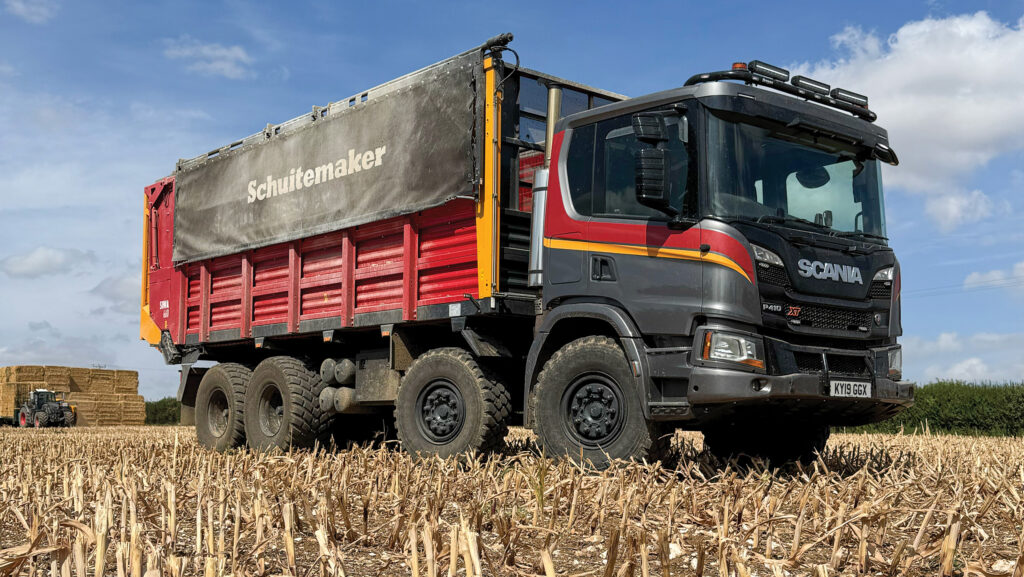
And at Lamma, Agri Industry Solutions (AIS) of Ipswich caused a stir with its Scania-Schuitemaker combination.
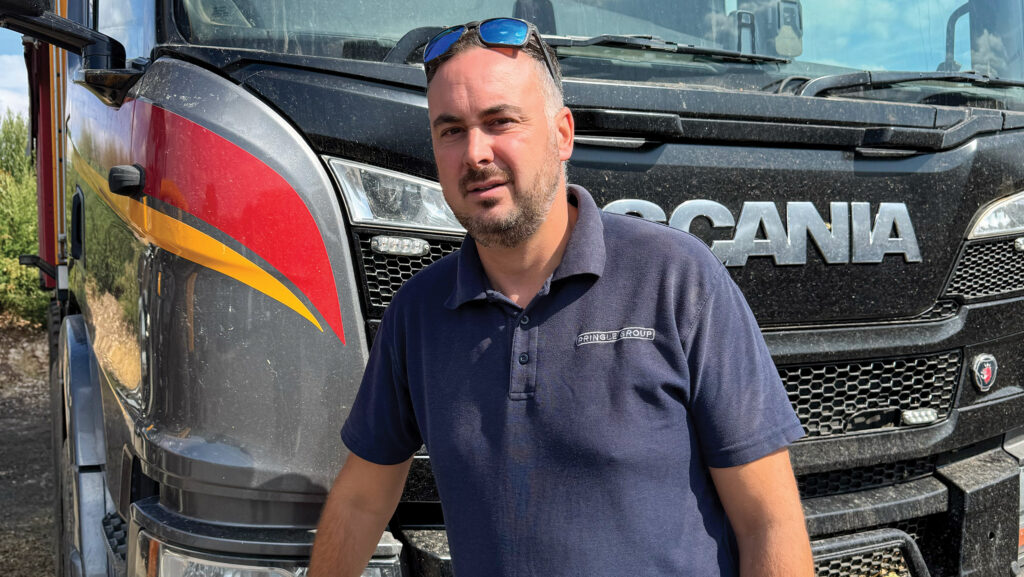
This has since been in the hands of Seth Cowie’s Pringle Group, which has branched into agricultural contracting over the past 18 months.
The firm already has 23 Scania eight-wheel tippers on the books for its primary enterprise – a hardcore crushing and screening operation – and took the AIS demo for its wholecrop campaign.
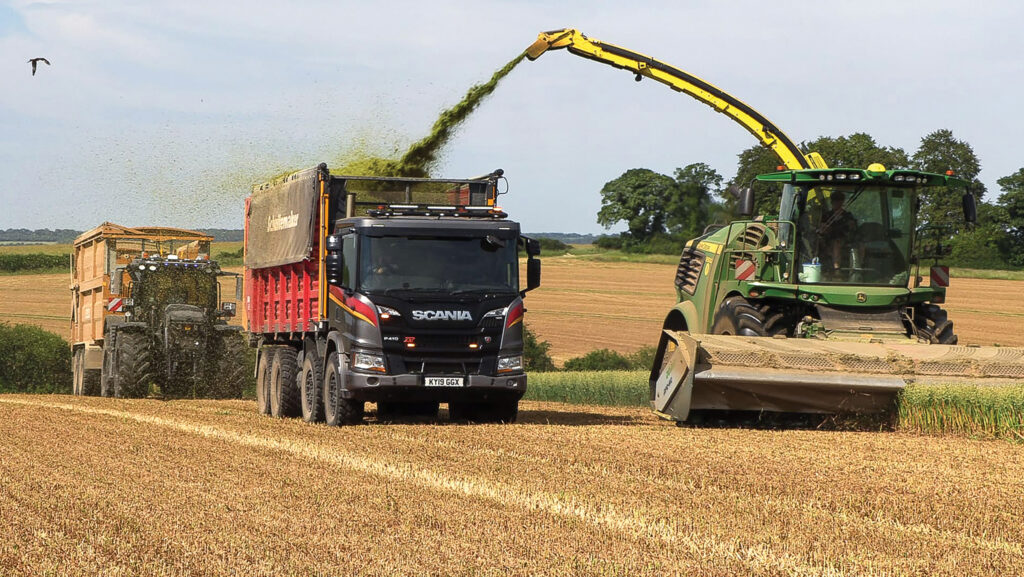
The concept proved so successful that Seth then hired it back again for what turned out to be a flash-in-the-pan maize harvest, hauling for nearby Acorn Energy.
Seth Cowie © MAG/Oliver Mark
About the business
Waste removal and recycling remain the centrepiece of Seth Cowie’s Winchester-based Pringle Group. Having started out in 2019 with a single grab, he now runs an extensive crushing and screening operation that supplies up to 75,000t of aggregates, topsoil and woodchip annually.
Ag contracting is a relatively new venture. Last year, the business supplied and spread 28,500t of lime from its own quarry to farms in Hampshire, Wiltshire, Oxfordshire and Sussex.
Alongside the AgriSpread and KRM spreaders, it has a Bunning Lowlander 175 muckspreader with weigh-cells and variable-rate capacity for its compost and chicken muck supply-and-apply service.
Then there is anaerobic digester maize and wholecrop haulage, for which most equipment is hired in from Lincolnshire firm GCS.
What is it?
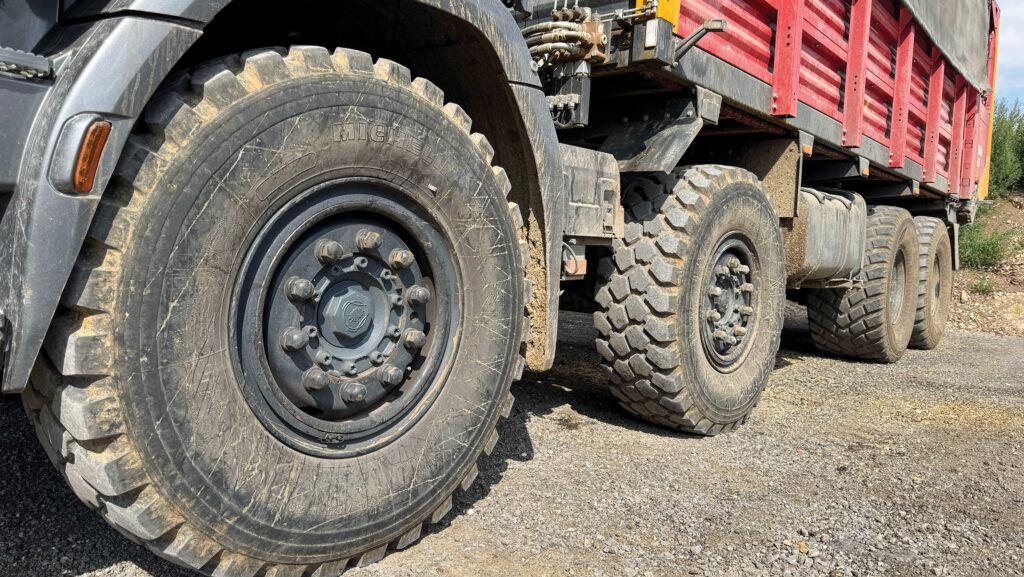
Like others of this genre, the version proffered by AIS is based on a second-hand eight-wheel tipper – in this instance, Scania’s P410 XT. It runs a 410hp straight-six engine and 12-speed automatic transmission, with fat, military-grade tyres fitted to the pair of rear driven axles and narrower, taller fitments to the two that steer up front.
Conversions are completed by Hertfordshire contractor and fabricator Joe Williams through his JW Fabrications business. He also runs one of these Scanias for forage operations, alongside a similar Volvo and an articulated HGV and trailer.
The mechanical metamorphosis that takes it from tipper to carter is relatively simple. It starts with shifting the 250-litre fuel tank to accommodate the bigger Michelin XZL 395/85 R20 front tyres and fitting a hydraulic pump downstream of the engine-driven pto pack.
This runs the forage box bed chains, door and sheet cover, which can be controlled from the cab or via a manual valve bank outside.
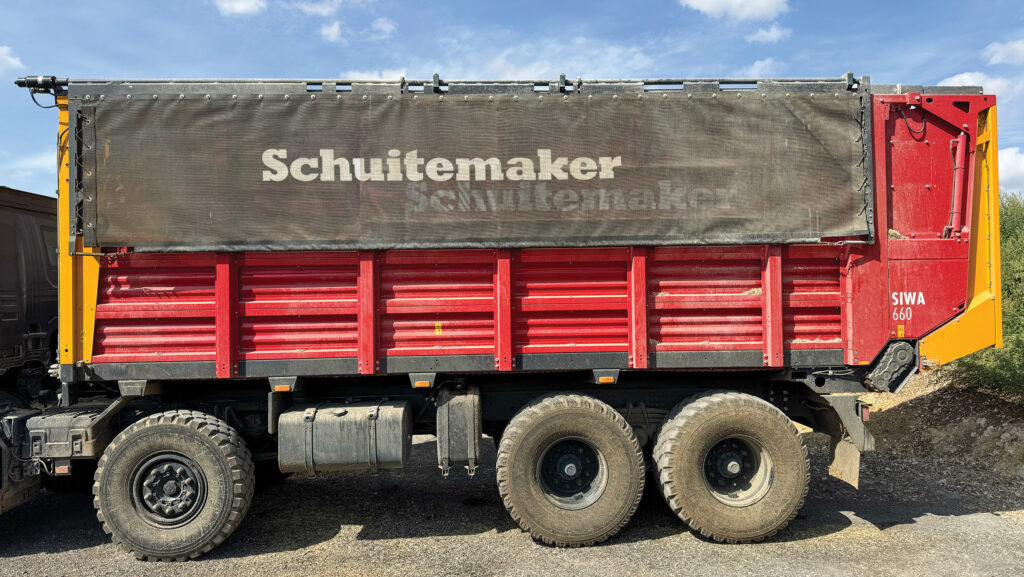
The body – a 38cu m Schuitemaker Siwa 660 with 210mm chain-and-slat walking floor – is bolted to the chassis via a box-section sub-frame.
Arguably the more arduous work is in registering it for full agricultural use, but it brings significant rewards.
Once officially converted, the AdBlue system can be removed – cue cheers from all and sundry – and it can be driven on a car licence, without a tachograph, and on red diesel.
Scania-Schuitemaker forage truck
- Tractor unit Scania P410 XT eight-wheel tipper conversion
- Engine 410hp Scania straight-six
- Transmission 12-speed automatic
- Top speed 75kph (can be increased)
- Tyres MRL FLR 333 560/60 R22.5 rear, Michelin XZL 395/85 R20 front
- Body Schuitemaker Siwa 660
- Unloading Chain-and-slat bed
- Price £140,000 (for demo example on 380,000km)
© MAG/Oliver Mark
Why get it?
Without the necessary workload or diversity of services, forage trucks are hard to justify when compared to the versatility of a tractor. But for grass, maize and sugar beet contractors ferrying AD feedstock and waste, the figures may well stack up – as Seth has found.
Since entering the farming world at the start of 2025, he has been running a gang of predominantly hired-in tractors and trailers.
Last year, they helped shift 25,000t of wholecrop and maize on sub-contract for Houghton Farming.
Having double-demoed the machine this season, he now intends to make something of its ilk a permanent fixture in the fleet – primarily because of the cost of ownership.
© MAG/Oliver Mark
“You’d be looking at £200,000 for a tractor and £35,000 for a trailer, or £140,000 for the converted Scania truck and body.” And pitting new against second-hand is fair game, he says.
“The 19-plate demo model might have clocked 380,000km, but these trucks are built for longevity. We have several that have done over one million kilometres, so we’d still expect to get a minimum of 10 years’ work out of it.”
Beyond the initial investment, owners should enjoy cheaper clock hours, and far lower fuel consumption.
While Pringle’s tractors might slug 150-200 litres/day, the Scania rarely breaches the 100-litre mark, making for significant savings over the course of a season.
It will also do 75kph – a restriction imposed for road safety rather than law – at 1,400rpm and, on typical hauls of up to 10 miles, Seth says it regularly laps the tractors.
“As a single unit it’s far more manoeuvrable and easier to operate, and it’s built for the road, with commercial running gear and brakes,” he adds.
Another critical factor for those keen to stay squeaky clean is the truck’s modest 14.5t tare weight, compared with the 18.8t of a John Deere 7290 and Richard Western 16-tonner.
This means it can carry 17.5t and stay within the 32t limit for an eight-wheel tipper – offering a major efficiency gain when hauling compost or similar products on a per-tonne basis.
© MAG/Oliver Mark
How has it performed?
Given it was invited back for a second visit, it’s no surprise that Seth is sold on the concept. “It goes like a rocket,” he says.
“We haven’t tested it in the wet, but I think it would be fine – the engine keeps the weight on the steering front wheels, and there is a diff lock for the driven rears so, unlike a trailer, it won’t turn into a sledge.”
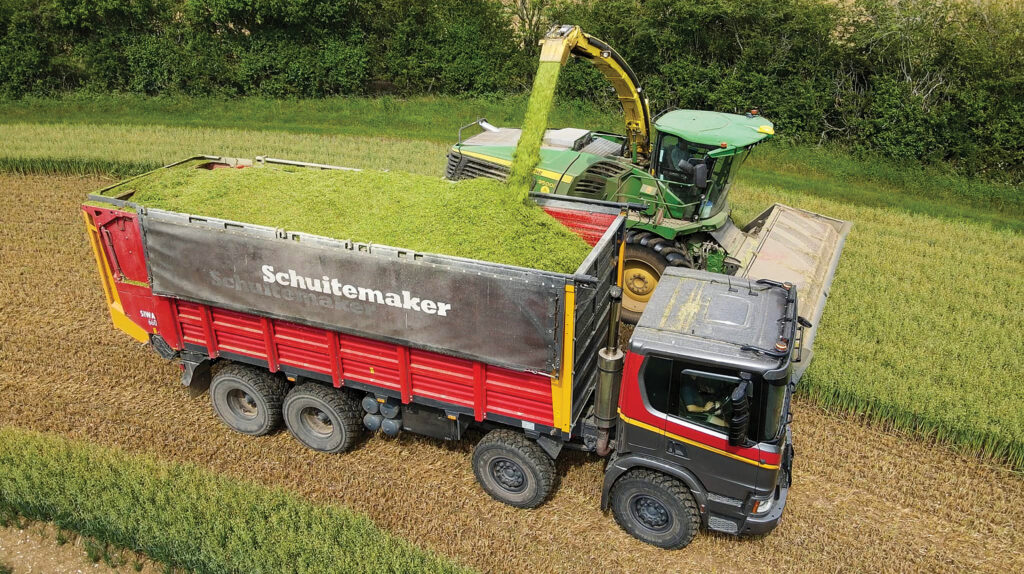
The mounted configuration is also far shorter than a tractor-trailer combination, making it easier to blow crop in when opening a field, and the chain-and-slat system makes it safer than tipping – and no slower.
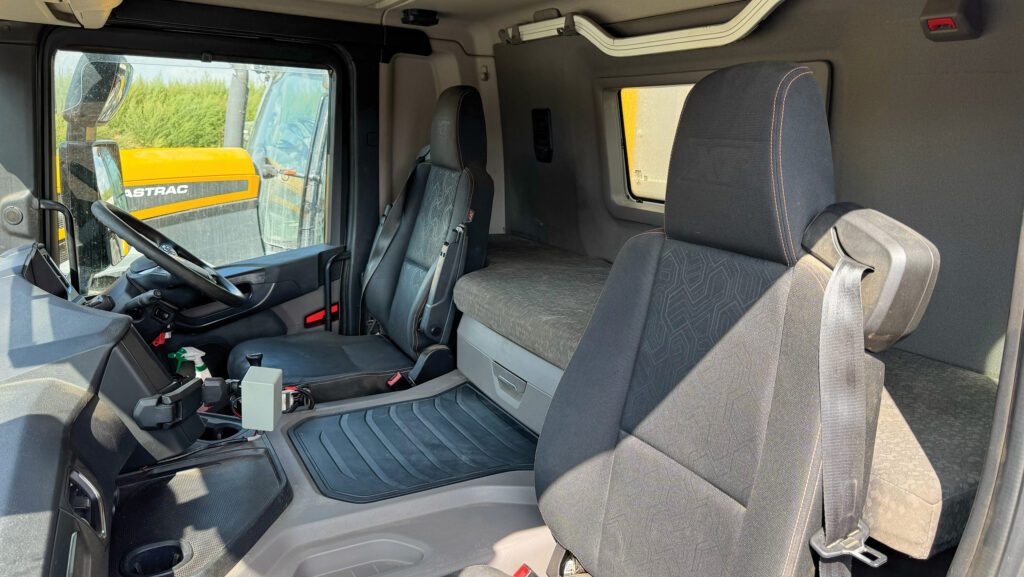
Then there are the creature comforts of the cab. For starters, air-cushioned seats, electric windows and an easy, low-effort driving experience that reduces operator fatigue. And, when it all gets too much, there’s a bed and night heater – ideal for a catnap when working away.
© MAG/Oliver Mark
However, trucks do come with strings attached, not least the requirement for a six-weekly inspection, at a cost of £250 a time.
“It’s not just a farm tractor and there are responsibilities that need to be respected,” adds Seth, who is installing his own HGV-friendly workshop complete with post lifts and a rolling road.
“But if you know what you’re doing, they’re easier to repair than tractors, and the parts are generally cheaper.”
So, will he buy it? “If we’d had three weeks of maize harvesting, rather than six days, then I would have already done the deal.
And for anyone with a long-term contract with an AD plant, I think it’s a no-brainer – I’d have five of these rather than eight tractors and trailers for hauling feedstock in and solid digestate away,” he says.
There’s also the option of pairing them with a field loader, as Joe Williams has done in Hertfordshire with his in-house-built conveyor.
For forage crops, this can be parked on the edge of the field, leaving the truck to shuttle between chopper and loader, and walking floor wagons to run the road routes.
AIS is now importing something similar in Perard’s Trans Express 3000, which can also be used for woodchip and vegetables.
© MAG/Oliver Mark