

Advertiser content
How to maximise straw use this winter
Straw supplies from the 2025 harvest are significantly lower because of the dry spring and summer reducing tiller numbers and causing crops to die early.
This had led to reduced bale numbers per hectare fears of a bedding shortage this winter.
For livestock producers looking to buy straw, the combination of short supplies, greater demand, and inflation, have already pushed prices high.
As some straw imports from Europe have already happened, what can farmers do to make straw go further this season? We spoke to Rhodri Jenkins at Kuhn Farm Machinery for his tips.

Rhodri Jenkins believes straw users can save up to 30% by switching from manual to mechanised straw spreading
He started by saying, for farmers still adopting a manual bedding approach, there’s an immediate win from switching to mechanised bedding, with effective straw shredders offering the potential for savings of up to 30% in usage rates.
However, he says the choice of machine, whether new or second hand, should be important.
“Versatility should be a primary consideration, so having a machine that is capable of feeding silage as well as chopping straw for bedding, such as the Profile Plus models, could be the way to go,” says Rhodri.
“It may also be that farmers are forced into using some lesser quality material this winter, given the predicted scarcity, so a well-built machine that is engineered to handle all types of fodder and straw may well be an advantage.”
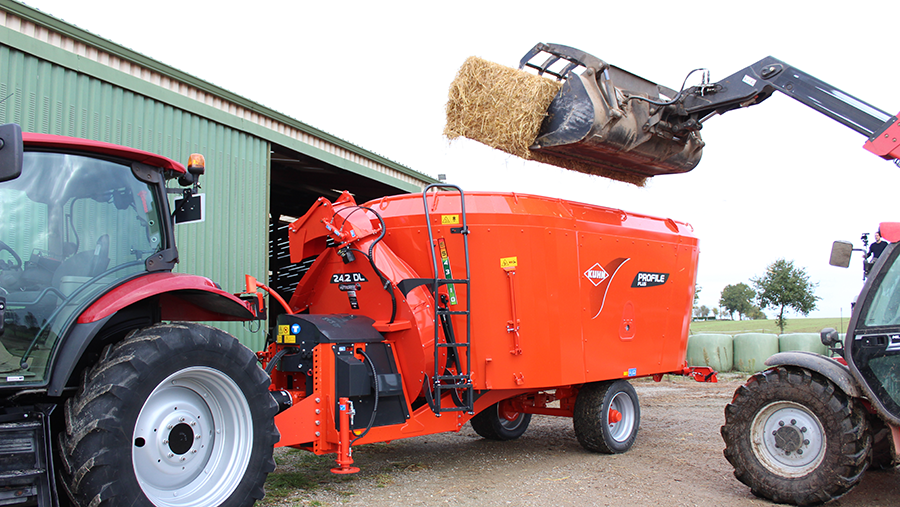
KUHN’s Profile Plus models can perform both feeding and bedding roles.
Effective spread
Maximising straw use means achieving an even spread of material and accessing the furthest reaches of the shed, and avoiding large piles forming in the middle and creating wastage.
Rhodri says the flexibility of spread direction is as important as the quoted distance.
“A swivelling chute, capable of accessing both sides of the machine and reaching the corners, is as important as the overall range and can be advantageous when bedding cubicles as well as straw yards.”
KUHN’s range includes the popular Primor 3570 M, offering a 3.5m3 straw bedder and feeder, capable of holding one, 2m diameter bale, or two, 1.5m diameter bales.
Square bales up to 2.7m long can also be used in the 3570 M.
Consistent delivery of straw is essential and the Primor’s turbine has eight bolted-on blades to vary the flow rate of straw into the turbine for an even shower effect as the spout moves across the pen.
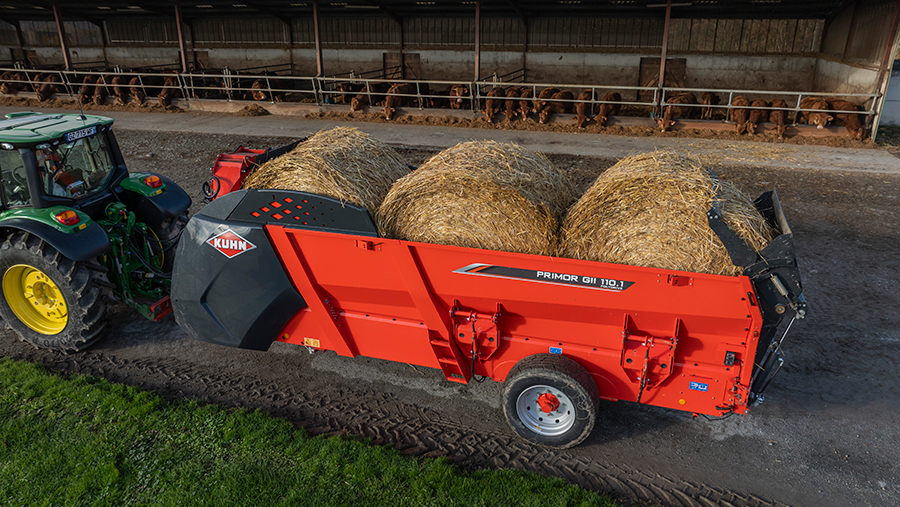
The latest KUHN Primor GII 110.1 can carry three round straw bales in one load.
Cleanstraw
Straw quality may be an issue this year as farmers are forced to use up older stock. Using matted or mouldy material can lead to problems with air quality at the time of bedding.
Kuhn’s Cleanstraw dust control system on the Primor straw bedding and feeding range can solve this problem.
Cleanstraw reduces dust in livestock buildings associated with straw bedding machines by applying a fine mist of water to straw as the straw is distributed.
The feature includes a 64-litre water tank and three misting nozzles mounted at the exit of the straw blowing chute.
The nozzles are fed by a pump, which provides water at a flow rate of 1 litre of water per 100kg of straw, without slowing the machine’s normal performance.
Applying a mist of water at this rate, and in this way, eliminates excessive levels of airborne dust by reducing the amount of time that these particles remain suspended in the air.
Trials have shown that the air in a typical livestock building will be dust-free within 30 seconds after straw-blowing with the Cleanstraw system has ceased, compared to several minutes without it.
“Reducing dust in livestock buildings not only creates a cleaner, comfortable and more productive environment for cattle, but is also far better for farm workers.
A fine mist of water as straw exits the spreading chute means very little water is required.
This not only preserves the straw’s absorbency potential, ensuring it remains an effective and hygienic bedding material, but also means the speed of operation is unaffected,” adds Rhodri.
Provided by
For nearly 200 years, KUHN has been synonymous with excellence in agriculture. Our expertise is at the heart of innovative solutions at every stage of the process. Our trademark is quality, driving innovation that improves farmers' efficiency and contributes to sustainable food production.