

JCB targets 350mph land speed record with 1,600hp Hydromax
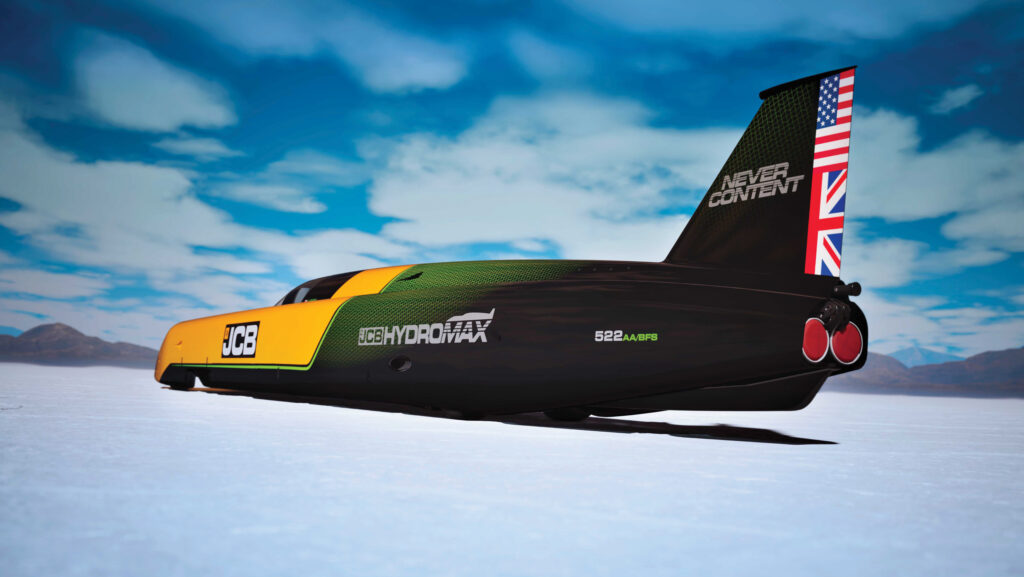 Hydromax racer © JCB
 With four-wheel drive, ultra-sleek bodywork and the best part of 1,600hp to play with, JCB engineers are pretty confident of beating the 350mph land speed world record set 20 years ago by the firm’s similarly slippery Dieselmax.
As before, there are two specially prepared JCB engines in the new hyper-tuned car – one at the back driving the rear axle and a second powering the front.
But the novelty this time is that the production-based 4.8-litre engines are fuelled by hydrogen.
See also: Video: Guy Martin smashes British tractor speed record in JCB Fastrac
JCB Hydromax
- Engine Two race-engineered JCB AB H2 448s
- Power 1,600hp combined
- Fuel Hydrogen gas
- Consumption Roughly 3kg/run
- Transmission Two six-speed sequential gearboxes
- Four-wheel drive One engine and gearbox per axle
- Chassis Tubular steel spaceframe
- Cockpit Carbon fibre tub
- Braking Parachutes and carbon wheel brakes
JCB has invested £100m to bring its AB H2 448 engine to fruition, and the new Hydromax racer has been built to emphasise that this zero CO2 tailpipe emissions fuel can generate the power and performance needed for everyday applications in a heavy, off-road vehicle such as a telescopic handler.
The first commercial hydrogen engine now being built has a modest 74hp (55kW) output and is installed in a backhoe loader unveiled as the speed record project was announced.
Comparatively, the reworked racing version puts out about 800hp (596kW).
JCB chairman Anthony Bamford said: “Britain has a proud heritage of setting speed records and, as a British company, I’m excited to challenge for a new one using hydrogen.
“This is not just about speed – it’s about showcasing the world-class engineering talent we have here in the UK and the robustness of our new hydrogen engines.
“The diesel-powered record, 350.092mph, was set exactly 20 years ago and still stands; with our hydrogen project now entering the commercial phase, we decided it was time to go again.”
That was the challenge Lord Bamford laid down in February last year, and after a period of intensive planning and seeking technical partners, the project got properly under way in June.
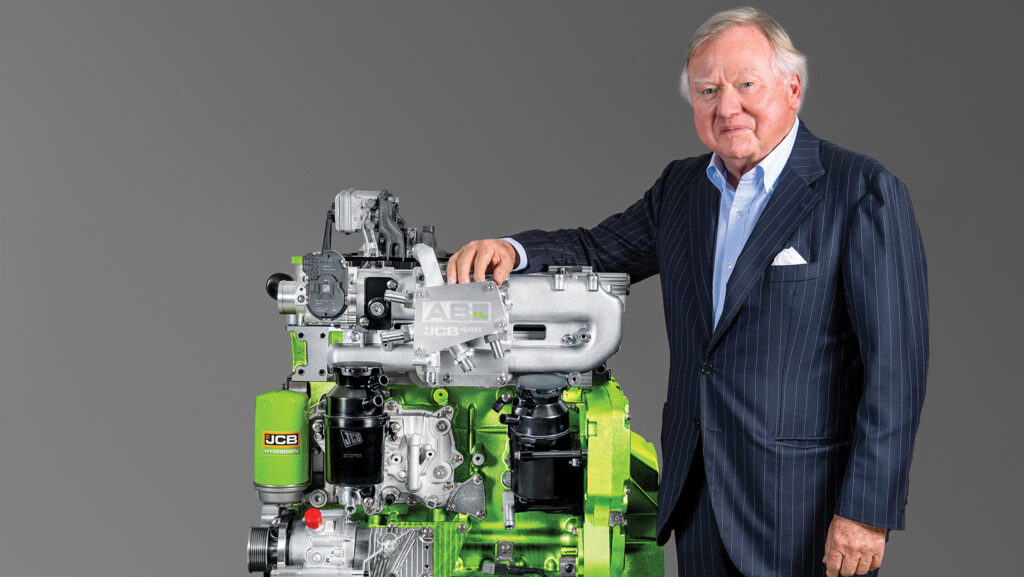
Lord Bamford with the JCB hydrogen engine © JCB
Incremental gains
While the Dieselmax provided design and performance benchmarks, every component except for the driver – former RAF Wing Commander Andy Green will be in the cockpit again – has been changed to gain incremental improvements.
The Hydromax is longer, at 9.75m, largely to accommodate the hydrogen tanks, it runs on new tyres developed by Goodyear, and has more compact but snappier six-speed sequential gearboxes.
Remarkably, the powertrain clutches (which are not used that much, it must be said) are the same as fitted to a JCB backhoe.
And, as project director Ryan Ballard recalls, JCB’s World’s Fastest Tractor project contributed lessons learned on turbocharging to inform the hydrogen engine’s needs and solutions.
All told, the Hydromax is lighter, sleeker, more efficient and more powerful than its predecessor of 20 years ago, and all the calculations show it should be faster, too.
Testing will begin in the UK in a few weeks’ time before the team, supported by motorsports specialist Prodrive and automotive engineering consultancy Ricardo, heads to the Bonneville Salt Flats in Utah for the record attempt in August.
Driver Andy enthused: “Once again, we’re going to show the world just how good British engineering and technology really is.
“This August we’re going to smash the hydrogen-powered vehicle record in the world’s fastest and most exciting zero-emissions vehicle. I can’t wait.”