

First look: Bateman revamps RB self-propelled sprayer controls
 © James Andrews
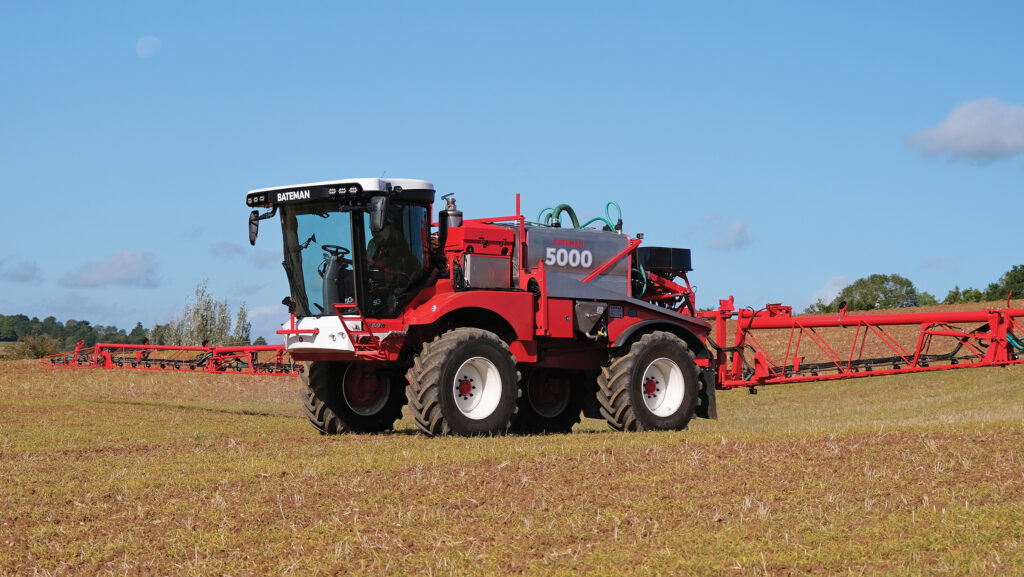
 To mark 50 years in the self-propelled sprayer game, Bateman has treated its venerable RB machines to a raft of updates.
A stronger chassis has been introduced, there’s a fancy programmable joystick, and the spray pack has been overhauled with extra features and neater plumbing.
See also: Driver’s View: Neil Hall’s Landquip InTrac 6036 trailed sprayer
Tanks have been redesigned too, the boom strengthened, and there’s a new higher-capacity, range-topping model.
This RB60 sits on a 70cm longer chassis than its siblings, which has made space for a 6,000-litre tank – the firm’s biggest yet.
All other models retain the same 3.4m wheelbase, with tank sizes, engine power and transmissions being the main differentiators.
Smallest of these is the 3,000-litre RB30, followed by the 4,000-litre RB40 and 5,000-litre RB50, which is currently the best seller.
Tougher chassis
In true Bateman style, there’s been no corner cutting to create these newcomers.
Engine and drivetrain aside, virtually all major components are designed and built in north Devon by Jason Bateman and his team, starting with the beefed-up chassis.
As spud spraying is generally the harshest work sprayers have to endure, the team worked closely with growers to see how the underpinnings could be improved.
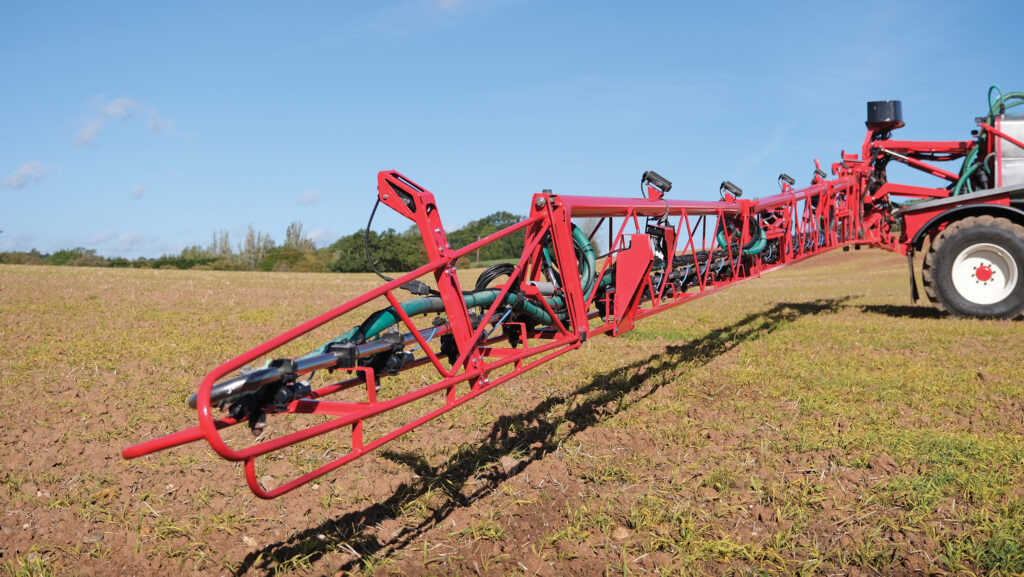
Booms are stronger and lighter than before © James Andrews
This led to tougher steel being used in high-stress areas, along with chunkier 50mm axle kingpins, up from 40mm.
However, to avoid making the machines unnecessarily heavy, other areas that were overengineered have been slimmed down.
In the case of the RB60, total weight is less than 11t with oil tanks brimmed and some fuel in the tank. It’s no pond skater, but some rival 6,000-litre equivalents are heftier than this before fluids are added.
Engine and transmission
John Deere continues to provide the power, with an industrial-spec version of its 6.8-litre PowerTech featuring throughout the range.
This is tuned to deliver 185hp in the RB30, 225hp in the RB40 and RB50, and 275hp in the RB60 with the help of twin turbos.
Two hydraulic pumps are on the receiving end: one that runs auxiliary functions such as the steering, telescopic axles and boom, and another that sends oil to the Poclain wheel motors.
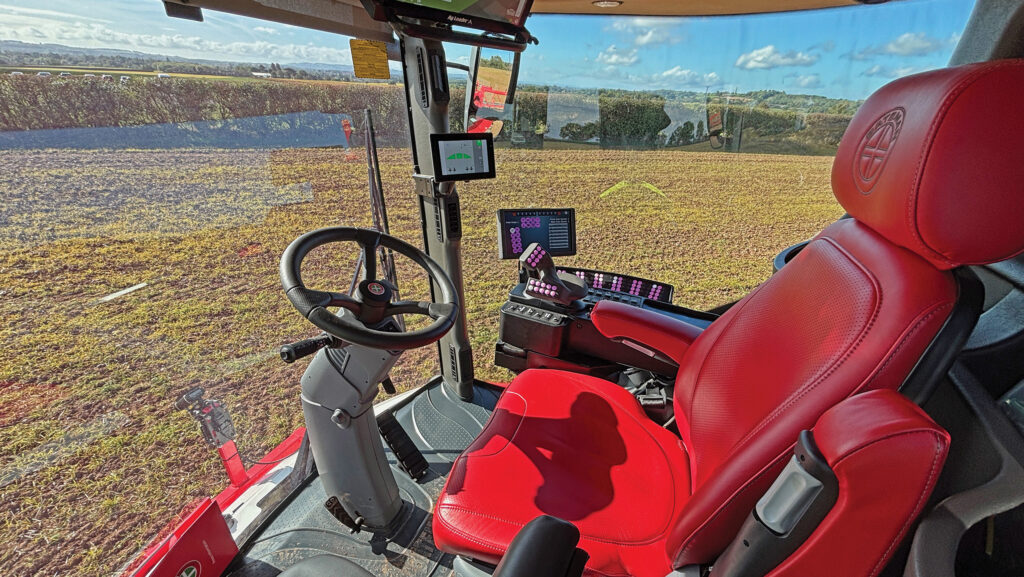
Heating and cooling of the seat is standard; red leather is optional © James Andrews
On the RB30, these are two-speed manual-shifted motors, which can be upgraded to three-speeders with integrated brakes.
The mid-rangers get four-speed units in base spec, though most go out with the firm’s E-Drive+ auto-shifting setup, which is standard on RB60s.
Guided by a gyroscope in the chassis, this will automatically adjust ratios to suit the terrain.
When traversing a hillside, for example, it’s able to have wheels on the higher side at a different ratio to the lower ones so that there’s less risk of them spinning out.
Top speed is 60kph and there’s a cruise control system that makes it easy to reach and stay at a target speed.
In addition, it has eco and sport modes, which alter performance according to the task.
The sport setting will give extra beans for tough terrain with a fully loaded tank, while eco helps save fuel when cruising back to the yard.
Joystick upgrade
There’s no change to the cab frame, which was introduced in 2017, but there is a new multi-function joystick.
Rather than adapt someone else’s, Bateman has come up with its own custom, moulded design that sits snuggly in the operator’s hand.
It is dotted with 18 buttons, all of which can be programmed to carry out different functions.
These are assigned using a touchscreen display, which gives the option of three different profiles – soon to be upgraded to six.
Each has its own colour, which lights up all functions so that it’s obvious which one has been activated.
Even colour-blind operators should be able to tell the difference, as the tones have been selected with them in mind.
Despite all this sophistication, a full suite of manual switchgear has been retained – there are 60 buttons along the right console, plus more next to the joystick and in the roof lining.
So, if the new system ever goes on the blink, there’s a good chance the machine will be able to keep working.
Operator comfort hasn’t been neglected either, with a heated and cooled seat coming as standard, which buyers can upgrade to red or black upholstery for an additional fee.
Another upgrade is a sound system with wireless Apple CarPlay and Android Auto.
Updated spray pack
By modifying the demount sprayer frame, designers have been able to fit wider stainless-steel tanks that sit lower in the chassis.
Clean water storage has also been moved to two saddle tanks that run along the top corners of the main vessel.
Standard capacity is 330 litres on most models, though the new positioning makes it easy for them to be extended.
Other features include a slow-fill mode that reduces the water intake rate, giving operators ample time to load complex cocktails without having to stop the flow altogether.
A speeding-up of the venturi system means the induction hopper empties three times faster. And, thanks to a dedicated second filling port, it can quickly draw in liquid fertiliser and chemical from IBCs.
Among the updates for the new Gen 4 variable geometry boom are a strengthening and lightening of the framework and the ability to spec 25cm and 33cm nozzle spacings, in addition to the usual 50cm.
Then there’s hydraulic break-backs on all fold points, movable magnetic lights and an in-house levelling system that uses Norac sensors.
Working widths top out at 36m, except on the RB60, where the longer chassis leaves room to go to 42m.
Advanced spraying tech
Bateman continues its partnership with Capstan AG to provide pulse-width modulation (PWM) for turn compensation and the ability to adjust flow independently of spray line pressure.
This is typically set to pulse the nozzles at 10Hz (10 pulses/sec) to give good results without wearing components prematurely.
Nozzle assemblies are modular so that individual parts can be replaced rather than the whole unit. Seals are about £5, plungers roughly £22 each, and the orifices £25.
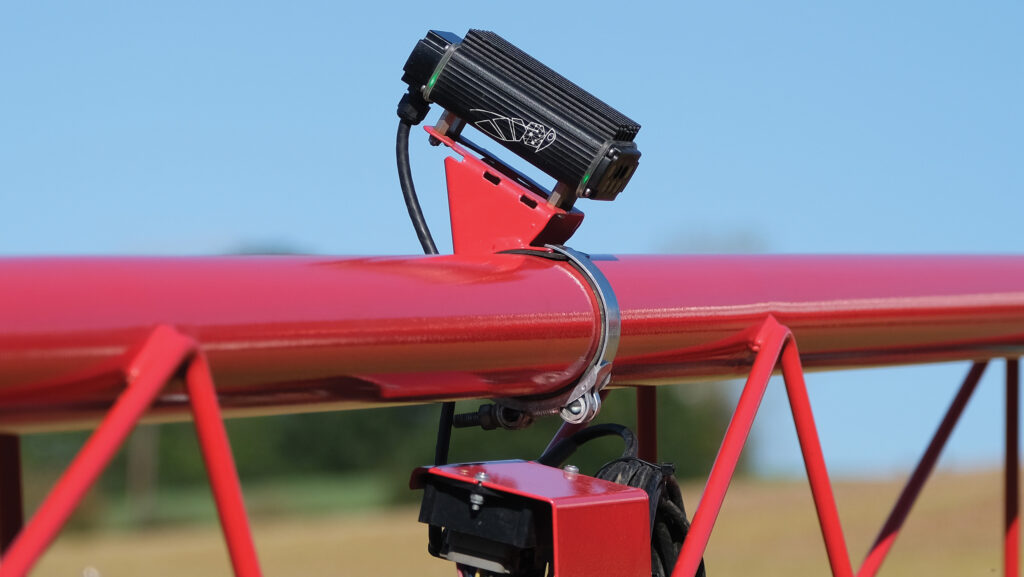
Carbon Bee’s spot-spraying system © James Andrews
The system is getting increasingly popular, to the point that roughly half of the 36m models Bateman sells are now fitted with it. On a machine of this size, the outlay is about £25,000.
For those seeking to streamline applications further, Carbon Bee’s spot-spraying system is on the menu.
This offers green-on-brown and green-on-green detection to better target chemicals where they are needed. It’s a pricey addition, at about £75,000 on top of the cost of PWM.
As for spray controllers and autosteer systems, buyers get an abundance of choice. Agleader is the typical offering, but John Deere, Topcon, Trimble and Raven are available, too.
Farmers Weekly verdict
To the casual observer, the new RBs don’t look that different to their predecessors. But having been peppered with umpteen subtle tweaks, there should be marked improvements in performance and longevity.
The new joystick controller has hauled the cab into the modern age, with enough custom options to satisfy the most tech-savvy drivers.
And having a larger 6,000-litre model on the roster will no doubt help the Devonshire brand nudge into larger farming operations.
Bateman RB60 specs
- Engine 6.8-litre, six-cylinder John Deere
- Power 275hp
- Transmission E-drive+ hydrostatic
- Top speed 60kph
- Spray tank 6,000-litre stainless steel
- Clean water tank 330-litre (option to go larger)
- Boom sizes 24-42m
- Starting price £248,000