Forward-control JCB Fastrac offers contractor plenty of versatility
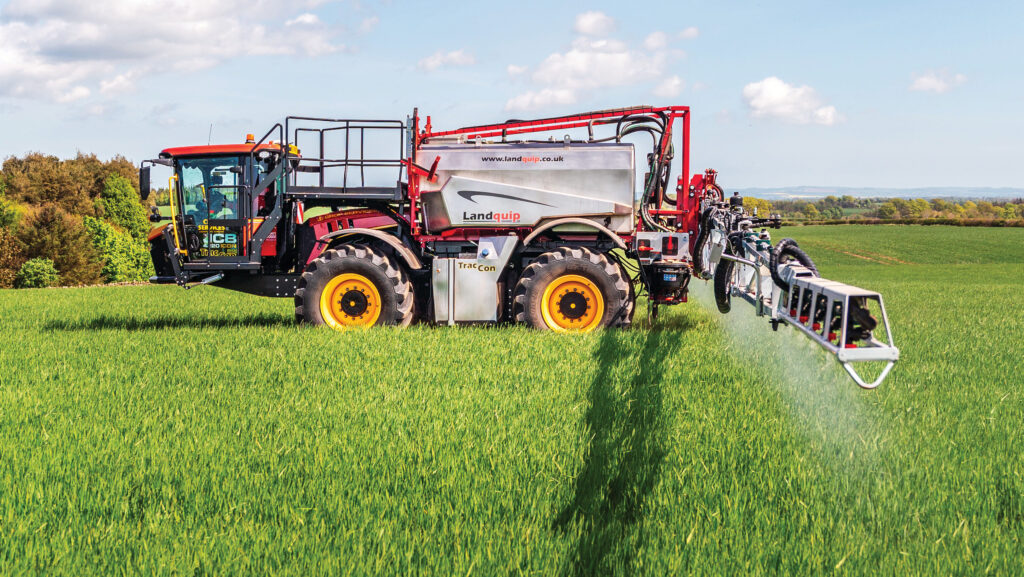 JCB Fastrac Trac-Con © JCB
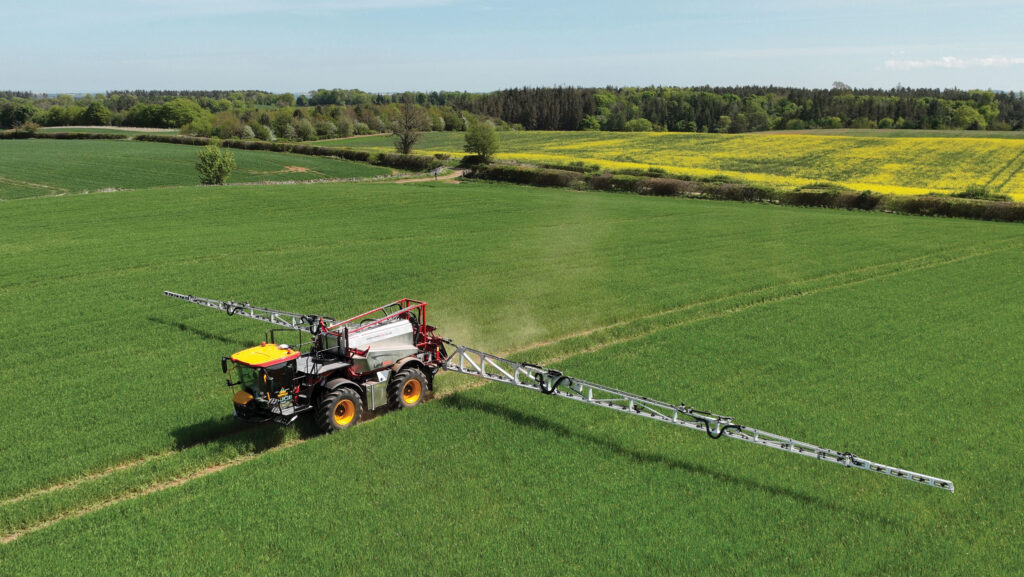
 Landquip is the latest manufacturer to have a crack at exploiting the potential versatility of JCB’s Fastrac by converting it into a front-cabbed implement carrier.
The newly minted Trac-Con tractor unit picks up where the mothballed Multidrive left off.
It offers the generous top speed, four-wheel steering and demount-friendly rear deck sought by dozens of spraying and spreading contractors.
See also: Farmers Weekly Awards 2025: Contractor of the Year
JCB Fastrac Trac-Con
- Engine 6.6-litre, six-cylinder Agco Power
- Max power 235hp
- Transmission Agco ML180 two-range CVT
- Top speed 60kph
- Spray pack 5,000-litre/36m Landquip
- Spreader body 7cu m Tramspread
- Price paid £344,000
Its format is much the same as previous iterations from Knight Farm Machinery and, going back a decade or so, Forfar-based AM Phillip.
Like them, it has the cab jutted out front, freeing up a circa 3m-long area aft of the engine to carry myriad implements.
As well as the typical spreader-sprayer double-up, Landquip hopes to snare a swathe of new customers attracted by the possibility of mounting a log-carrying body for timber extraction, a mobile workshop for emergency repairs on hostile terrain, or an off-road firefighting pack.
But its first production model is operating on familiar territory, having been snapped up by Farmers Weekly’s 2025 Contractor of the Year – Douglas Stephen’s Crop Services business – last spring.
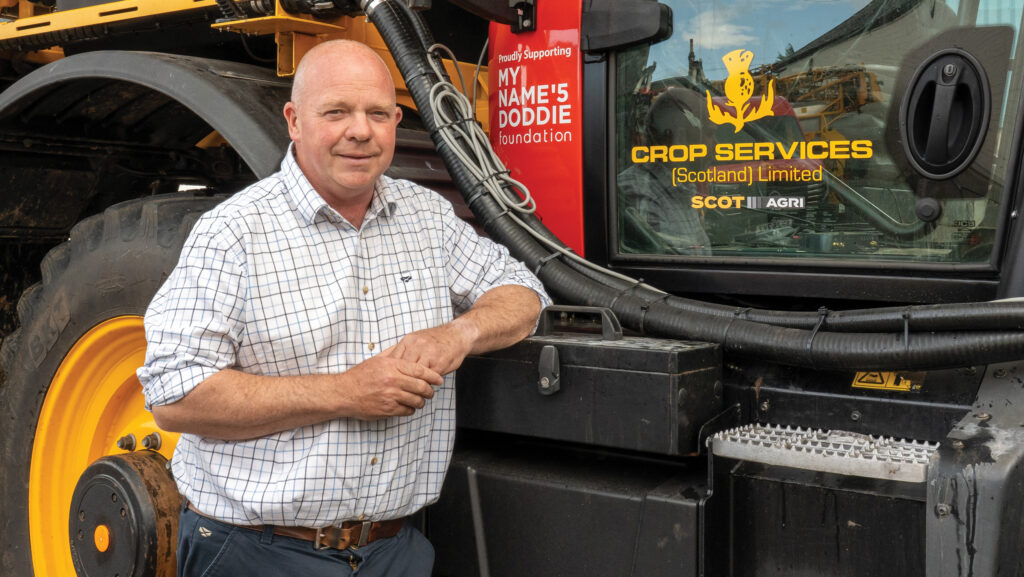
Douglas Stephen © Angus Findlay
The modified 4220 iCon has subsequently covered 4,000ha alongside a clutch of self-propelled sprayers and trailed spreaders, and a 2017-built AM Phillip Fastrac conversion with its own demount kits, which arrived almost nine years ago.
That machine helped wean the business off its reliance on Multidrives, of which it had been an avid user until McConnel wound down production to focus on the lightweight Agribuggy.
The two have much the same qualities, not least the rare ability to carry a 36m sprayer through the spring and summer, and a KRM or Tramspread spreader body for post-harvest lime and Fibrophos applications.
“Like the Multidrives, the main attraction of the Fastrac is its versatility, which means we can keep it working for a large chunk of the year,” says Douglas.
Other virtues include its ability to tow its own water bowser, the 60kph top speed and outboard disc brakes, 9m turning circle and active suspension that makes for a comfortable ride.
Landquip conversion
When it came to sourcing a second forward-control Fastrac, Douglas was in a quandary.
AM Phillip had canned its conversion business due to underwhelming financial returns and Knight’s was too expensive, so he went in search of another willing modifier.
Richard Abbott, boss of demount sprayer maker Landquip, eventually succumbed to the temptation of the challenge.
Douglas shipped his older model to the firm’s Suffolk headquarters, and work started on replicating and modernising the design.
The most obvious change is the extension of the ladder chassis to position the cab ahead of the Agco Power engine.
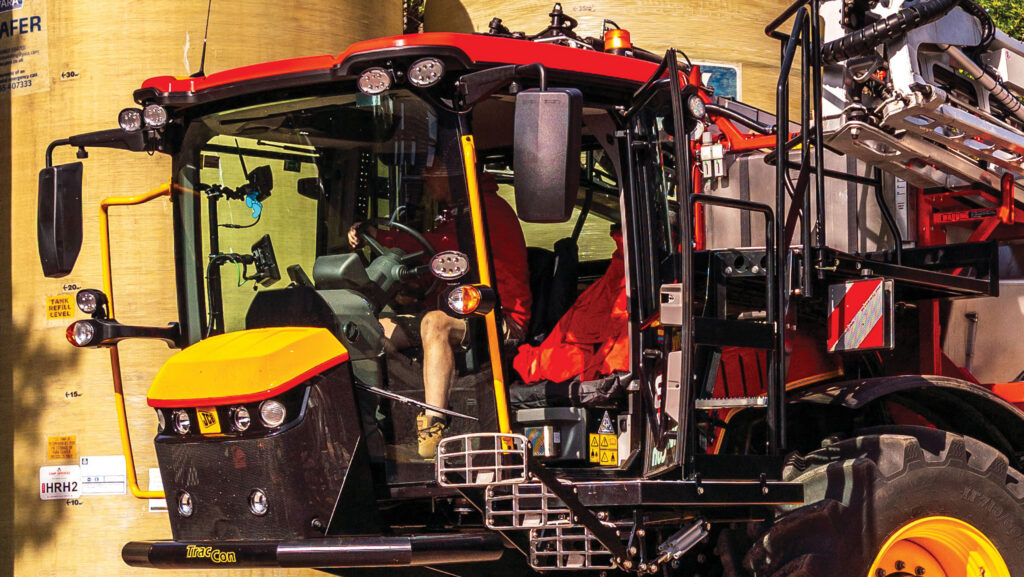
The Fastrac Trac-Con’s cab © JCB
But this move brought its own complications, necessitating alterations to the exhaust system, steering hydraulics and air conditioning.
Pneumatic power was provided to the pick-up latch, and the wiring harnesses were reworked, with new looms produced by JCB’s original equipment supplier.
Landquip also incorporated Crop Services’ own modification, replacing the plastic diesel tank with a stainless-steel version to accommodate high-clearance row crop wheels on 380/90 R46s tyres.
How much?
First in a list of five- and six-figure outlays was the base tractor.
Stripping back the spec by doing away with a front linkage and pto meant this came in at £170,000 with a long warranty.
Though a significant investment, it was a good deal cheaper than a fully loaded 4220, for which Douglas was recently quoted just under £200,000.
Unlike Crop Services’ other, out-of-warranty Fastrac 4220s, it hasn’t been chipped from its 235hp max output to their heady 280hp.
“The difference in the performance of those is night and day, such that we’d happily have one over a heavier 8000-series for towing the trailed spreaders, as they’re so much nimbler.”
Then there was the forward control conversion work that totalled £44,780, plus £7,200 for the wheels on BKT Agrimax Spargo row crop rubber.
That left £129,295 to pay for Landquip’s spray pack – Crop Services’ existing demountable bulk spreaders have been kept in service – taking the total bill to £344,000.
“The total outlay isn’t far off the going rate for a big self-propelled sprayer – except we can also put 10,000t/year through the spreader body without needing a second tractor unit,” he says.
“This helps justify the expense, and though it can’t match the Sands self-propelleds for crop clearance, it’s quicker on the road, can tow a bowser and is equally comfortable to drive.”
Demount spray pack
The transformation from sprayer to lime spreader, once pre-harvest glyphosate applications are finished, is easy.
Thanks to the Fastrac’s double-acting hydro-pneumatic suspension system, the tractor simply squats below the demount unit, which is supported on its parking legs, before slinking away.
Both attachments – Landquip’s 5,000-litre/36m spray pack and the 7cu m Tramspread – run through a plug-and-play isobus system, with Trimble providing straight-line guidance.
As standard, the sprayer has 2m automatic section control, but Douglas is keen to improve the accuracy of applications and is currently eyeing up retrofit pulse-width modulation (PWM) options.
“The spray pack is plenty good enough,” he says.
“But I’d like some of the benefits that PWM offers, especially as we apply a lot of liquid fertiliser.”
These include single nozzle switching and turn compensation.
The latter will help avoid under- and overdosing on bends and provide more control of droplet size to improve penetration into the crop.
“It’s windy up here, so the ability to alter droplets to compensate for weather conditions will make a big difference to efficiency and efficacy,” he says.
JCB Fastrac Trac-Con © JCB
“It’ll also give us variable rate control on individual nozzles across the whole boom, which means we will be able to act on crop variability at a far higher resolution, rather than one switch opening and closing 72 nozzles at a single set rate.”
This technology is already offered by the big brands, but retrofit options are relatively limited.
Douglas is currently looking at procuring a LeapBox system through BBLeap.
“The challenge is that the company has no UK representation, so we’ll have to support ourselves.
“Arag has also just launched something similar, so we have options.
“My plan is to fit PWM to one machine and assess it over the course of a season to make sure our customers are seeing a benefit and we get a return on our investment.”
British fleet
This latest addition to the Crop Services fleet is operating alongside a raft of UK-built sprayers.
And a second Trac-Con could be in the cards, with the original forward control Fastrac having now clocked 11,000 hours and due a change – potentially this spring.
This would run the outgoing model’s spray pack, carving a good chunk off the cost of any investment.
Both 4220s are expected to cover about 6,000ha a year around the firm’s satellite depot in Fife, alongside a Sands Horizon 4,000-litre 24/28/32m.
Then, at the firm’s Kelso nerve centre, there’s a 5,000-litre/36m Sands Infinity and two 36m Horizons (4,000- and 5,500-litre capacities).
All of these can be geared up to spray on 24m, 28m, 30m, 32m and 36m tramlines.
Plus, there’s a McConnel Agribuggy V300 for smaller farms and softer ground.
This is no match for the big machines but, just like Landquip hopes to find with the Fastrac, versatility is key.
The 2026 Farmers Weekly Awards

The 2026 Farmers Weekly Contractor of the Year Award is sponsored by Rural Asset Finance.