£700,000 centrifuge helps make solid fertiliser from digestate
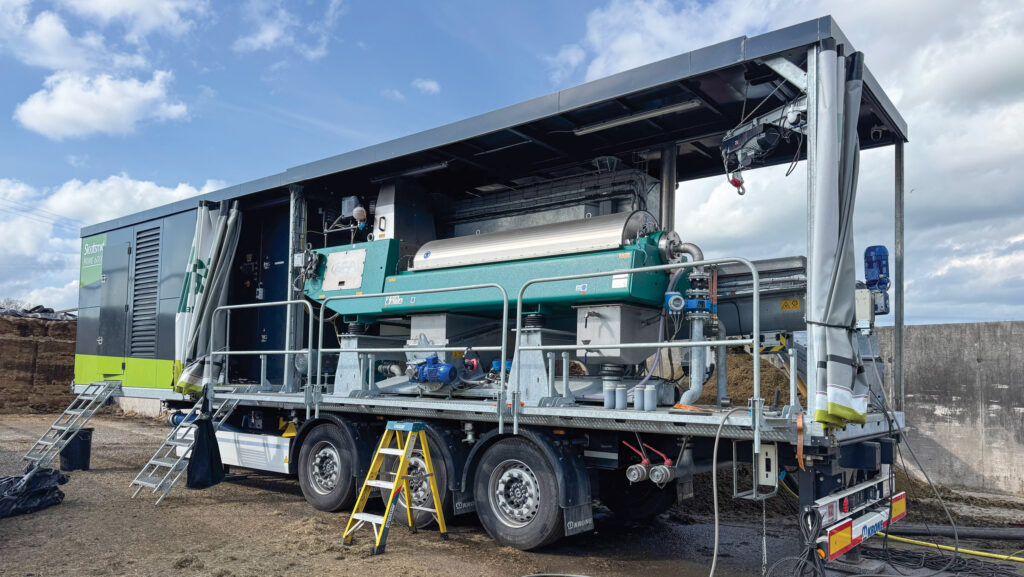 Prime 6000 centrifuge © MAG/Oliver Mark
 Ultra-processed products might get a bad rap, but applying the principles to slurry and digestate could make them healthier for the environment and easier to apply.
After all, these materials contain many of the same chemicals as synthetic fertiliser, just locked in a less valuable format.
County Down-based BH Estates is on a mission to recover and redistribute the goodness they harbour, having recently added a second – and highly sophisticated – separator to its fleet.
See also: Novel home-made trommel separator handles sand-laden slurry
The firm is now armed with seven figures’ worth of mobile Slootsmid gear: a £480,000 SMS6 screw press that it has been running for the past 20 months, and a £700,000 Prime 6000 centrifuge – the UK’s first.
This prodigious spend comes off the back of winning £4m funding from the Department of Agriculture, Environment and Rural Affairs (Daera) for a three-year project focused on the sustainable use of livestock slurry.
It is centred on improving nutrient management by maximising the use efficiency of nitrogen and phosphorus from cows – both the real and “concrete” types – and minimising their impact on broader ecosystems.
The end goal is to complete what managing director Jack Blakiston Houston describes as the “circular nutrient economy” by drying digestate and transforming it into pelletised “bio-based” fertiliser.
Farm nutrient surplus
Abundant grass, high stocking densities and tighter spreading windows in Northern Ireland mean slurry application is often as much a waste disposal exercise as a means of pasture management.
It is a perennial headache for farmers and biogas plant owners alike, with both parties often drowning in brown stuff.
“Managing this material is an important task, often with complex mechanical and environmental requirements,” says Jack.
There is also a well-publicised nutrient surplus that far exceeds crop demand, which can lead to increased losses to watercourses and the atmosphere.
For perspective, the country accounts for 6% of the UK’s land area but 12% of its ammonia emissions.
This can be partly solved by separation, he says, leaving farms with the nutrients they need and removing the ones they don’t.
The fibreless fraction can be dribbled onto or injected into fields, infiltrating the soil far quicker than raw slurry and delivering grass growth dividends sooner.
Ammonia losses are therefore reduced and there’s practically no surface debris, minimising the contamination risk to the following crop and potentially lowering mycotoxin levels, too.
Meanwhile, the solids are hoicked away, slung into a digester as feedstock, then re-separated and dried to produce a phosphate-dense fertiliser.
“Like in the Netherlands, Northern Ireland has too much waste to put on nationally,” says Jack.
“Reducing stock numbers isn’t viable, and farmers can’t increase land area, so the only solution is to make these excess nutrients available to others in an accessible form.”
Two-stage separation
Doing so means splitting the solid and liquid fractions – in BH Estates’ case, more than once.
The process starts with a Slootsmid SMS6 screw press, featured in these pages last year. This uses six Bauer FAN augers to compress the incoming raw slurry and separate the constituent parts.
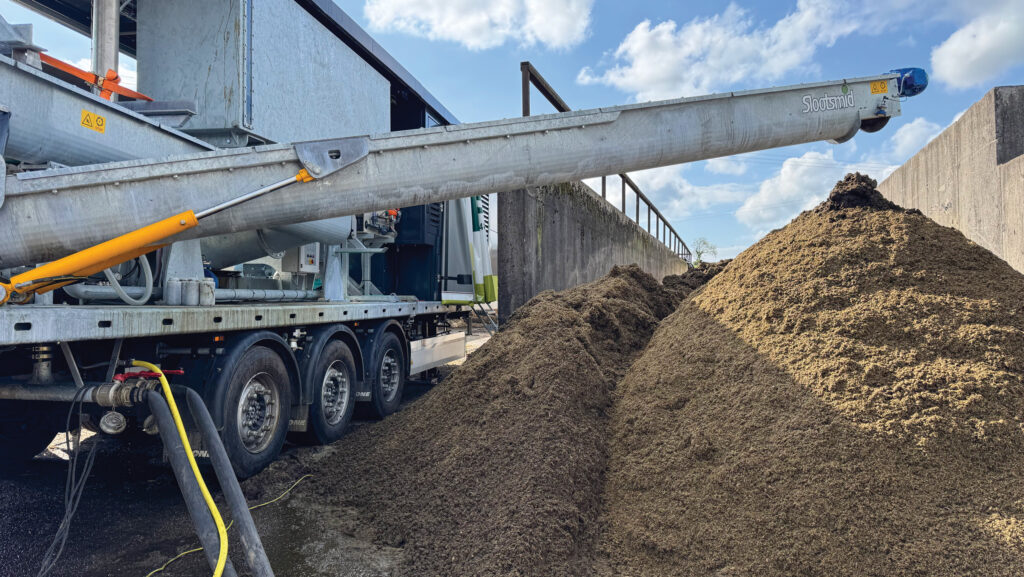
Solids auger on the centrifuge © MAG/Oliver Mark
It’s a service the firm offers for free, provided it keeps the 25-30% dry matter solids to fuel its 500kW anaerobic digestion (AD) plant. Nitrogen-rich liquor is left on the farm.
Taking this approach has increased the proportion of BH’s feedstock sourced from waste from 5% in 2020 to 50% today, drastically reducing its reliance on silage and other expensive energy crops that would otherwise take land out of food production.
However, there’s still the 10,000t of digestate – roughly 90% of the feedstock mass – to deal with.
This is where the Prime 6000 comes in, centrifugally separating the waste to produce 2,500t of solids and 7,500t of liquid.
“For every gallon going into the AD plant we’re getting a kilogram of solids out, and we want to make use of that,” says Jack.
Processing digestate – the effect on nutrients
The centrifuge separates digestate-bound nutrients more efficiently than a screw press.
Liquids remain in the plant’s possession for local field applications, while the solids can be dried to reduce moisture, weight and volume.
This effectively condenses the material into a concentrated fertiliser that is easier to transport than a wet product.
Given digestate typically holds 4kg of phosphate per tonne, BH Estates’ plant alone is excreting the best part of 40t’s worth annually.
Between 50% and 75% of this can be extracted through the centrifuge to create the bio-based fertiliser.
Jack estimates that the nutrient upcycling exercise could make big inroads into the 7,000t national phosphorus surplus, and drastically reduce reliance on Russia-sourced supplies in other geographical areas.
These phosphate imports currently account for 25% of the European market and, as a globally traded commodity, prices are vulnerable to volatility.
“Our aim is to make a ready-to-use 12-3-3 [nitrogen/phosphorous/potassium] or 12-4-4 fertiliser,” he says.
“The challenge is getting the consistency out of an AD plant given the variability of inputs.”
BH Estates has also published a weighty Farm2Export report on the ammonia emissions resulting from this alternative nutrient supply chain, in conjunction with the UK Centre of Ecology and Hydrology.
It concluded that 12% – and up to 30% – of the national ammonia emission reduction target could be delivered through widespread adoption of the processing model.
How does it work?
The Slootsmid Prime 6000 is a “decanting” centrifuge, mobilised by its mounting on a 40ft flatbed. A containerised version is also available.
Upon arrival at a farm or AD plant, the first job is to unload a Borger PL300 satellite feed pump and accompanying Slootsmid SF6E macerator using an on-board winch.
The 6in feed pipe can then be slung into a lagoon and the other end connected to a port on the side of the trailer.
From here, material runs through a flow meter that monitors feed-in volume before entering the high-capacity GEA Prime 6000 centrifuge.
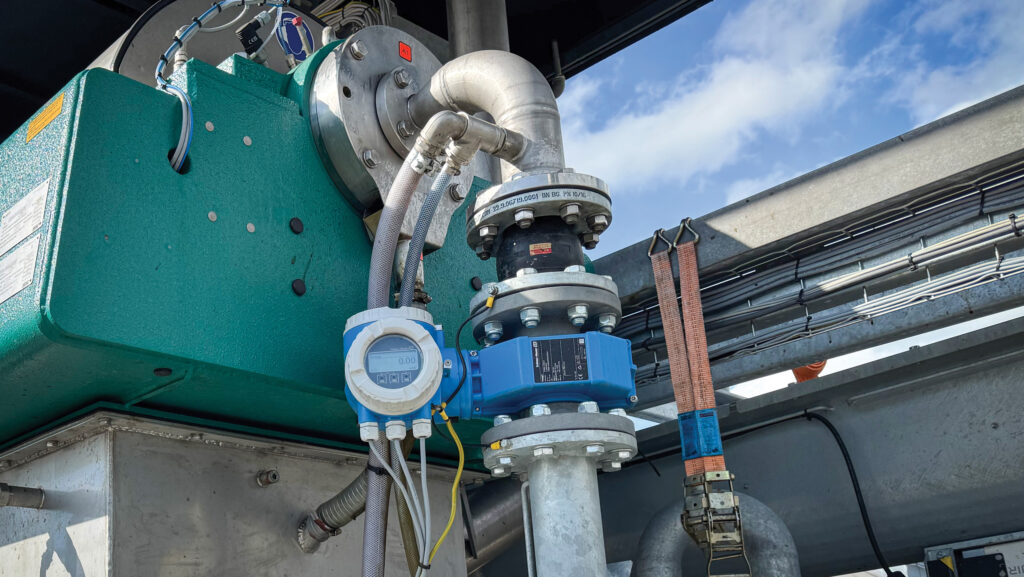
Flow meter on the centrifuge © MAG/Oliver Mark
It spins at 3,600rpm to apply a discombobulating G-force that sends molecules in different directions depending on their mass.
Much like with a screw press, available nitrogen ends up in the liquid fraction and is pumped back out to a store, while the phosphorus-rich solids depart via a series of augers into a heap or trailer.
Inbound digestate dry matter is usually about 7%; solids are jettisoned at about 27%, of which it can produce several tonnes an hour.
Typical processing rates are 25cu m/hour in stodgy AD waste and 40cu m in thinner material.
To avoid overloading the centrifuge, and to maintain the desired dryness, the system constantly measures torque load, flow volume and dry matter level automatically.
This allows the Scada computer to control input from the satellite pump without any manual intervention.
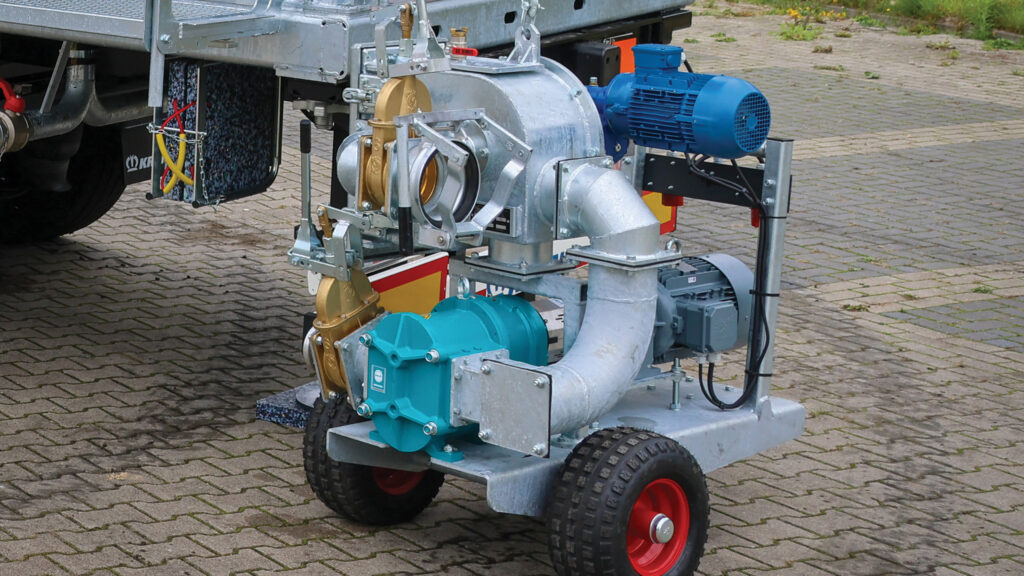
Satellite pump © MAG/Oliver Mark
There are also three near-infrared sensors to monitor constituents – dry matter, nitrogen, phosphorus and potassium – of inbound and outbound material, and two cameras for remote operators to keep tabs on proceedings overnight.
Together, these features mean that, once up and running, it can effectively self-manage.
Should there be a blockage – an errant slice of cow mat in the macerator, for instance – there’s a 3,000-litre water tank to maintain a flow of liquid that protects the astronomically expensive components from damage.
The same supply can be used to run a flush-out afterwards and feed an on-board pressure washer.
Providing power for the umpteen electric motors is a 300kVA generator fore of a control room complete with air conditioning to keep the electrics at a comfortable 20C.
Such complexity doesn’t come cheap. BH Estates charges £150/hour for the service, with the promise of taking away 20-25% of an AD plant’s digestate volume and at least 50% of its phosphorous.