Traction control boosts plough performance
Implements that actively transfer weight to the rear axle of the tractor can improve traction and boost workrate, explains Peter Hill
It may seem like an innocuous-looking crank arm connecting a hydraulic cylinder to the top link. But a new addition to the Pöttinger Servo 45 mounted plough can do a better job of regulating traction than the tractor’s own draft control system, according to independent trials.
The device is one of a handful of mechanisms developed to improve output and reduce fuel consumption with ploughs and cultivators – mostly on semi-mounted implements but also a fully-mounted machine in the case of the Servo 45S.
Tillage equipment specialist Lemken has already demonstrated the performance advantages of the weight transfer system on its semi-mounted Lemken VariTansanit plough and more recently achieved the same effect by inserting a hydraulic cylinder between the frame and pivoting headstock of the new Karat combination cultivator.
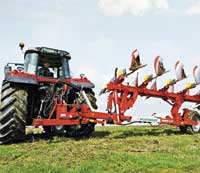
A similar arrangement is available on Pöttinger’s new Servo 6.50 six- to nine-furrow semi-mounted plough to transfer mass from an implement that is normally just a dead weight to pull. Again, it helps the tractor’s tyres gain traction and make better progress in the field.
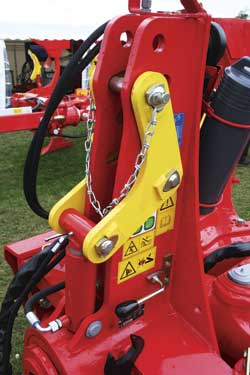
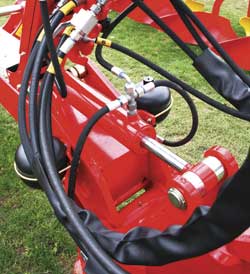
The device comprises a pair of boomerang-shaped links pivoting from the headstock at their apex. Pressure from the hydraulic cylinder transfers some of the plough’s weight to the tractor via the top link. |
|---|
Mounted implements achieve this through the tractor’s lift arms as the draft control system responds to implement “drag”.
Yet the Austrian manufacturer, which spent three years developing the traction control system for the Servo 45S mounted plough, calculated that an implement-based system could be more effective. Field tests carried out by Austrian university research staff seem to bear that out.
The device comprises a pair of boomerang-shaped links attached to the headstock by a pivot pin at the apex. The links are also coupled to a short hydraulic cylinder mounted vertically on the turnover shaft housing and are then connected to the top link of the tractor’s three-point linkage.
Extending the cylinder transfers weight from the plough (and, as a consequence, some also from the front end of the tractor) to the tractor’s rear axle.
A headstock slot for the top-link pin allows the plough some movement as the combination passes over humps and through hollows, with oil displaced as it does so absorbed by a nitrogen-charged accumulator.
The system requires nothing more than a single-acting hydraulic service to determine the load applied through the top link to the tractor and this is easily adjusted on the move to find the best setting for circumstances.
Pöttinger engineers say that, because of the constant loading of the tractor wheels, operators using the traction device can reduce the draft control setting. That should result in the plough working at a more consistent depth, even when passing through a patch of heavier soil or an area of compaction.
Output should also be improved by controlling wheel slip more effectively – a claim put to the test by staff from the Vienna Institute for Agriculture, University for Soil Sciences, who conducted a replicated comparison of ploughing performance across three different soil types using just the tractor’s draft control system or just the plough’s traction control.
The test involved a five-furrow version of the Servo 45S with slatted mouldboards and a tractor carrying 1200kg of front ballast to give axle loads of 3090kg and 9340kg front and rear respectively.
On heavy soil, operating at 6kph, using the traction control device in the absence of draft control reduced wheelslip by more than 8.5% from a little over 15% to 14%, lowered fuel consumption on a litres per hectare basis by just over 3% and gave an output advantage of 2.4% – from 0.84 to 0.86 ha an hour.
Working on a medium soil at 8kph, the test recorded a 31% reduction in wheelslip from an already low figure of 4.8% achieved using draft control alone, with a 10% gain in recorded fuel economy. Output was up by 6.7% to just over 2ha an hour.
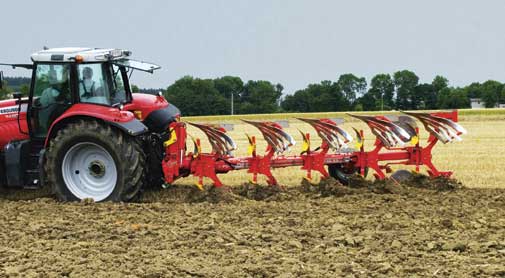
The optional Traction Control System available for all 2009-model Pöttinger Servo 45S mounted ploughs is designed to improve traction and reduce reliance on the tractor’s hydraulic draft control.
Disengaging four-wheel drive for a light soil test run at 8kph provided a further comparison. In this instance, using the traction control device cut wheelslip by more than 40% from the 15% figure achieved with draft control.
As a consequence, the amount of diesel used to plough a hectare was cut by 18% and output increased by 9.5% to 1.96ha an hour.
The Traction Control system is available on any 2009-model onwards Servo 45S plough series, which encompasses four-, five- and six-furrow sizes (the larger two with removable bolt-on extensions) built around an internally reinforced beam.
LEMKEN
An electronically-controlled hydraulic top link used with Lemken’s VariTansanit 8 reversible plough transfers weight to the tractor’s rear axle to improve traction.
It gives the plough, the characteristics of both a mounted plough and a semi-mounted implement. It is available in six- and seven-furrow sizes – the latter with a bolt-on extension – for tractors up to 230hp and 250hp, respectively.
A large mounted plough is good for weight transfer in work but a big tractor is needed to lift it; a smaller tractor can handle a semi-mounted implement of the same size but lack of weight transfer means traction is often a limiting factor.
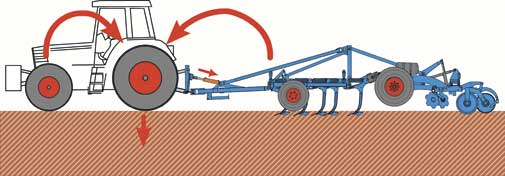
The semi-mounted Karat tine and disc cultivator from Lemken features as standard a traction assistance mechanism to optimise traction and output. Compressing the hydraulic cylinder between the headstock and cultivator frame transfers between 1500kg and 2000kg to the tractor’s rear axle.
The VariTansanit’s design aims to combine the advantages of these two arrangements through a three-point linkage headstock, which is free to pivot for transport but is locked in work so that the plough swings round on its castor wheel behind the tractor. It therefore needs headlands little wider than a mounted plough.
According to Lemken, pressuring the hydraulic top link transfers the equivalent of up to 2.5t to the tractor’s rear axle (including some from the tractor front end); but the link can extend and retract to compensate for undulations.
The system is regulated through a control box in the tractor cab, where the driver selects the required weight transfer to the tractor by setting a top link operating pressure. A constant oil flow, via one of the tractor spool valves, allows the system to monitor and constantly adjust the top link to maintain the selected pressure and weight transfer.
The mechanism makes a significant difference to traction; so much so, say Lemken engineers, that a 160hp tractor can achieve outputs with a VariTansanit at the level of a much bigger power unit working with a mounted plough – and with dramatic differences in fuel usage.
A similar effect is achieved on the new semi-mounted Lemken Karat cultivator but using a simpler mechanism, comprising a drawbar-mounted hydraulic ram pressurised by gas-filled oil accumulators. At 160 bar pressure, an additional 1500kg to 2000kg of weight is placed on the tractor rear axle.
Pressure changes resulting from the tractor and cultivator moving over surface undulations are compensated by the flexible ram length to ensure a consistent working depth.
As with the VariTansanit, the hydraulic traction assistance mechanism, which is standard on all semi-mounted Karat cultivators, optimises weight transfer to reduce wheelslip and save fuel. It should also enable tractors with less power or inherent weight to be used with the implement.
Designed to improve grip with a plough format that normally transfers relatively little weight to the power unit pulling it, the device comprises a hydraulic cylinder between the beam and pivoting headstock, with a pressurised oil accumulator absorbing movement between the two over undulations. Set at 150 bar using a single-acting spool valve supply, activating the system will add around 1400kg to axle rear weight, says Pöttinger. The new plough is produced in six- to nine-furrow sizes with shear-bolt or hydraulic protection for the leg and mouldboard assembly, and manual or hydraulic width adjustment. |
|---|
Tillage Events: The two Tillage 2010 events take place at Leverton Farms, Burton, Lincolnshire, on Tuesday 14 September and at Burghill Farms, Inchbare, Brechin, Angus, on Thursday 7 October. For more details go to www.tillage.co.uk or ring 0845 644 8748.