Why a Cumbrian contractor runs five ageing Claas Ares tractors
 © James Andrews
 If you spot a tidy-looking Claas Ares trimming a Cumbrian roadside, chances are it will belong to the C Davidson clan.
That’s because the Carlisle-based contractor runs a total of five Le Mans built 800-series tractors, all of which are regularly primped, preened and treated to a fastidious maintenance regime.
See also: 6 high-hour tractors still going strong on progressive dairy farm

From left: Callum, Clark and Cyril Davidson © James Andrews
In return, they’ve given years of reliable service, clocking up thousands of hours mowing verges, trimming hedges, blowing snow and hauling gritters.
But it’s not just dependability that attracts the father, son and grandson team of Cyril, Clark and Callum Davidson to Claas’s debut tractor range.
They’re also sensibly priced compared with bigger name brands, offer a comfortable ride for long schleps on tarmac and, crucially, come from the pre-diesel particulate filter and AdBlue era.
“They’re on hedgecutters most of the time, working day in, day out at 1,400rpm, which is about the worst thing you can do for those emissions systems,” says Clark.
“The Ares have none of that stuff, so we never have to worry about regens, AdBlue problems or blocked filters.”
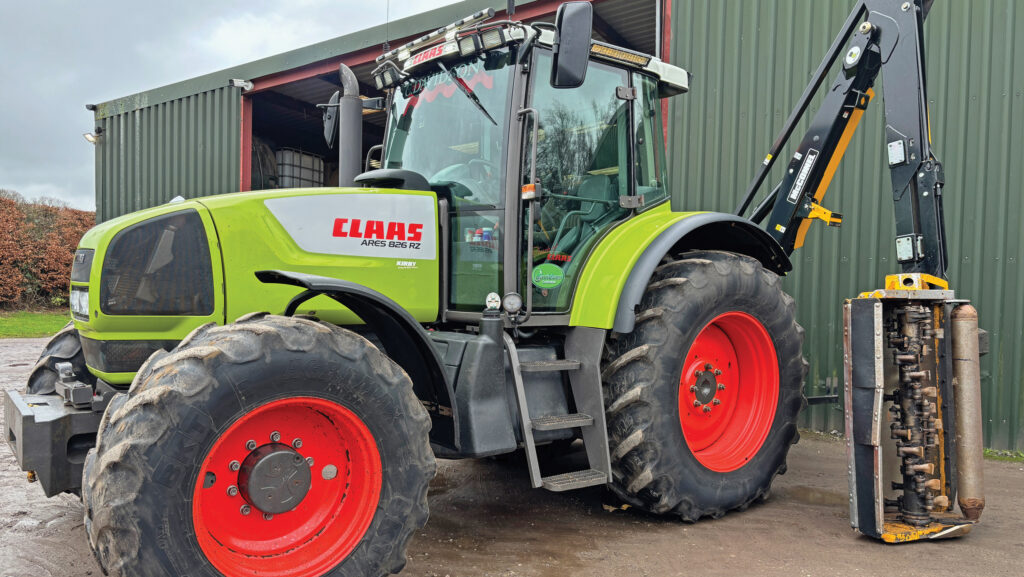
Newest member of the Ares fleet is this 826 © James Andrews
Solid components
Just like the Renaults that went before, the Claas-branded Ares is underpinned by a solid set of components.
Power comes from John Deere’s 6.8-litre, six-cylinder, which puts out a healthy 164hp in the entry-level 816, 181hp in the 826 and 205hp in the range topping 836.
Allied to this is a Gima back-end with a 32-speed Quadrishift transmission featuring four powershifts – the same setup as Massey Ferguson’s Dynashift.
Then there’s the double-wishbone Carraro front axle which, combined with coil-spring cab suspension helps give a comfortable ride.
The only concession for long journeys on the road is their 40kph top speed.
As for cabs, simplicity is the order of the day, with an abundance of levers, a smattering of rocker switches and a couple of small LCD displays.

Levers and switches keep things simple in the cab © James Andrews
Problems to watch out for
They’re not perfect though, with a few common ailments that can out the uninitiated; that said, most are easily fixed or avoided with proper maintenance.
Head gaskets are a well-known weakness for this iteration of Deere’s 6.8-litre power plant and almost all the Davidsons’ tractors have had a replacement at some point.
Thankfully, the upgraded kit puts this problem to bed and none have shown any signs of leakage since.
The only other engine-related gremlins have been a failed fuel pump on one tractor and the odd ECU that’s gone on the blink.
Rather than replacing them with new ones, they got these patched up by David King Electronics when it was still in business.
Now, they go straight to Rickerby, which offers exchange units that don’t break the bank.
Transmissions have never given them an ounce of trouble. Neither have the hydraulics. And, despite their reputation for self-destruction, the front axles have stayed largely in one piece, too.
Regular maintenance
This is because every one of the umpteen nipples littered across the assembly gets a regular shot of grease.
“We haven’t had to rebuild a single one but, if you scrimp on the maintenance, you’ll have all sorts of trouble,” says Callum.
The Davidsons have also gone to the trouble of adding an extra nipple on the driveshafts to keep the needle bearings lubricated.
These were fitted after a failure on one of the tractors and they haven’t had trouble with any others since.
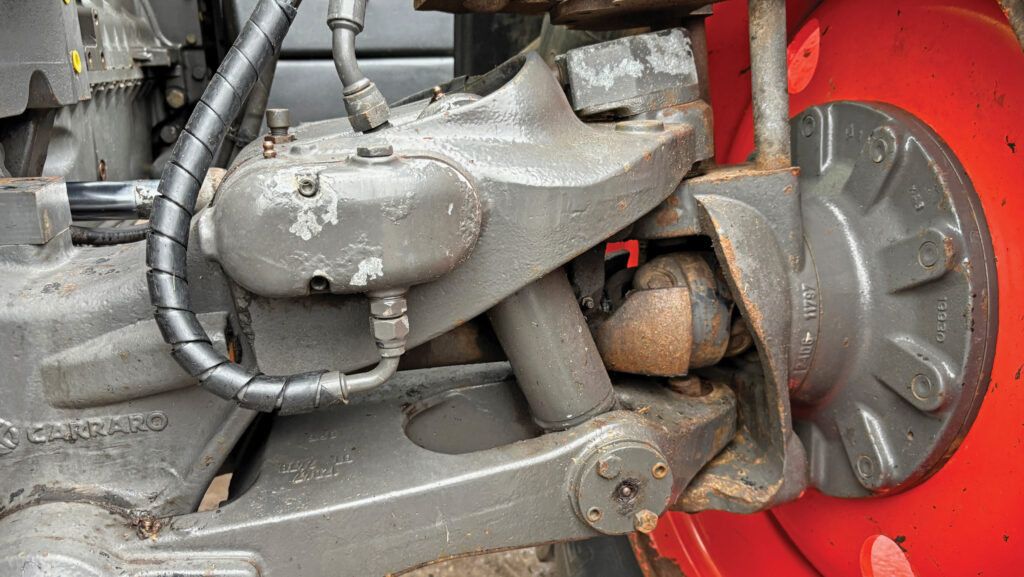
Carraro front axle gives a comfortable ride © James Andrews
Accumulators for the front axle suspension are another potential trouble spot that can reduce the usually plush ride to a jarringly uncomfortable one.
“If they go it’s worse than having no suspension so it’s definitely worth getting them done – they’re positioned under the rear cab and the pair costs about £600 to replace,” he adds.
To make sure other servicing is carried out on time, they keep filters in stock and have 205-litre drums of engine and back-end oil with pumps stationed in the corner of the workshop.
Finding the gems
Like any tractor, the secret to long and uneventful ownership starts by buying a decent one.
This was easy enough when the Ares was nearly new, but almost two decades after they went out of production tidy, lower-hour examples are getting increasingly difficult to find.
Any models the Davidsons bought new have now been moved on due to the amount of work they’d done – one totted up 20,000 hours.
However, they’ve still got a few that were only a couple of years old when they joined the fleet.
The oldest of these is a 2006 816 that came to the farm on just 1,500 hours and now has 15,000 under its belt.
Despite the workload, they reckon it’s the smoothest to drive and pulls just as well as more junior team members. The only slight sign of aging is a little more slop in the range change lever.
This 816 is joined by two others sitting on 8,600 and 13,500 hours apiece and an 836 that’s approaching 9,000.
Youngest and freshest of the quintet is a 2008 826 that was bought in 2023 from GM Stephenson for £30,000.
“It must have been one of the last made and we were lucky to find it as it had only done 2,600 hours,” says Clark.
That’s now crept up to 5,800, begging the question where they’ll be turning next for their replacements.
“We’ll hang on to these for as long as we can and snap up any lightly used, tidy tractors if we can find them – after that, we might have to think about moving on to the early Arions,” he says.
Hedgecutters
As for the kit fitted on the back, four of the Ares are almost permanently shackled to a McConnel PA 6570T or 6572T.
These are running fine competition flails and, in contrast to the tractors, are changed every few years to keep reliability in check.
The 836, meanwhile, tends to pilot their home-made front-mounted tool for stripping back verges that have encroached onto roadways.

© James Andrews
This has a disc for slicing through the turf and a hydraulic rotating wire brush for flicking the loosened material out of the way. A conventional sweeper brush at the rear then finishes the job off.
Firewood is another sideline, for which they run a hydraulic log splitter on the oldest tractor in the line-up.
This is a 1999 Renault 103-54 which came to them brand new and spent most of its tenure running a hedgecutter.
When it retired from frontline duties about 15 years ago, they tidied it up and repainted it in Claas colours to match its stablemates.
Modern sister fleet
Alongside the Davidsons’ hedge and verge work they carry out a range of conventional agricultural contracting services including cultivation, combination drilling, forage wagon silage and baling.
These duties are generally handled by their more modern Arion 630 and 650 and Axion 800, though some of the Ares tractors put in a shift when required.
The final member of the fleet is a Reform Metrac hillside tractor which gets used for flail mowing slopes and collecting clippings with a sweeper box on areas growing environmental mixes.
C Davidson’s Ares quintet
- 2006 Ares 816 – 15,000 hours
- 2007 Ares 816 – 13,500 hours
- 2008 Ares 816 – 8,600 hours
- 2008 Ares 826 – 5,800 hours
- 2007 Ares 836 – 8,900 hours
Other tractors
- Claas Axion 800
- Claas Arion 650
- Claas Arion 630
- Renault 103-54
- Reform Metrac