What’s in Your Shed? visits Kaleb Cooper Contracting
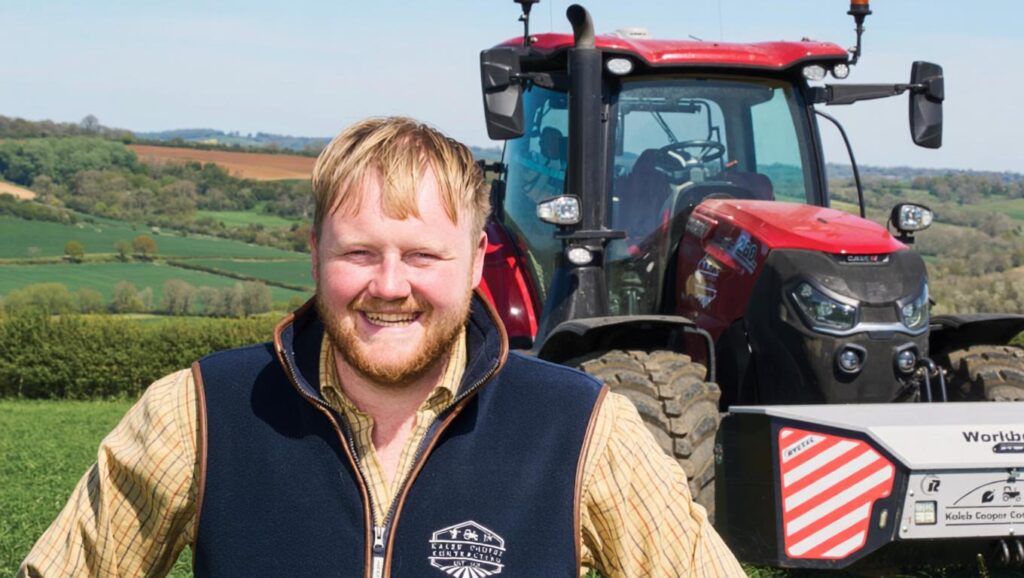 Kaleb Cooper © Oli Lees
 Four different tractor brands feature in the fleet owned by contractor and star of Clarkson’s Farm, Kaleb Cooper.
What’s in Your Shed? heads over to Oxfordshire to find out what they are and which is his favourite.
See also: What’s in Your Shed? visits a fledgling contracting business
Business facts
- Arable 800ha of stubble-to-stubble contracts, share farm agreements and tenancies
- Grassland 320ha
- Main contracting services Forage harvesting, combining (200ha), muckspreading (90,000t/year), round baling (30,000 hay and silage bales/year), spraying (800ha), drilling (800ha)
- Staff Eight
How did you get started?
I’m not from farming stock: my mum is a dog groomer and my dad a carpenter.
But I’ve worked on farms since I was young and always wanted to build a business where I could be my own boss. That started when I spent £5,000 on my first tractor – a Case 1394 – when I was 15.
I threw another £2,000 at a topper and went knocking on the doors of all the horsey people in the area, telling them they had lovely stables but their fields would be so much nicer if I looked after them.
By 2021, my brother Kieron and I had assembled a low-cost fleet of grass kit, including a mower, rake and tedder, and cut 500 acres [200ha] of hay that we stored in rented barns.
That same year, the person farming Jeremy Clarkson’s land gave up and we effectively took on the stubble-to-stubble contract, albeit in a complicated arrangement that allowed Jeremy to do some of the work.
Jack Tuckey, my friend from college, also joined the business, and together we decided to make one of our biggest ever investments: £100,000 on two high-spec Ktwo Bio spinning disc spreaders.
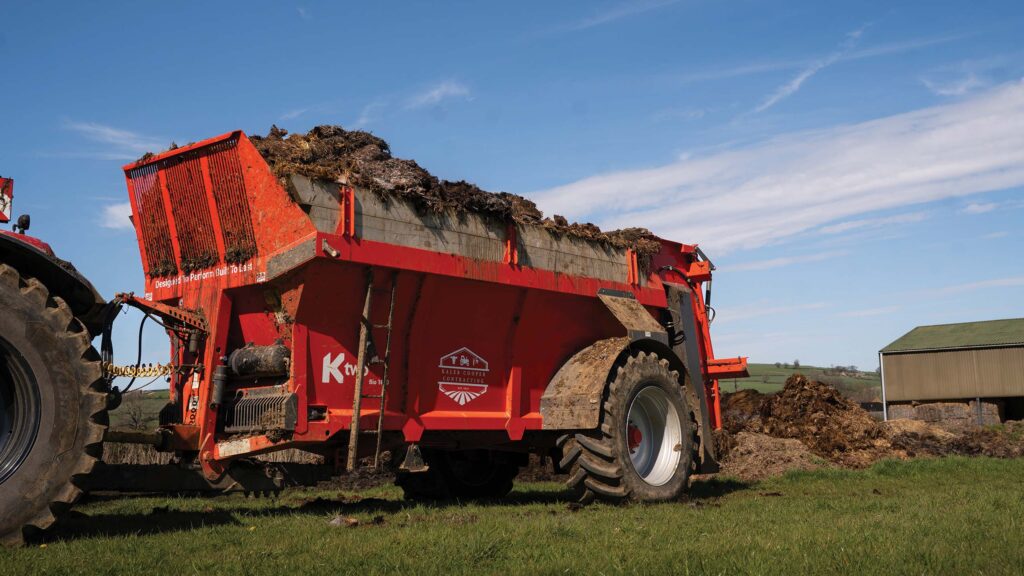
Three Ktwo Bios spread a combined 90,000t/year © MAG/Oliver Mark
At the time, we didn’t have a single tonne to spread.
But the war in Ukraine had sent fertiliser prices through the roof. We saw an opportunity to buy chicken muck and, using the variable-rate system, apply it accurately on customers’ fields.
The sales pitch was that we could keep their costs down and put the nutrients where they were needed.
We worked all hours to get it going, and farmers gradually saw our logic – and the benefits – to the point that we’ve now got three spreaders doing a combined 90,000t/year.
They go as far as Leicestershire, Wiltshire and Surrey, usually working their way back from the furthest point before getting a grease-up in the yard and heading out again.
Several series of Clarkson’s Farm were filmed during that period, but it didn’t take up as much of my time as you might think.
When I was filming at Diddly Squat, I was usually there doing contracting work anyway. And, when it was done, I’d come home and help the team.
That said, it did stunt our growth a bit, as farmers seemed wary of using us.
Fortunately, we’ve managed to push on over the last couple of years. Where possible, we try and buy different machinery to other local contractors, rather than offering identical services.
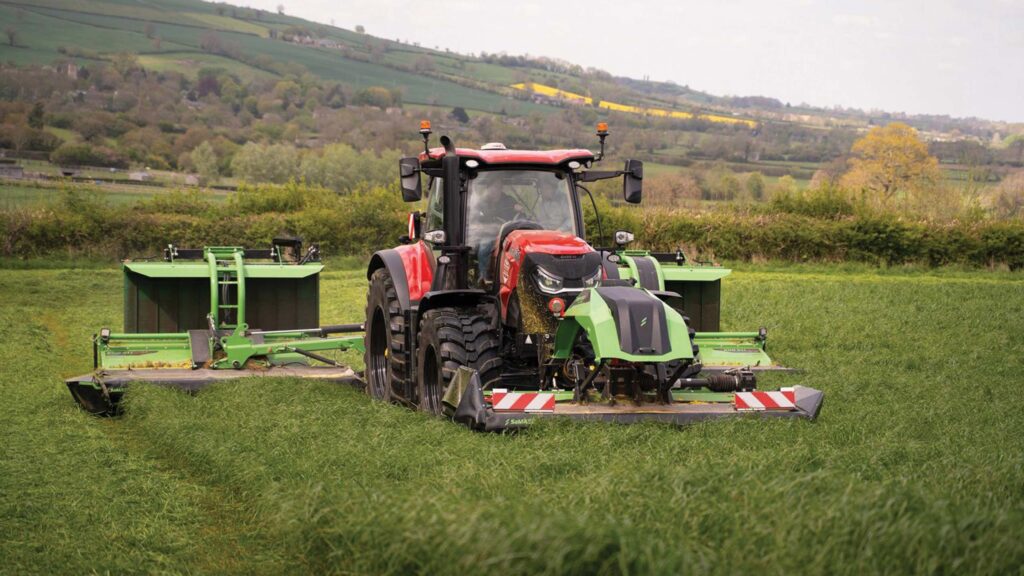
Case IH Puma 260 tooled up with Samasz triples © MAG/Oliver Mark
For example, we’ve got Samasz triple mowers with groupers to save a pass with the rake, Hi-Spec Kompactor trailers to weigh crop coming into the pit and dump the load without tipping, and a John Deere forager with the Harvest Lab technology.
What about staff?
For a long while there were three of us – me, Kieron and Jack.
We’ve now got six full-time in the contracting business, plus students through a bursary I set up to help young people on their journey into farming.
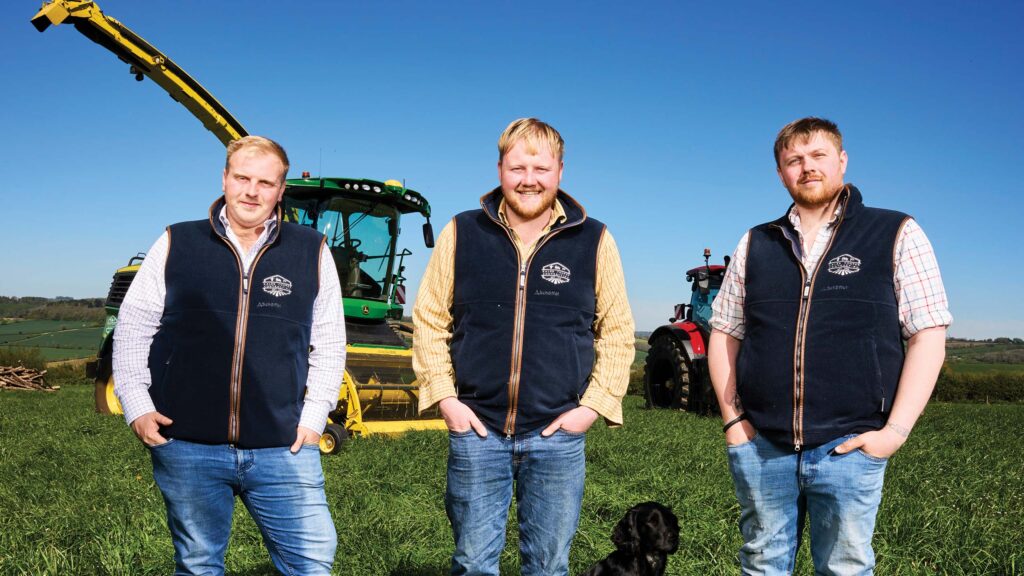
The team (from left): Jack Tuckey, Kaleb Cooper and Kieron Cooper © Oli Lees
Everyone in the team is younger than me [27] and, unintentionally, none comes from a farming background.
We’re big on staff training and being new to the industry means they’re keen to learn, open-minded and not too embarrassed about getting things wrong.
My one rule is that I’ll pay for the first broken mirror. If it happens again, they have to cough up.
How brand loyal are you?
As a business, not. We care more about dealer backup.
However, each of us has a favourite: I love my Fendt, cut Kieron and he bleeds John Deere green, and Jack is a Case man.
I think it’s good to get the drivers’ input, and each of us speaks to our respective dealer.
Plus, all the tractors are suited to the jobs they do.
My little Fendt 516 is cheap to run and the perfect size for the rake and baler. It even carries the topper in horse paddocks.
Kieron’s 6195R does the drilling and spraying, the big Cases are good value for money and the New Holland T7.210 is bog standard and perfect for youngsters learning the job.
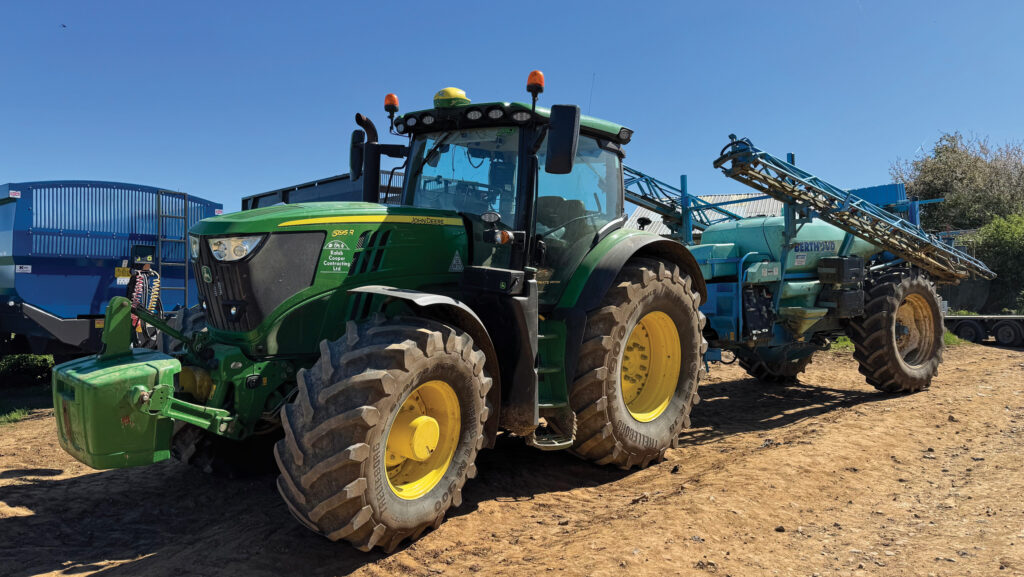
Kieron’s 6195R runs the sprayer and drill © MAG/Oliver Mark
The only brand we are loyal to is Ktwo. The Bios have the best spread pattern, the company is local and it stocks everything we might need on the shelf.
Favourite dealer?
KFS at Chipping Norton would have been up there if it hadn’t gone bust. We were probably its biggest customer.
Now we rely on Turneys, Farols and Chandlers, all of which offer a good service.
Favourite piece of kit?
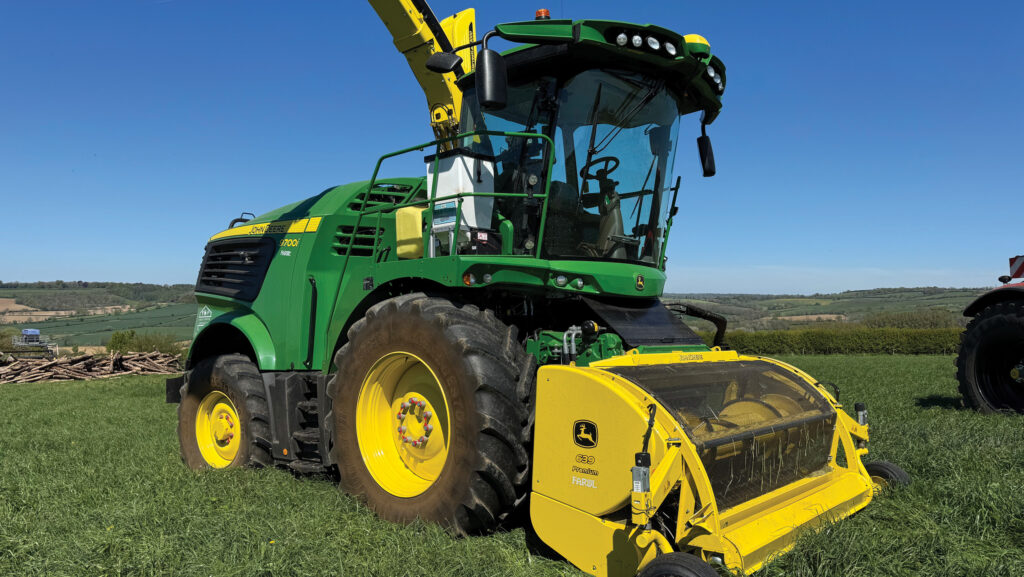
John Deere 9700i © MAG/Oliver Mark
The new John Deere 9700i forager, though we’ve barely used it yet.
We already had the mowers, five trailers and a loading shovel for forage harvesting, but were hiring someone in at £50,000/year to do the chopping. That was basically the cost of a finance package.
At £200,000 for a 23-plate, we felt it was good value, and Farols provides excellent support.
Like the first muckspreaders, we bought it with no work.
But there are plenty of AD jobs coming up in the area, we can fit it with 64 knives for short cuts, and it’s got Harvest Lab to provide customers with all the data they could want.
As with the variable rate on the Ktwos, this technology helps get us work, even if we can’t charge extra for it.
And your least favourite?
The three-year-old Kuhn Multi-Longer hedgecutter. It’s suffered from a few electrical problems, but it’s more the fact that I despise hedgecutting.
We just can’t make money from it. The rate around here is £45/hour – nowhere near the figure we need to cover depreciation, insurance, fuel and a driver.
Latest purchase?
The forager and a New Holland BB1290 big square baler.
Everyone is down on straw so everything will be baled this season. Knocking out 10,000 bales in the summer will go a long way to paying off the £40,000 investment.
Also incoming is a new Case Puma 220, due for delivery in August. It’s a proper simple powershift, which made it dead cheap [£114,000].
First on the jobs list is to get the rims on all three painted black – like everything I own.
I was obsessed with Yellowstone, the TV series based in Montana, where they branded workers’ chests with a hot iron to symbolise their lifelong loyalty to the ranch.
Sadly, I couldn’t do that to the team, so instead I put my mark on the equipment.
Oldest machine?
The oldest still working is a Lamborghini 1060 Premium, which replaced my original Case when it started causing trouble.
It’s a 1998 model – the same year I was born – and cost me £5,000. I clocked about 4,000 hours topping and fencing; it’s now on 9,000 and lives on the straw blower.
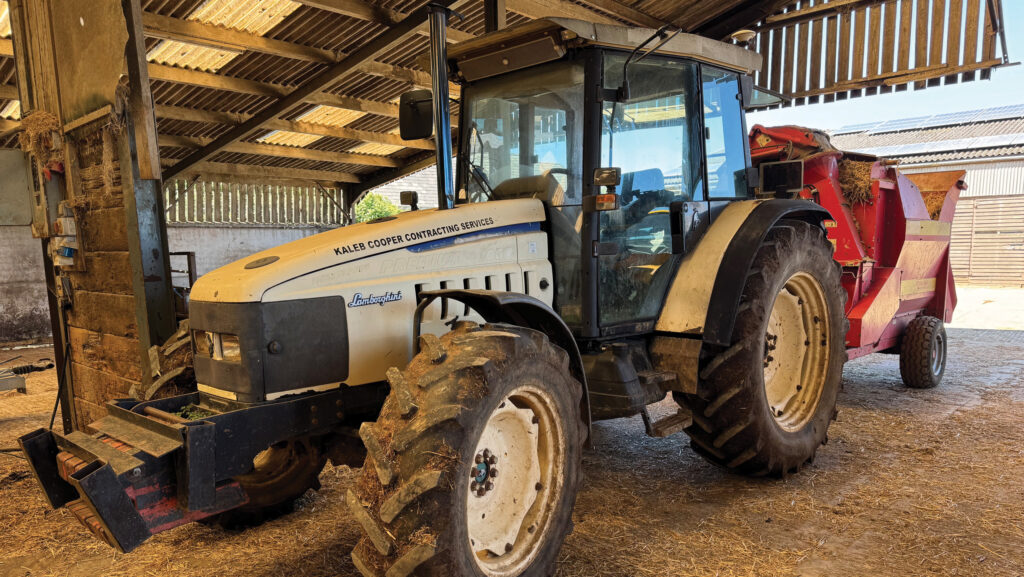
Lamborghini 1060 Premium © MAG/Oliver Mark
But the oldest tractor in the yard is a Ford 4000. I bought it as a present to myself when I completed my UK tour. It has only done 1,400 hours and occasionally putters away on the log splitter.
How long do you keep your machines?
Good machines can stay forever.
We take the tractors on five-year/5,000-hour warranties. In an ideal world we’d change them at the end of that, but we’re trying to grow the business and the money is better spent on other things.
So most, if not all, of the tractors will stay long beyond their warranty – unless they’re complete stinkers.
The thing I like about Fendt is the option of bolting on extended warranty. We added two years to the 516 and it paid off handsomely after one expensive breakdown.
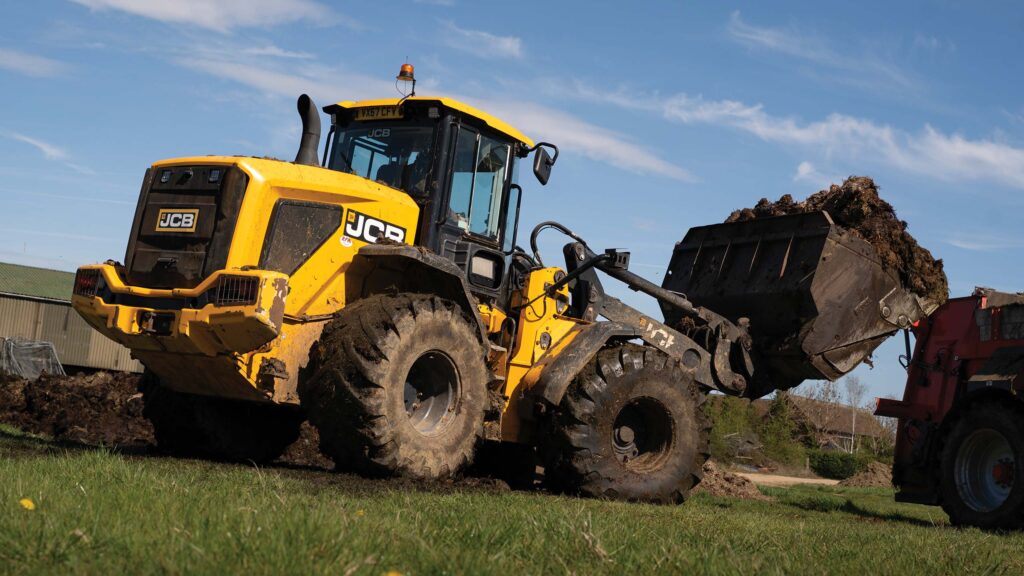
A JCB 427 does all the heavy lifting – for now © MAG/Oliver Mark
Most of the other self-propelled machines are on the old side. The 67-plate JCB 427 is on 6,000 hours and the bulletproof, 20-year-old New Holland combine 2,000.
It won’t be worked as hard this year, as we’ve lost the best part of 100ha to the Cereals event at Diddly Squat.
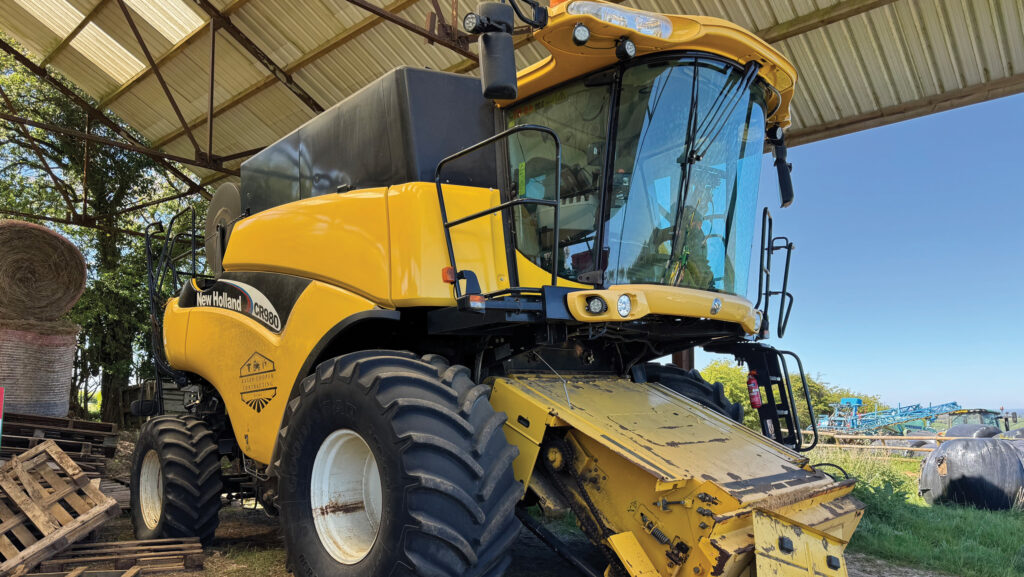
New Holland CR980 © MAG/Oliver Mark
Next on your wish list?
A JCB 435. We need an extra loading shovel to have one on muck and another on the clamp.
And, with the 50kph transmission, we’d be able to drive it on the road. The 427 is too slow and has to be carted around on a low-loader.
Biggest machinery mistake?
One that springs to mind is when Kieron bent the muckspreader’s back light on its first trip out; the wheel dropped into a dip in a tight gateway.
A week later, and before we’d got around to fixing it, a Travis Perkins lorry backed into the spreader on the same side, causing more damage to the light, and also to the wheel and tyre.
So, Travis had to pay for it.
Most expensive repair bill?
Two Claas tractors almost bankrupted me and put the business on the back foot for years.
I only had £60,000 to spend at the time so I bought an Arion 540 and an Axion 820. They were the cheapest I could find to get me going.
Neither was being worked hard. They were doing about 500 hours a year and, as I was young and keen, I was even taking the 820 topping.
The 540 suffered from EGR, turbo and air-con problems, though I actually quite liked it otherwise.
But the 820 was a different story. It was just rubbish – the gearbox, front axle, front pto and seat.
I was delivered a single £25,000 bill for repairs on them and I’ve only recently managed to clear the debt.
After getting the invoice, I got rid of them immediately and bought a New Holland T7.210 powershift – my first new tractor and the one I’ve still got.
It did 600 hours in four months and basically saved the business.
Most overpriced spare part?
Pto guards. Suppliers should offer them at cost and just charge for the shaft.
Best invention?
Last year, we were mowing and baling wholecrop wheat for Gentons Pedigrees at Bloxham.
The stubble was puncturing the wrap so, after messing around with bags of wool and various other things, we came up with the idea of towing a piece of plywood behind the baler.
It worked a treat – the bale dropped onto the board, which took the initial impact, before gently rolling off.
What couldn’t you live without in the workshop?
Adjustable spanners. If nothing else, it saves using loose change as a spacer when you can only find a 19mm spanner for a 17mm nut.
Kieron tends to do most of the repairing, but he gets busy and things often end up getting taken apart and staying that way. The plough is still a work in progress after two years.
Fortunately, we have a couple of local engineers that are awesome.
Peter Haine, who lives in the village, is brilliant at welding and Dave Cox is an ex-main dealer mechanic who looks after the bigger machines when we’re busy.
Both are self-employed and invaluable when we need them, so we always make sure they are paid the next day.
Everyday transport?
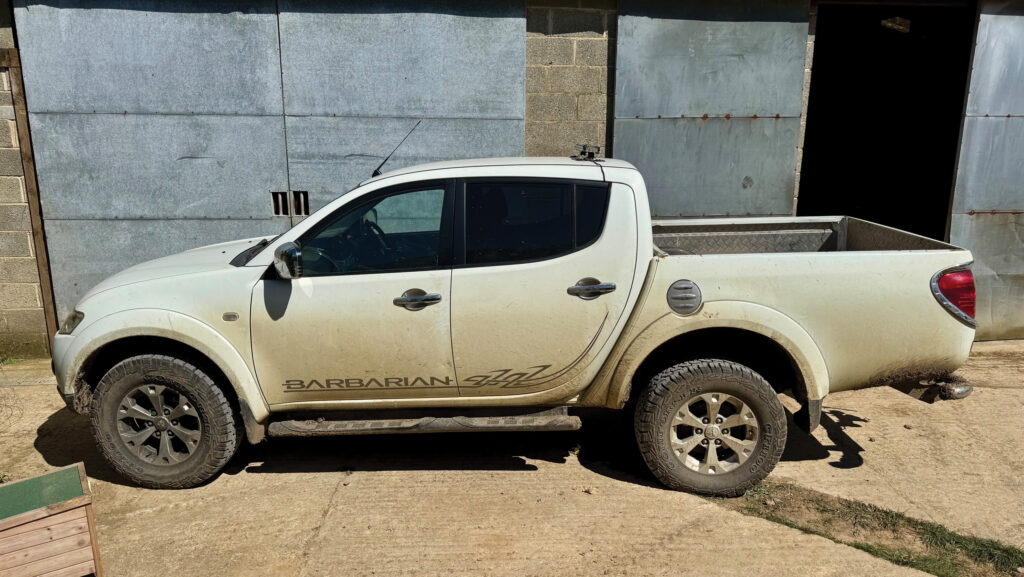
© MAG/Oliver Mark
We’ve got two 2011 Mitsubishi L200 Barbarians – one on 220,000 miles and the other 100,000. We did have third on 190,000 until it got T-boned by an Ocado van.
I love them. They’re simple, cheap and bombproof, plus we find the 2.5-litre engine really good on fuel when winter gritting.
In fact, we’ve just bought another two on 80,000 miles, coincidentally also 2011 models. We jump on them whenever they come up for sale locally.
Best tractor you’ve had?
Kieron would say the Deere 6195R, Jack’s is the Puma 240 – in part because he clocked so many hours in it – and mine is the Fendt 516.
It’s a four-cylinder pocket rocket and will comfortably pull the McHale Fusion up a hill, no problem. It’s also insanely comfortable.
Sadly, customers won’t pay a premium for me to live in luxury, so I can’t afford more than one.
Hopefully when I make it one day, I’ll have a 728 sat in the yard just for me to drive.
That said, I like to keep myself grounded by taking out the New Holland from time to time. It proves a point to the youngsters and makes me feel like I’ve put in a good shift.
Worst tractor you’ve had?
That Claas Axion 820. Not reliable and not comfortable.
Most surprisingly useful feature on a machine?
Hydraulic top links. I’m done with turnbuckles.
We now spec them on all the tractors and are looking at getting one for the front mower to save the aggro of getting out and tweaking it manually.
Jack and Kieron would probably also say headland turn systems in the tractors. I don’t bother with that stuff – an AB line is good enough for me.
Most pointless piece of technology?
Not sure if it still qualifies as technology, but long-wave radio has to be the most pointless thing in a tractor cab.
Who listens to it? It’s just fuzz that goes a bit quieter when you turn the beacon off.
We all use Spotify or Apple Music. Sometimes I feel like I’ve completed the catalogue over a long day, from slightly depressing ballads to gangster rap and inspirational stuff like “Life is a Highway”.
Biggest machinery bargain?
Two years ago, I bought a flat roll at an auction for £20, pushed it off the side of the trailer at the scrap yard on my way home and pocketed the £600.
Biggest bugbear?
The weather. Life would be easier, and the money better, if it just rained between 11pm and 4am and then dried up for 8am. Everyone would be happy.
Kit list
- Tractors Case IH Puma 260 x2, John Deere 6195R, Fendt 516, New Holland T7.210 and T7070, Lamborghini 1060, Ford 4000
- Combine New Holland CR980
- Forager John Deere 9700i
- Handlers JCB 427 and 542-70
- Mowers Samasz triples with groupers
- Balers McHale Fusion 4, New Holland BB1290
- Cultivators Five-furrow Kverneland plough, Vaderstad Carrier
- Drill 6m Weaving Sabre Tine
- Sprayer 24m Berthoud trailed
- Fertiliser spreader Kuhn Axis 30.1
- Trailers Hi-Spec Kompactor K36 x2, Ktwo Curve 1400 x2
- Muckspreaders Ktwo Bio 1600 x3
- Other Major tanker and nurse tank