

New Year plans: What a LEAF audit can do for you
Open Farm Sunday, organised by Linking Environment and Farming (LEAF), has brought hundreds of thousands of people on to Britain’s farms. But few have heard of the LEAF Audit, or understand what its innovative approach can do for farm businesses. Tom Allen-Stevens finds out more.
As you look round the Waddesdon Estate in Buckinghamshire, you begin to realise there’s little point in asking what is being done to benefit the environment and biodiversity – the list is endless.
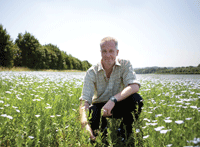
Farm manager and Farmers Weekly Award winner Alastair Brooks (pictured) is more concerned with finding what’s still to be done and how it can benefit the business.
“We’ve got environmental credentials coming out of our ears, and the estate is 100% behind the projects we pursue. But we can’t justify doing anything unless it’s profitable.”
So that’s the challenge he’s set LEAF. “How much will LEAF membership cost me? What benefit will it bring me? And what can it do that I don’t already do?”
The first question is easy to answer – £210 buys him membership for a year and access to a range of services headed up by the LEAF Audit. According to a recent study of LEAF members, carried out by the Countryside and Community Research Institute, this brings savings of up to £10,000 a farm, and can boost income by up to £7000.
But exactly what Mr Brooks should do and how he can achieve these benefits is less clear. The 2025ha estate encompasses arable cropping, with a 850 ewe-lamb flock, 100 Simmental-cross suckler cows and followers.
The farm is in Countryside Stewardship and Entry-Level Schemes. On top of this, the estate is undertaking numerous projects and initiatives, but it is hard to see how these relate to core farming activities.
Stepping through elements of the LEAF Audit proves a useful way to assess these, advises LEAF technical director Jeremy Boxall. “The LEAF Audit helps you identify what needs changing in your business and prioritises these. It’s a great way to fine-tune a farming business, which should prove useful here.”
Divided into eight sections, the audit is a self-assessment tool that asks a series of questions about your farming and business practices. Links and guidance notes throughout offer pointers to get started on any areas that do need improving. A farm’s performance can be cross-checked against all LEAF producers via benchmark scores that are given for each question.
Organisation and planning is the first section, and a firm grip on the farm’s figures was one of the aspects that earned Mr Brooks his title of the 2010 Farmers Weekly Farm Manager of the Year, sponsored by Claas. What stands out here is a thorough understanding of carbon emissions, and there is also a target to reduce these by 20% by 2015.
But Mr Brooks says it can prove a difficult task to keep a handle on everything that is going on. “If there are gaps, then the busier we get, the more will appear, but they’ll be harder to identify.”
Under soil management and fertility, Mr Brooks displays a host of plans that tie in regulatory requirements with crop needs. But he questions the benefit of carrying out an audit to point these out to him.
“The LEAF Audit can identify what you have, what purpose it serves and where you keep it,” says Mr Boxall. “It’s not about adding to your admin burden, but streamlining what you have.”
Moving to pollution control and the estate is about to undertake a particularly interesting project with the Environment Agency. “There’s an area that often lies under water, so we recently set about clearing the ditches, mole-draining the area and reviving the old dew pond,” reports Mr Brooks.
“We suspect there’s a fair bit of phosphate and general nutrient run-off from the area. We will be monitoring this to see how we can reduce it at source – no-one wants to waste valuable nutrients. But the dew pond now acts as a settling pond to minimise pollution downstream.”
Since reinstating the dew-pond the estate has benefitted from more wildlife now being attracted to the area, and that in turn helps with the estate’s Higher Level Stewardship application. From being a project with a doubtful return, it’s now realised a high degree of value. “That’s a classic illustration of Integrated Farm Management used to best effect,” notes Mr Boxall.
Mr Brooks is quite active when it comes to marketing his produce – “I like to trade something every day.” Some milling wheat is sold locally, and the estate sells game to the hotel in the village, but currently he doesn’t market direct to the public that visit Waddesdon Manor.
But certification under assurance schemes is an area where he feels he is doubling up effort. “I know I’m in the top 10%. There ought to be something that tells the ACCS and Environment Agency inspectors and the rest of them that gives me a soft touch.”
LEAF is close to getting agreement with the relevant authorities to ensure LEAF Marque farmers get a lighter touch, confirms Mr Boxall. The certification visit can also take in Red Tractor schemes with the same inspector, to avoid duplication. But would it add a premium to farm produce? “It may well enhance our branding,” said Mr Brooks.
On the landscape and biodiversity side, a DEFRA-funded hedge management project complements unfunded hedge-laying and the pond creation work. “A recent RSPB survey showed we have just about every bird on the red list,” says Mr Brooks.
And there’s plenty of community involvement. “Our tractor driver is brilliant with children and everyone gets a huge sense of satisfaction out of showing inner-city kids around. But it’s an unknown how much this delivers to the business.”
So having had a brief insight into the LEAF Audit and applying it to the business, is Mr Brooks any the wiser? “It is good at capturing everything we’re doing on the estate and how each activity impacts or complements another.”
The greatest potential is to cut down duplication of effort and streamline processes, especially where regulation and certification are concerned. “Everyone wants the same end goal, but there are a million and one ways to do it. If we’re not careful, we’ll bring ourselves a lot of extra admin for no benefit. If there’s a holistic approach that fits all requirements, that’s got to be worth pursuing.”
Integrated Farm Management – your questions answeredWhat is Integrated Farm Management?IFM is a whole-farm approach that combines the best of traditional methods with beneficial modern technologies. The aim is to achieve high productivity with a low environmental impact. It’s a way of farming that LEAF has championed since 1991, and has developed a number of management tools designed to help farmers progress their business. But don’t I already practice IFM?If you abide by cross-compliance conditions of your Single Payment, then technically, yes you do. If you find these a chore, rather than essential cogs in a well-oiled machine, LEAF would argue you’re not running your business to its maximum potential. So what should I do?Start with the LEAF Audit. This is a self-assessment tool where you interrogate all aspects of your business to identify its strengths and weaknesses. Not another audit?True – bad choice of name. This one’s supposed to be more of a framework on which to hang various aspects of your business – from financial, to practical, to regulatory. It encompasses how you market your produce and how you project yourself to your customer and local community. How will that boost my profits?You’d be surprised. The idea is that you’re encouraged to look at the business in a more structured way – your soil management plan can be a tool to identify fertiliser savings. Managing footpaths becomes an opportunity to engage with the public. Invite the public onto the farm? You must be joking…The point is you’re dealing with them already, whether they eat the food you produce, walk on your farm or decide the fate of that planning application you’ve lodged. But they’ve also got money to spend, so there’s the opportunity. I thought IFM was supposed to be about the environment?It’s about all aspects of the business and how they work together. So it’s as much about public engagement as it is about measuring biodiversity, assessing water usage and performing a carbon audit. Carbon audit? You’re losing me again…Don’t knock it – it could be a powerful marketing tool. The aim of LEAF Marque, an independently-assessed standard with a logo, is to turn your environmental credentials into something that’s recognised on the supermarket shelf. LEAF states it should also give you a lighter touch on regulation. Less government snooping? That’s more like it. Where do I find out more?There’s more information about IFM under the farmers’ section of the LEAF website |
|---|