

OFC 2010: Re-shape European rural policy for the 21st century
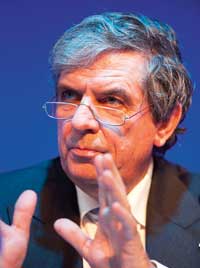
Reform of the Common Agricultural Policy after 2012 should abandon support for farmers and focus on developing a new regime for the “whole European rural area”, according to a leading Dutch academic.
Cees Veerman, speaking at the Oxford Farming Conference, told delegates that a new “Common Rural Policy” should be built around the central principle of rural land use and communities rather than perpetuating an outmoded bureaucratic system.
“One issue remains in the agenda of EU policy makers. What shall we do with the CAP? Looking at World Trade Organisation negotiations is appears the CAP still contains a number of stumbling blocks. If we take a broader view of climate change, world food policy, energy and the role of agriculture, we are in need of new perspectives.”
Faced with the “huge dynamics” of global development, the EU and its member states needed to redefine their position towards the demands society would make of its farmers and rural areas in the future, Prof Veerman said.
“The shifting of climatic zones and scarcity of water that will affect many parts of the world will change conditions in many farming regions. Demand for food and other agricultural products will change dramatically over the coming decades. It comes down to finding new balances in the triangle of people, profit and planet.”
Europe, with its productive farmland and technologically developed agricultural industries, would be at the heart of future food and energy production, he said, and rural policy required a root-and-branch reform to deliver this.
“I believe it is crucial that our policies meet the demands of our society. When the CAP was designed in the 1960s the focus was on production volume to ensure our own food supplies.”
But the challenges of addressing climate change, changing consumer habits, nature conservation and new ethical standards of production meant a new rural policy was needed, not one hinged on food production volumes alone, he said.
“What will be the function of the European rural area in the coming years? A combination of activities and different processes are necessary. This will result in the emergence of a large number of ‘new mixed farms’, combining plant and animal production and geared to energy efficiency.”
Prof Veerman suggested that, while EU support payments to farmers would have to be abandoned, some form of intervention would be necessary to protect against commodity price volatility.
He also indicated that some form of financial support, aimed at farming entrepreneurs, would be necessary. “This should be based on a broader European interest, it should be aimed at a longer period through contracts with entrepreneurs and be based on a reasonable payment in the form of income support.”
But he acknowledged significant difficulties in arriving at a “just” level of support and how it could be implemented. “Let us not forget that with the accession of 12 new member states the number of farmers in Europe has risen from 5m to 15m.”
Europe’s rural area would not just be seen as a food production factory, but would have to deliver public “goods and services”. “These would include the stewardship of nature and landscape values.” The rural area’s contribution to public health, production of renewable energy and capturing carbon dioxide from the atmosphere would also be seen as public goods for the benefit of all.
“The pathway of gradually changing the CAP and bringing down the EU budget will be the most likely outcome of the intensive debates in the years to come. But the most important challenge for the future CAP is that we develop a new vision about the future of the European rural areas based on their functions in the 21st century.”