

Agronomists warn of ‘unforeseen consequences’ from SFI
 © Tim Scrivener
 Independent agronomists are warning of “unforeseen consequences” arising from the Sustainable Farming Incentive, including the potential loss of food production and service industry contraction.
An interactive poll held at the recent Association of Independent Crop Consultants (AICC) conference revealed that the vast majority of members are involved in clients’ Sustainable Farming Incentive (SFI) applications, either taking control of the process or advising on suitable actions.
But attendees at the conference reported that significant areas of arable land are being taken out of food production and put into non-food producing SFI options.
See also: How much income can nature provide on a commercial farm?
There was also a fear this could have devastating consequences for associated agri-businesses.
Buckinghamshire-based agronomist Andrew Cotton said that contractors and farmers reliant on contracting their neighbour’s farms could struggle to survive where large areas of arable land are being put into SFI options rather than being farmed commercially.
Once these businesses are lost, it would be very difficult for them to re-enter the industry due to the ever-increasing cost of new machinery.
“It has already had a significant impact on a local grain trailer manufacturer, who has seen sales plummet,” Mr Cotton said.
Flood concern
AICC adviser Peter Cowlrick also warned of possible unforeseen consequences from the push towards no-till farming under SFI, suggesting that remedial cultivation might be required in some cases to improve water infiltration.
“Without it, there could be increased risk of run-off and elevated flood issues,” he said.
However, Defra’s policy development lead, Jonathan Marsden, said the SFI offered a “pick and mix” approach, so no one was forced into any action if it was not appropriate on their land.
He also revealed that the no-till option built in the occasional need for subsoiling without penalty, helping to minimise issues with drainage.
More money, more options for 2024
Despite worries about SFI’s long-term impact, AICC members welcomed the release of more details of SFI 2024, due to open this summer.
Payment rates are now 10% higher on average, and there are 50 new actions to choose from, alongside 50 updated ones.
New actions of interest to arable producers include precision farming adoption, with £27/ha paid for variable-rate application of macronutrients nitrogen, phosphorus, and potash.
Other options include £43/ha for use of camera or remote sensor guided herbicide applications, £150/ha for robotic mechanical weeding, and £101/ha for robotic non-mechanical weeding with electric or laser weeders.
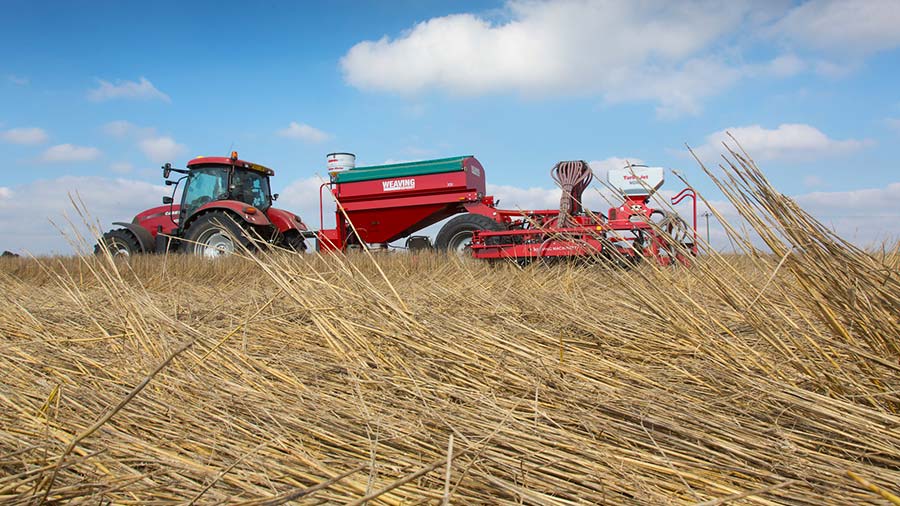
For soil health, growers will be able to claim £73/ha for no-till farming with the action requiring growers to direct-drill straight into stubbles. Strip-till drills will not be eligible.
Explore more / Transition
Follow the experiences of our 16 Transition Farmers and access in-depth supplements, expert webinars, live events and practical content covering the challenges and opportunities facing farm businesses.
Transition is an independent editorial initiative supported by our UK-wide network of partners.
Explore the Transition hub for the latest insights, resources and events.
