

Bradshaw dismisses claims of UK food ‘resilience’
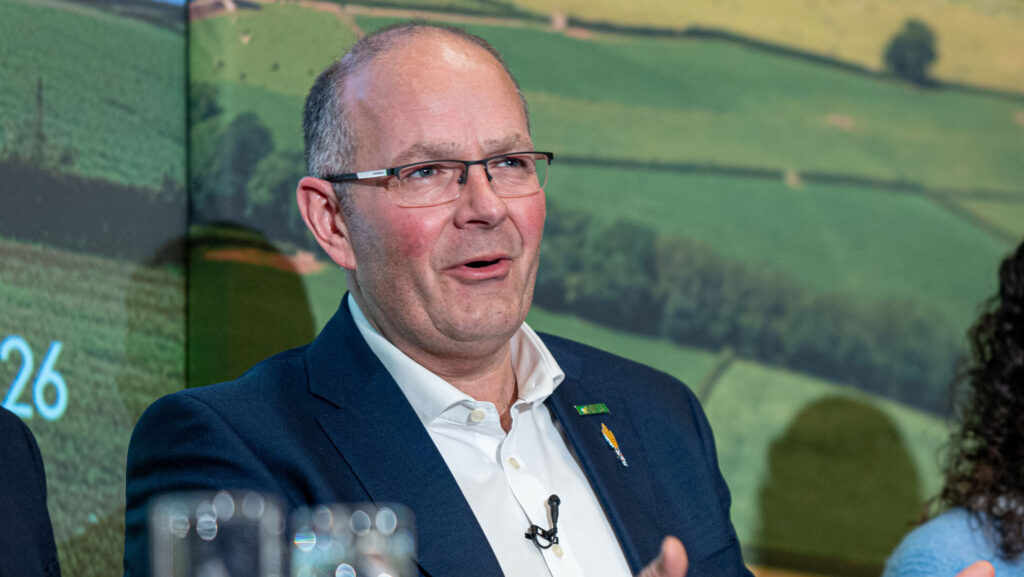 Tom Bradshaw © Telling Photography
 Claims that UK food and farming systems lead the world in terms of food resilience have been dismissed by NFU president Tom Bradshaw, who said such notions were far removed from the reality on the ground.
The claims are contained in an upcoming Resilient Food Systems Index prepared by Economist Impact (part of The Economist Group) provisional details of which were shared at a Future of Food Summit in London on Tuesday (10 February).
See also: Persistent rain threatens crops and farmers’ livelihoods
The new index assesses food resilience according to affordability, availability, quality/safety, and climate risk responsiveness – and on that basis the researchers conclude that the UK is in the top three globally, topped only by Portugal and France.
The UK leads the US, and is way ahead of African countries such as Uganda, Kenya and the Republic of the Congo.
However, Mr Bradshaw said this ran the risk that policymakers would wrongly perceive UK agriculture to be in a place of strength.
“When you say that the UK is third in the world, a lot of people will think, ‘brilliant!’,” he said. “But I can tell you that is completely misrepresentative of how British farmers are feeling today.”
The reality was that many British farmers were currently living off past profits, were unable to invest and were constrained by a planning system that didn’t work, he said.
There was a particular issue around an overdependence on food imports and a lack of support for domestic production.
“With the climate changing around the world, we’ve got to take responsibility for our domestic food system,” he said.
Profitability
The biggest weakness in the Resilient Food Systems index was its failure to talk about farmer profitability, Mr Bradshaw added. “That is the absolutely critical metric that is missing,” he said.
There was also a critical need for more investment in agriculture – and that was the responsibility of the whole food chain.
Using the example of the broiler sector, Mr Bradshaw said the UK was leading the world by reducing stocking rates to an all-time low, yet the planning system, influenced by animal welfare NGOs, prevented growers from building the additional shed space required.
“We are producing less poultry now that we were five years ago,” he said. “We’re drawing in more poultry produced in Poland, Ukraine and Brazil that aren’t meeting our standards of production. Offshoring our externalities is not acceptable.”
The UK population was expected to grow from 70m to 77m by 2050 so it was imperative that the industry could build its productive capacity.
Yet the “staples” such as poultrymeat, cereals, vegetables and red meat were all in decline. “That is not a resilient food system,” he said.
Lowering standards
Mr Bradshaw rejected any suggestion that the UK should lower its production standards by way of response, but instead sought legislative change to ensure any imports met UK core standards.
There should also be a change in the taxation policy to encourage more farm investment in broiler sheds, glasshouses and water storage, by extending and increasing annual investment allowances.
“At the moment, your annual investment allowance can’t be used to build an on-farm reservoir – it’s absolutely crazy,” he said.
Mr Bradshaw also called for mandatory domestic production targets for individual farm sectors.
“If we don’t have a target, then there is nothing to hold the government to account,” he said. “At the moment, we don’t even have a [government] ambition for food production.”