

Food security overhaul urged as volatility is ‘new norm’
 © AdobeStock
 Farmers and food producers are facing a permanent era of instability driven by energy shocks, climate pressures, cyber threats and escalating global conflict, MPs were warned at an Efra committee hearing on UK food supply resilience.
Witnesses said continuing tensions in the Middle East, alongside the war in Ukraine, are feeding through to global oil and gas markets, pushing up costs for fertiliser, transport and food production across the UK supply chain.
Speaking at the Environment Food and Rural Affairs (Efra) committee hearing in the Commons on 19 May, food policy expert Professor Tim Lang told MPs the UK can no longer assume stable prices or predictable supply after repeated systemic shocks.
See also: Opinion: The age of volatility demands a new approach
“I think the thing you can no longer take for granted is the lack of volatility,” he said. “Volatility is the new norm, is what most analysts now will tell you.”
He said the current environment exposed long-standing weaknesses in UK food security planning, rooted in assumptions of constant availability.
“We assume food is there. It will always be there,” he said. “We assume others will feed us.”
He added that government thinking had too often relied on retailers to manage supply, describing the approach as “leave it to Tesco et al”.
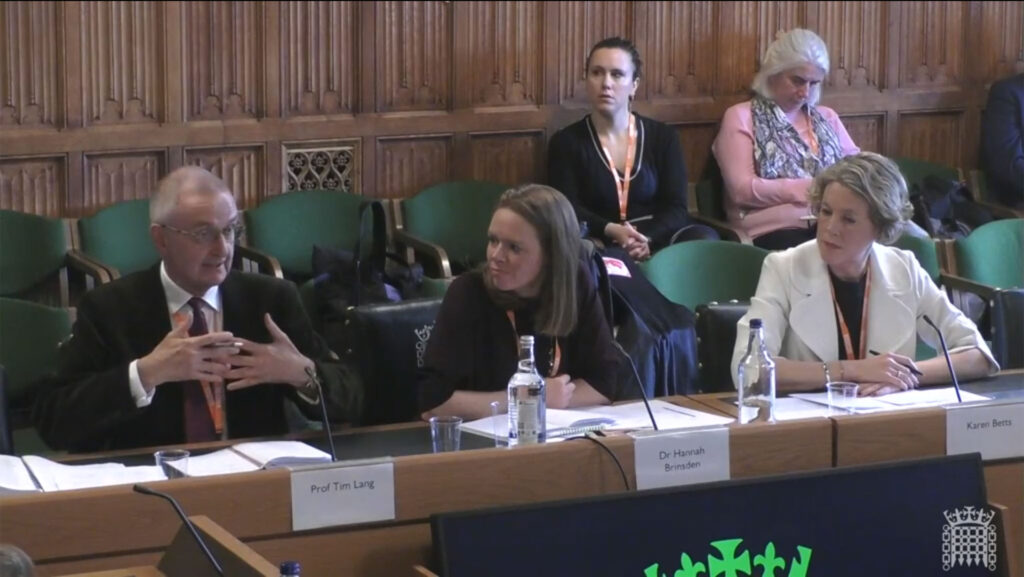
Prof Tim Lang, Dr Hannah Brinsden and Karen Betts at the Efra committee hearing © Parliament TV
Prof Lang called for structural reform, including new legislation on food security and the creation of a national food security council, bringing together government, industry, public health and civil society, arguing that existing institutional frameworks are not equipped for repeated shocks.
Exposure to repeated cost shocks, particularly from energy and fertiliser, was a central theme of the hearing.
Food inflation
Karen Betts, chief executive of the Food and Drink Federation, said rising energy costs across the food system are driving renewed inflation pressure.
“You’ve got energy embedded in every part of the system from farming and fertiliser through to processing, manufacturing, retail, and hospitality,” she said.
She warned food inflation will rise again as global energy markets react to conflict and supply disruption, saying: “We think that food inflation will be somewhere between 9% and 10% by the end of the year.”
For farmers, that means higher input costs with limited ability to pass them on, reinforcing long-standing concerns about fairness in the supply chain.
Ms Betts added that many firms have already exhausted their ability to absorb further cost pressures. “I don’t think companies have got many places to go now,” she said.
She noted that smaller food businesses are particularly exposed due to weaker purchasing power in energy and commodity markets.
Food insecurity ‘rising’
Hannah Brinsden, head of policy and advocacy at the Food Foundation, warned that food insecurity is beginning to rise again.
“When food prices rise, food insecurity goes up,” she said. “If food prices are going to rise again, we’re expecting food insecurity to rise again.”
She added that households are already cutting back on fresh produce, with “around half cut back on fruit and around 40% cut back on vegetables”.
Dr Brinsden said the UK has not recovered from the previous cost-of-living crisis before new inflationary pressures emerged. “We’re seeing this layering effect,” she said. “There’s nowhere to go now.”
The Efra committee’s inquiry is examining trading relationships and the resilience of the food supply chain.