

Hereford cattle ‘rare breed’ dispute heads to High Court
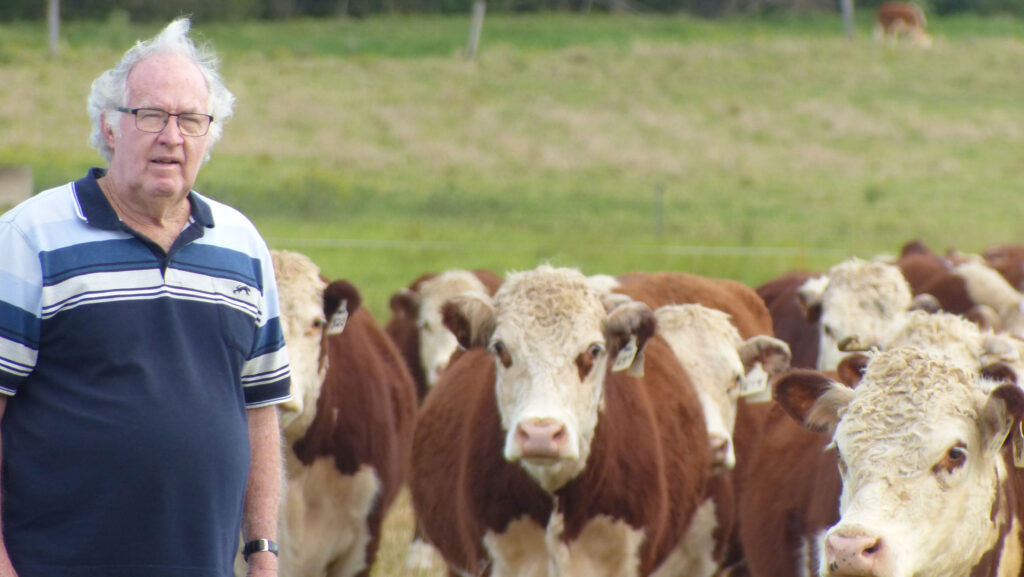 Peter Hall © Peter Hall
 A High Court challenge over the classification of Traditional Hereford cattle could have implications for farmers seeking support to conserve the historic British bloodline.
A hearing on Thursday (10 September) will consider Australian cattle breeder Peter Hall’s application for permission to bring a judicial review against Defra over its treatment of Traditional, or Original Population, Herefords.
See also: UK’s ancient White Park cattle breed moves to priority risk
Traditional/Original Herefords were previously identified separately within native-breed-at-risk reporting, but in 2021 were merged with the larger Hereford population for national breed inventory reporting.
The Native Breeds at Risk (Nbar) list was replaced by Defra’s Native Breeds Support (NBS) list in April 2026, which classifies Hereford cattle as a whole as “not at risk”.
For cattle, the threshold for at-risk status is 6,000 breeding females, or fewer.
Below this threshold, it is possible to claim a supplementary payment under the Sustainable Farming Incentive in England.
The Traditional Hereford Breeders’ Club’s latest census records just 1,230 pedigree-registered Traditional breeding females.
Mr Hall argues the much larger North American Derived (NAD) Hereford population masks the rarity of Traditional cattle when the populations are counted together.
He is challenging Defra’s decision to treat Traditional Herefords as a sub-population of the wider Hereford breed, rather than a separate native breed, and its decision not to exercise investigative or enforcement powers against the Hereford Cattle Society.
Legal challenge
Speaking to Farmers Weekly, Mr Hall said he had turned to the courts after Defra declined his request to investigate.
“Their answer was no. We don’t have to investigate,” he said. “So that’s why I’m where I’m at. That’s the only way.”
Mr Hall said some Traditional bloodlines were particularly vulnerable, with just one female from the Maria family and two from the Lively family remaining in the UK.
He keeps about 170 Traditional Herefords on 150 acres in New South Wales, including 10 Lively females.
His family’s involvement with Herefords dates to the 18th century and he rebuilt his herd using 100 embryos imported from England.
If his challenge succeeds, he wants Traditional Herefords separately recognised.
“They have to be a breed on their own,” he said. “They have to have their own herd book. They have to have their own breeding plan.”
Whole breed approach
The Hereford Cattle Society is supporting Defra in its defence of the status quo and will appear as an interested party.
General manager Seth Wareing said: “The society and Defra do not accept that the Aberystwyth genetic test relied upon by Mr Hall provides a basis for defining Traditional Herefords as a separate breed.”
Agricultural law specialist Laura Mackain-Bremner of Clarke Willmott, representing the society, added: “This case is not simply about genetics; it is also about breed governance, conservation policy and the role of recognised breed societies.”
Defra said it follows a scientifically advised “whole breed approach” to native breed conservation rather than treating sub-populations individually.
A spokesman said: “We have followed the latest scientific advice to protect Hereford cattle for generations to come and ensure there is genetic diversity in the population.”
Thursday’s hearing will determine whether Mr Hall has permission to proceed to a full judicial review.