

Opinion: Agri-tech must earn its place on-farm
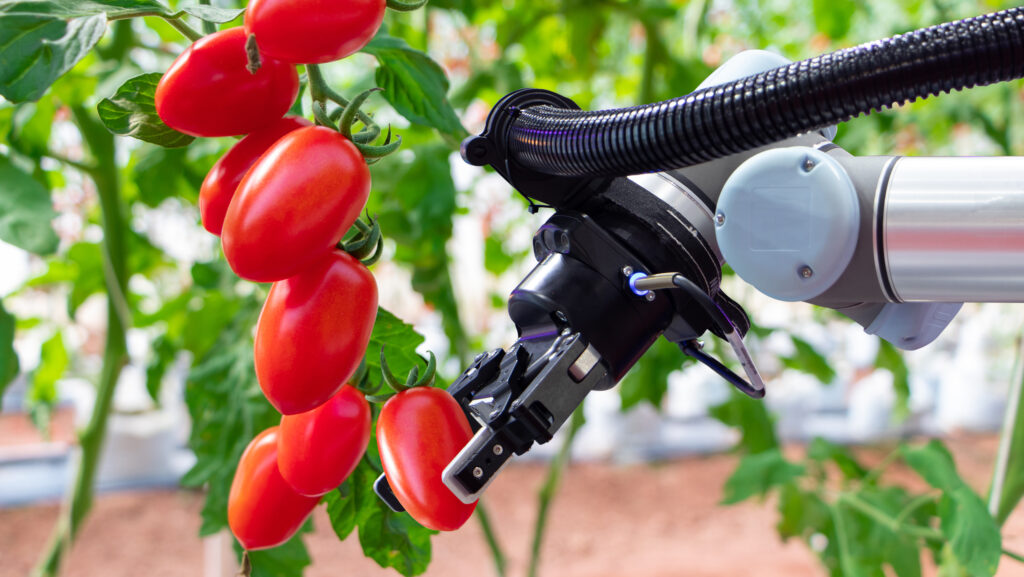 © Adobe Stock
 The potential benefits of embracing agri-tech for farmers running high-risk, capital-intensive businesses are clear to see.
Innovation in artificial intelligence (AI) and robotics, for example, holds huge potential to bring positive change to farming, including operational resilience and efficient resource management.
See also: Have UK’s Agri-Tech Centres achieved and what’s next?
About the author

Steve McLean is the chief executive of the UK Agri-Tech Centre.
Here he sets out why farmer involvement is key to agri-tech success.
The UK government’s 10-year Modern Industrial Strategy, launched in 2025, identified agri-tech as a frontier sector, backed by significant investment in robotics and automation.
Too much of the national conversation, however, still focuses on what is technologically possible, not what works in practice.
The UK Agri-Tech Centre was established to close this gap.
Accelerating the path from innovation to adoption by validating return on investment on commercial farms, “stress-testing” in real-world environments, and tackling other practical barriers, de-risks the process for innovators and farmers.
With the farmer ultimately bearing the brunt of risk in agri-tech take-up, taking a connected approach to share risk across the value chain is critical for success.
AI and robotics
Artificial intelligence is beginning to earn its place on-farm by delivering measurable benefit.
Businesses supported by the UK Agri-Tech Centre through scale-up and commercialisation include Fotenix, whose AI-powered crop diagnostics enable early intervention and precise input use, and Hoofcount, whose technology can detect lameness at the earliest stage of lesion development, protecting welfare and productivity before losses escalate.
What these tools have in common is that they strengthen decision-making rather than replace it and crucially, they are being validated in real farm systems rather than a controlled environment.
In horticulture, acute labour shortages and regulatory pressures have accelerated the adoption of robotics.
Earth Rover has commercialised laser weeding systems that reduce chemical reliance and labour dependency, and UPP’s robotic broccoli harvesting system addresses a known bottleneck in high-value crops, both supported by UK Agri-Tech Centre.
In combinable crops, we are earlier in the development cycle.
However, autonomous platforms such as the Robotti from Agrointelli and the AgBot from AgXeed are generating significant interest (though their higher capital costs, integration challenges and questions around long-term servicing are slowing widespread uptake).
Initiatives like the UK Agri-Robotics Regulatory Network, led by the UK Agri-Tech Centre in partnership with the University of Lincoln, Harper Adams University and the Manufacturing Technology Centre, aim to slash the red tape both for farmers and technology innovators, simplifying the regulatory landscape and lowering the barriers to adoption.
Integration or disruption
There are two approaches to the adoption of agri-tech – integrate or disrupt.
Integration into existing machinery fleets and workflows reduces risk and accelerates uptake, while disruption can deliver transformational change, but typically requires three to five years of operational and cultural adjustment.
Our role is not to favour one model over another, but to ensure both approaches are tested rigorously before scaling.
Farmers should not be expected to shoulder disproportionate risk while technologies mature, but need adaptable, open systems that evolve with their businesses.
Above all, adoption depends on shared risk and cultural change.
The route to change must be farm-led from the outset, shaped by real operational needs, tested in working systems, and validated economically before widespread release.
Proven success
Over the past year, more than 200 companies have worked with the UK Agri-Tech Centre to refine and prove their technologies in commercial conditions. Proving profitability of technology is key.
The latest round of grants in the Farming Equipment and Technology Fund 2026 will also be an important method to ensure agri-tech is invested in on farm.
Our job is to ensure that technology is market ready and fit for purpose.