

Opinion: Conducting on-farm trials is a great way to learn
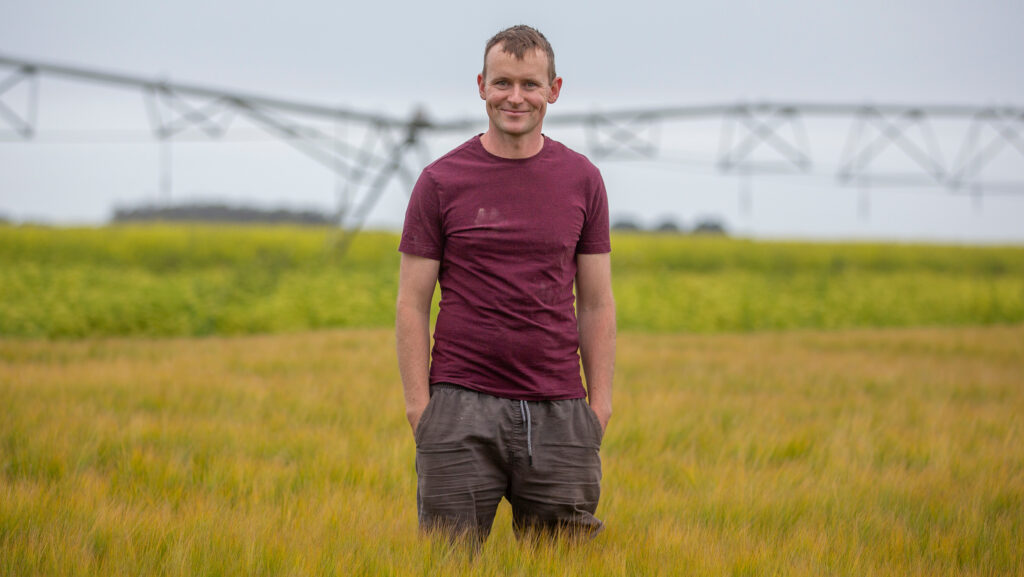 Chris Bennett © Johnny Houston
 As I walked our increasingly flea beetle-attacked oilseed rape crops, the quote “if you’re not failing, you’re not learning” sprung to mind.
It was a Gabe Brown quote, but before you skip to the next article, I am not here to talk about regenerative agriculture but about the importance of doing your own on-farm trials.
See also: Opinion – new SFI means more risk and more cost for farmers
About the author

In this regard, we need to fail at a few things every year to work out what does and does not work on our own farms.
There are some fantastic replicated and very official trials done all over the country by many organisations at vast expense.
These provide great value to the industry, but are limited by having to generalise results across many soil types, weather patterns and situations.
There is no better trial than trying something on your own farm, whether that be treating a tramline differently or testing across neighbouring fields.
On our farm, every year we seem to have countless tramline or split field trials attempting to work out all sorts of things. Is it only us that does this or does everyone else do it, too?
We have done in-house trials to work out the optimum amounts of nitrogen, we have tried applying complex mixes of micronutrients, we have tried direct-drilling after oilseed rape both with and without a catch crop and are currently trying winter cover crops of different varieties to see their effect on blackgrass.
I’d find it hard not to try things out. I think it stems from indecision on my part.
When a problem arises and I’m not sure what to do, I think: Why not try both options? One of them will be better and at least I have learned something by the end.
We have been trying to figure out the best way to establish oilseed rape by varying drilling date and variety.
Through trying things over multiple years, the optimum drilling date appears to vary wildly year-on-year and the varietal differences are not as significant on-farm as they appear to be on the AHDB Recommended Lists.
If failure equates to learning, it seems there is plenty of opportunity to learn with oilseed rape establishment.
After returning to the UK, one of the first things we tested was whether insecticides were effective or whether we should enter the Sustainable Farming Incentive (SFI) as insecticide free.
National data told us that insecticide resistance was spreading but we did not know whether our own set of pests were resistant or not until we tried. We left a field of spring beans unsprayed to see the effect on bruchid beetle and similarly in oilseed rape for flea beetle.
In both cases we found little benefit and that it would be better to take the SFI payment to not use them. The trial gave us confidence to scale up and avoided the risks of an “all in” decision on day one.
Farming changes so quickly it is no longer good enough to keep doing the same thing every year assuming it is still the best thing.
Learning has to be a priority. If you find yourself questioning the effectiveness of a pesticide application or whether there is a better way of doing something, why not try something different on a small area, miss a tramline out or treat a field differently?