

Opinion: Lowe’s Defra challenge is right, but why ignore Brexit?
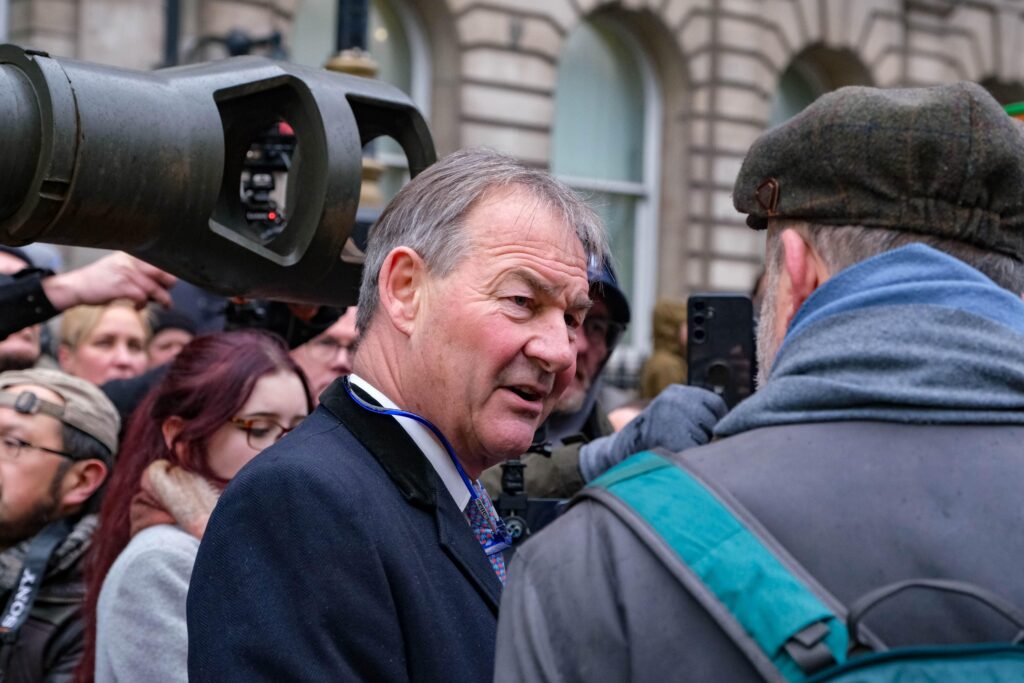 Rupert Lowe MP © Mark Lear/Alamy Live News
Restore Britain MP Rupert Lowe’s recent confrontation with Defra permanent secretary Paul Kissack in Westminster exposed genuine problems facing British agriculture: rising costs, shrinking margins, policy instability and threats to food production.
Yet his diagnosis overlooked one of farming’s biggest structural changes in generations: Brexit.
About the author

Matthew Mountain
Matthew is a director of Mountain Farms, based in Lincolnshire. Here he argues that Brexit has inflicted untold damage on the agri-food sector’s interests.
See also: Analysis: Brexit decade brings mixed fortunes for farmers
Mr Lowe was justified in challenging the Sustainable Farming Incentive (SFI) debacle. Farmers cannot plan rotations, machinery investment or environmental commitments around abruptly closed application windows.
Labour did not create this framework. Successive Conservative governments left the CAP, phased out basic payments and designed the original Environmental Land Management schemes. Labour owns its SFI failures; the Conservatives designed much of the system.
But why was Brexit largely absent from Mr Lowe’s examination of food security? A policy debate that overlooks export friction, changing import competition and the removal of direct payments risks mistaking the pressures farmers experience for the decisions that helped create them.
Paperwork
Within the EU single market and customs union, British farmers traded with their closest major market without today’s customs formalities and sanitary certification. Meat, dairy and plant exporters now face extra paperwork, delays and costs.
Meanwhile, post-Brexit agreements have granted overseas agricultural exporters additional UK market access, including producers operating under very different regulatory and cost structures.
While British farmers meet demanding environmental, animal-welfare and production standards, they must compete with imports sometimes produced under less stringent requirements.
This exposes a contradiction in the sovereignty argument. As an EU member, Britain helped establish common agricultural standards and negotiate trade agreements with the collective weight of a market of approximately 450 million consumers.
Pooling sovereignty strengthened our bargaining power over the conditions under which farmers competed.
Outside the EU, Britain has greater freedom to set domestic rules, but cannot automatically prohibit imports merely because production methods differ.
World Trade Organisation obligations constrain unjustified or discriminatory restrictions, including science-based requirements for certain health measures. The EU faces those obligations too, but its larger market gives it considerable negotiating leverage.
Britain has also lost its vote over EU rules affecting its largest neighbouring agricultural export market. Is that greater practical sovereignty, or less power to shape markets?
Consequences
The economic consequences extend beyond agriculture. The Office for Budget Responsibility estimates Brexit will leave UK long-run productivity approximately 4% below what it otherwise would have been.
Research published by the National Bureau of Economic Research shows UK GDP was 6-8% lower by the end of 2025, and business investment 12-13% lower than without Brexit.
Against a roughly £3tr economy, that GDP gap implies approximately £190-£260bn in lost annual output. Applying a tax-to-GDP ratio of about 36% gives an illustrative £70bn–£95bn in forgone annual receipts, rather than a directly measured Treasury loss.
Fiscal capacity matters when farmers face contentious inheritance tax changes and pressure on rural support.
False choice
Mr Lowe’s suggestion that Defra risks turning farmers into gardeners creates a false choice. Soil health, drainage, nutrient management and biodiversity underpin productive agriculture. Environmental payments should support viable food production, not displace it.
Equally, expensive energy reflects gas prices, electricity markets and network charges, not solely net zero; drought and flooding also damage yields. Food security depends on profitable farms, investment, competitive markets and coherent policy.
Mr Lowe’s Restore Britain rhetoric raises a fundamental question: what happens when populist promises of restored sovereignty encounter the economic realities of farming outside the EU?