

Opinion: Reality check needed over domestic food production
 © Coldsnowstorm/iStockphoto
 At a time of global turmoil, it is frankly baffling that domestic food production is not being given the support or recognition it so drastically deserves.
Governments still seem in hock to a belief that food can be imported from anywhere in the world, even though geopolitical stability seems to be a thing of the past.
See also: ‘Seismic waves’ on the way for farming as Iran war persists
These themes were examined in our recent report Food For Thought – Securing Sustainable Farming Futures, which drew on insights from the likes of NFU Cymru’s Abi Reader, Cath Crowther of the Country Land and Business Association East, Royal Welsh Agricultural Society chief executive Aled Jones, and many more.
About the author

Rory Hutchings is a partner and head of agriculture for law firm HCR Law.
Here he argues that a just-in-time food supply chain is a risk we can’t afford.
All were in agreement: there are too many barriers standing in UK farmers’ way when it comes to feeding the nation.
We seem to have been lulled into a false sense of food security. Over the past 50 years, supermarkets have largely replaced the plethora of small high street shops that went before, and that means the nation’s food supply has become less local and less connected with the consumer.
Cheap and plentiful food is now the norm, and the proportion of household income spent on food has diminished. Bluntly, food is taken for granted.
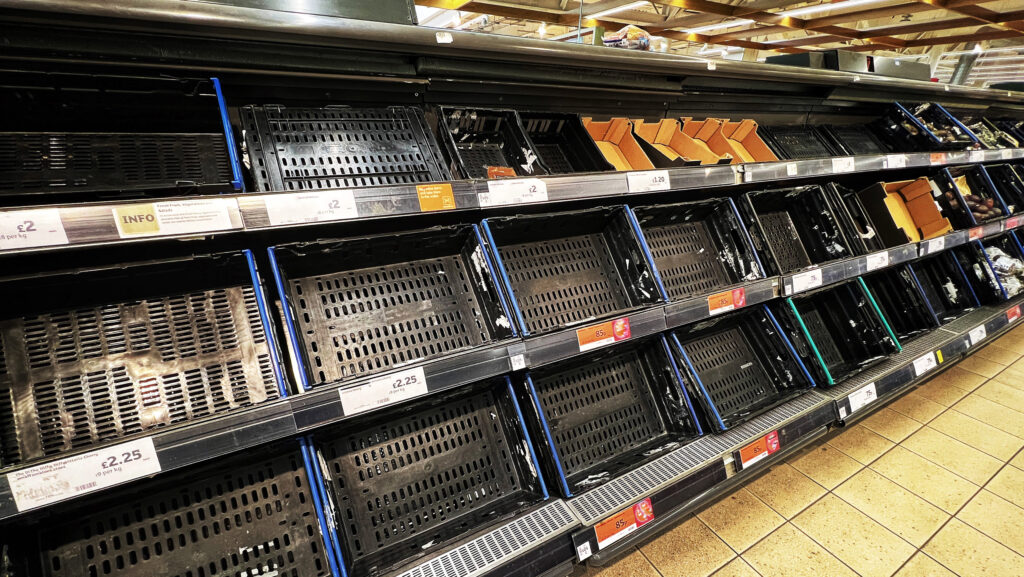
‘Just in time’
A speaker at the NFU annual conference last February said policies relating to the supply of food had shifted from being “just in case” to “just in time” in their outlook.
A just-in-time system is no issue when everything runs according to plan, but in life we know that things don’t always run smoothly.
You only have to think back to the Covid-19 pandemic and the fact that toilet roll became the country’s “must have” item.
To use a boxing analogy, everyone has a plan until they are punched in the face. Recent global events have been the metaphorical punch to the world economy and no one knows what is likely to happen next.
How times have changed. At the end of the Second World War the country understood the need for food security and policies therefore encouraged food production.
Subsidies and support enabled a huge shift in investment and the adoption of technology to allow farming to produce the food the nation needs.
Inconsistent decisions
On the world stage we have become governed by character-based leadership and subjected to inconsistent decisions.
We face wars and tariffs that we could not have imagined even a few years ago. There are now major conflicts in Europe and the Middle East. The consequences of both will be far-reaching and will affect us at the fuel pump and the supermarket checkout.
The world economy, only just recovering from the pandemic, has had to deal with the Russian invasion of Ukraine and the unravelling of American diplomacy, with US president Donald Trump removing the leader of Venezuela, threatening to invade Greenland, and driving a coach and horses through the Middle East.
Rebalancing
The upshot is that there needs to be a rebalancing in what we do to ensure food security in this country.
We need sustainable food production and increased national self-sufficiency, so the country is in a better place to deal with the next geopolitical shock.
That means that while we still need to look after the environment, as it is key to sustainability, the focus should be on creating a sustainable and resilient farming sector.
Governments must let farmers do what they do best, and that is producing food.