Trial shows beans can cut carbon footprint of spring barley
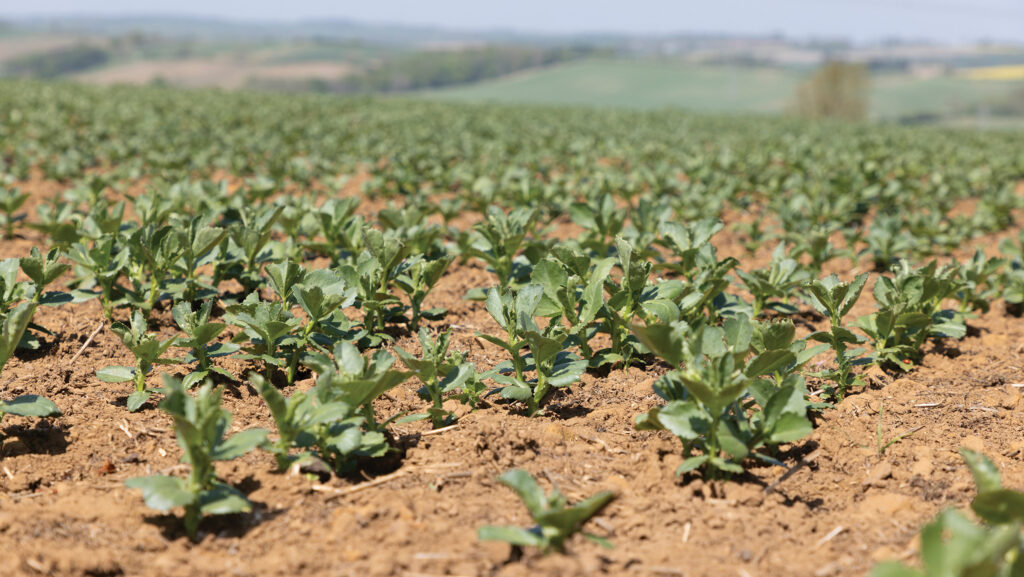 Spring beans © GNP
 Research shows that adding beans into cereal rotations can reduce fertiliser use, lower environmental impacts and, in most years, increase the yield of the barley crop that follows.
Scientists analysed data from the John Hutton Institute’s long-running research at its Centre for Sustainable Cropping (CSC) at Balruddery Farm near Dundee.
They compared spring barley grown after field beans with barley grown after barley.
See also: Beans can deliver high yields in Scotland, trial shows
Dr Cathy Hawes, who leads research at the CSC, says in this study, synthetic nitrogen fertiliser use for barley following beans was reduced by an average 22kg/ha.
Pesticide use – another major contributor to the environmental footprint of crops – can also be substantially lower after field beans.
Across five two-year cropping periods, growing field beans before spring barley reduced the environmental impact of barley production in four of the five periods.
Averaged across the crop sequences, environmental impacts were reduced by about 25%.
There was also a potential productivity benefit. Across the five years examined, spring barley following beans yielded an average 1.2t/ha more than barley following barley in four of the five years.
However, the researchers caution that beans are not an automatic guarantee of higher yields.
In the unusually dry conditions associated with the 2022 barley crop, barley following beans yielded less than barley following barley.
The study suggests that weather, particularly temperature and humidity, together with how well the preceding bean crop performed, strongly influences the benefit received by the following cereal.
These findings are particularly relevant to Scotland, where spring barley underpins major brewing, distilling and livestock industries.
It concluded that wider adoption of bean-barley sequences could offer substantial greenhouse-gas reductions.