Beans can deliver high yields in Scotland, trial shows
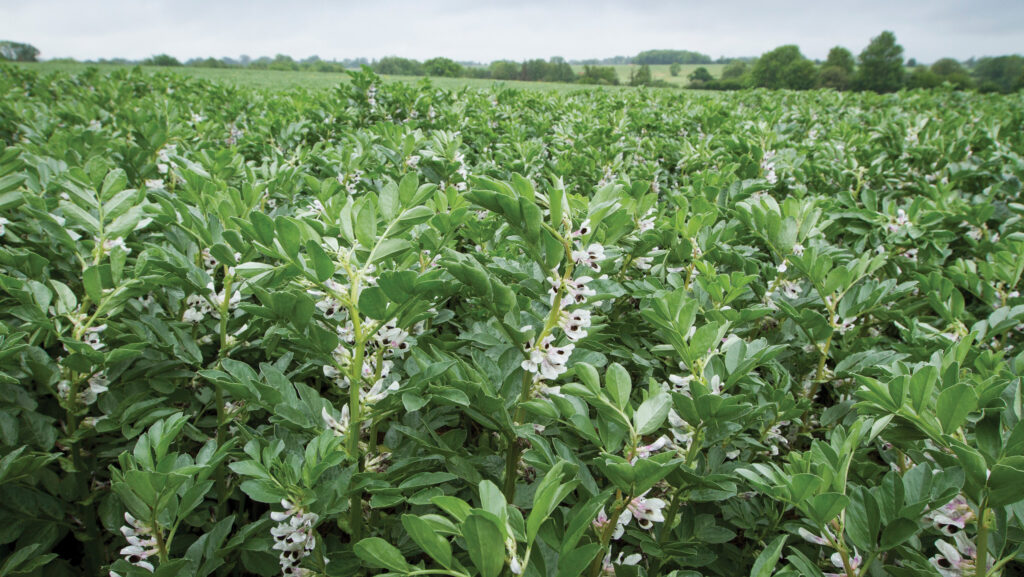 Winter beans in flower © GNP
 A trial has shown that growing beans in Scotland can successfully deliver high yields, but careful site selection, variety selection and drilling date are key to success.
Scottish break crops are facing challenges; the depressed malting barley market is hitting spring barley returns, while oilseed rape is increasingly suffering from pest and disease pressures including clubroot.
One potential alternative that does not suffer from clubroot is beans. However, they are rarely grown in Scotland and little trial work has been carried out.
Therefore, the main objectives of the two-year Innovative Farmers field lab are to better understand which varieties are best suited and to evaluate the suitability of bean production in Scotland.
See also: Why beans may have a place in Scottish rotations
Innovative Farmers Field Lab
Five arable farmers in Scotland are taking part in the two-year Innovative Farmers field lab.
The Processors and Growers Research Organisation is co-ordinating the trial, with research support from Scottish Agronomy.
Speaking at a recent briefing, agronomist Stevie Gray at Scottish Agronomy says they had five sites stretching from the Black Isle in the north down to East Lothian.
Each site had four varieties – three winter and one spring type – all sown in autumn.
The Bean YEN project used one variety (Tundra) from each site to estimate yield potential at each site.
It also allows the researchers to see how these trials performed within the same season relative to the rest of the UK.
Out of the three sites, two didn’t make it to harvest having suffered winter kill on all varieties.
Stevie suggests this was not a varietal issue, but was likely due to the later drilling date leading to sub-optimal conditions for establishment.
Sites
Looking at the three sites that did produce a crop, he says yields were held back by the lack of rain. At Inverness, the crop averaged 4.5t/ha.
“The crop established well and was structurally sound, but it didn’t reach its yield potential due to the dry conditions.”
North Berwick was the best performing site, averaging about 6.4t/ha.
Stevie believes this was down to the beans being established a little earlier (five days earlier than Kirkaldy and 19 days earlier than Inverness).
However, yield was again limited by the drought. The third site (Kirkaldy) averaged 5t/ha.
Varieties
Looking at varieties, Lynx was on average the lowest yielding variety and Vincent was the highest.
Lynx is a spring variety, so was expected to yield the lowest, though it still performed well overall.
Stevie points out that variety performance was location specific. For example, Vespa performed well at some sites and proved disappointing at others.
Another finding was Tundra’s performance. Tundra is 15% behind the top performer (Vincent) on the Processors and Growers Research Organisation (PGRO) Descriptive List.
However, in Scottish conditions, Tundra performed well, and along with all the other varieties, it exceeded the UK average.
In conclusion, winter beans can succeed in Scotland and Scottish crops can match or even exceed UK-level yields.
However, drilling conditions is a key agronomic factor for beans, says Erin Matlock, research agronomist at the PGRO, who helped manage the trial.
Achieving good seed-to-soil contact and avoiding compaction are essential.
“YEN data shows that earlier drilling can lead to higher yields, but going too early increases the risk of frost damage and more severe chocolate spot, says Erin.
“If soils become too wet to travel in late October to mid-November, it’s far better to wait for conditions to improve rather than force the drilling date.”
Key points
- Beans can perform as well as in rest of the UK
- Getting the agronomy right should be the primary focus
- Variety selection is key, as varietal performance can vary by region – particularly in non-traditional growing areas