Can probability weather forecasting improve farm decisions?
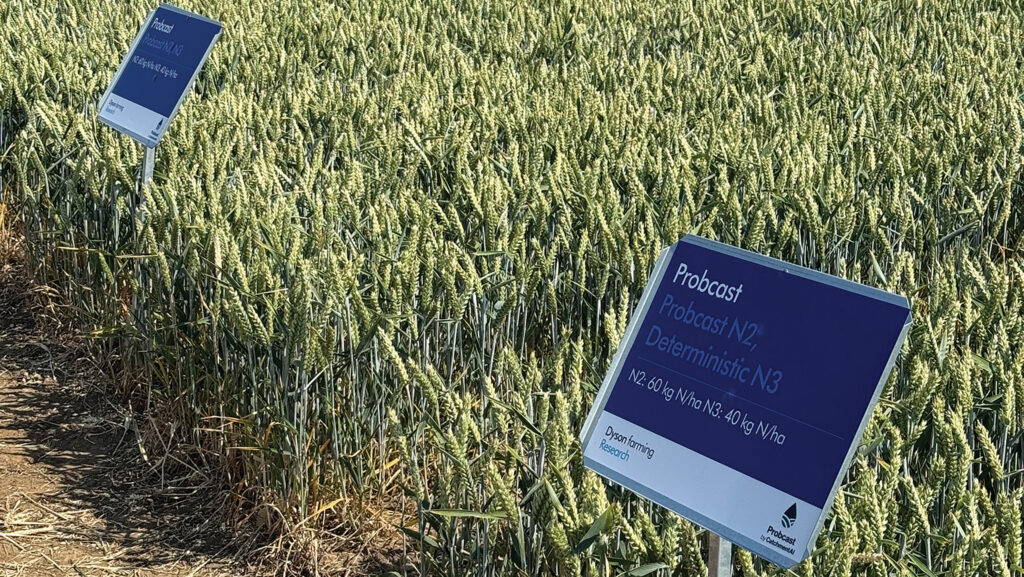 © Catchment AI
 How many times have you consulted multiple weather apps to find a slightly different forecast for your farm?
And then chosen the one you like best as the final arbiter of whether to go spraying, drilling or fertiliser spreading on any given day, only to find it was the wrong decision as the weather doesn’t play ball?
See also: Grower trial aims to unlock food-grade millet production
It’s precisely this frustration that Northamptonshire arable farmer Stuart Tabernor is seeking to avoid as the lead farmer in a new Adopt project trialling CatchmentAI’s Probcast service, a probability weather forecasting service developed by Jack Dunning and Dr Will Veness.
Rather than condensing complex weather models into a single average hourly prediction, or worse a vague icon, Probcast analyses the 18 Met Office simulations that go into producing the average forecast, to give growers much more explicit hourly predictions of rainfall volumes, wind gusts and operational windows.
“We give probabilities rather than just a single prediction,” explains Will.
“We show the farmer [the results from] the 18 weather model simulations, so they can see not just the expected average, but also the most extreme outcomes.
“For example, what is the heaviest rain in this hour, or the chances that the wind is going to pick up above a speed suitable for spraying.”
Displaying that in a way that is easy to understand for the user is crucial, so CatchmentAI has developed colour coded charts and graphs that highlight different probabilities.
A five-day rainfall forecast chart, for example, shows the probability that rainfall will exceed a specified level in six bands ranging from under 2.5% – the maximum simulated outcome – to 90% chance.
“It’s good, detailed information,” Stuart says, highlighting the next day’s forecast for rain between 12 and 1pm during the Farmers Weekly interview.
“There’s less than a 2.5% chance of exceeding 2.5mm, and just a 10% chance of over 0.25mm, so I would work with that risk.”
Stuart likes that he can also easily toggle on and off the lower probabilities, which quickly highlight when the greatest chance of rain might be in a forecast, helping with planning operations.
“You can do the same with a 15-day forecast,” he adds.
“But what I really like is that CatchmentAI has developed a really neat system of weather windows that gives predictions for when you will be able to spray in the next week.”
Users set the conditions for spraying using criteria such as maximum average wind speeds, wind gusts, rainfall in the spraying window and in the six hours prior or after spraying and minimum and maximum air temperatures.
“This allows me to tweak it to the job you are doing. For instance, if you have a sprayer with windshields on the front and back, you could tweak the wind speeds up,” Stuart says.
Traffic light system
The model has a traffic light system showing green when 100% of the conditions are forecast to be met, amber for 80-100% chance, and red for below 80%, to make it quick to understand when windows could occur, while still giving the percent overall chance of good conditions.
Underneath the summary chart, a breakdown of the individual criteria shows why a particular criteria has or hasn’t been met using the same traffic light colour coding.
Similar models can be built for other weather-dependent operations, such as fertiliser spreading, drilling and harvesting using different criteria, Stuart says.
For example, drilling windows can pull in soil temperature data either from soil probes on the farm or from modelling supplied by the Met Office.
User friendly
The system is very usable for farmers, Stuart says. “It provides simple information quickly, but if you want to go into more depth, you can, and it is easy to do.”
While there is a potential danger that some users could become too risk-averse, if the system shows a low probability of a heavy shower in a particular period, Stuart says in his experience with Probcast since March, he’s found the opposite to be true.
“When you look at forecasts on the Met Office or BBC it’s easy to write a day off because it says there is a 50% chance of a shower all day, whereas looking at Probcast and you might see [the greatest chance is for] rain in the morning and then [more likely go to be] dry in the afternoon and be ready to go as soon as conditions are right.”
He says there’s nothing worse than standing in the yard thinking “I could have been spraying now”.
Monitoring for the probability of a trough in wind speed is data Stuart has also found incredibly useful.
“It was very windy in March and April – not much rain, but changeable wind speeds. To be able to see when the wind was going to drop at a particular time paid dividends.”
Quantifying the real-world value of improved decision-making using Probcast is a key aim of the Adopt project Stuart is leading, in conjunction with Dyson Farming Research and Imperial College.
Farmers needed
That needs more data than just one or two farmers could provide individually, so the aim is to find 70 growers.
Each will be given a free 12-month Probcast licence and paid £350 in return for providing information about decisions made using the service, Will says.
“We want each grower to maintain a log throughout of any major decision made using Probcast and what regular weather apps were showing,” he explains.
“We don’t want to make it too burdensome, so it could be screenshots and/or answering some simple questions.
© Blackthorn Arable
“At the same time, we’re also asking for historical operational logs for at least a year, as well as during next year. We’ll use these to analyse when operations were done and what their forecasts were showing to capture the amount of risk exposure they were working under.”
The aim will be to demonstrate that access to detailed probability weather forecasting allows farmers to work under lower risk of weather disruption, and take advantage of narrow operational weather windows they might miss using standard weather apps, he explains.
Analysing operational records should also provide some quantifiable data around cost savings made from better decision making.
“And hopefully we will get some practical guidance for how the whole industry can better use weather forecasts to improve operational efficiency in a time of increasing weather volatility,” Jack adds.
Data collection
The project will run for 18 months, with data collection starting in January for 12 months after a three month set up period, with three months of data processing to follow.
“At the end, we would like the growers, having learned how to use probability weather forecasts and hopefully seen operational savings, to feel that using Probcast has created value and want to continue using it,” Will says.
For commercial users, price for the service is now set at £10/month/user, rather than the per hectare cost originally envisaged by CatchmentAI.
“Hopefully, with 70 farmers involved, we can prove that the service is worth that,” Stuart says.
“From my experience, while I think for drilling it is still worth walking the field to make sure conditions are right and you won’t be picking up soil, for any spraying, fertilising and broadcasting jobs, I’ve found it invaluable.”
What is Adopt?
The Accelerating Development of Practices and Technologies (Adopt) funding through Defra’s Farming Innovation Programme aims to support farmer-led on-farm trials developing and testing new solutions to farming challenges, with the results shared to help other farmers.
Projects last from six months to two years and are led by a farmer.