Beet trial shows benefit of elicitor on foliar disease control
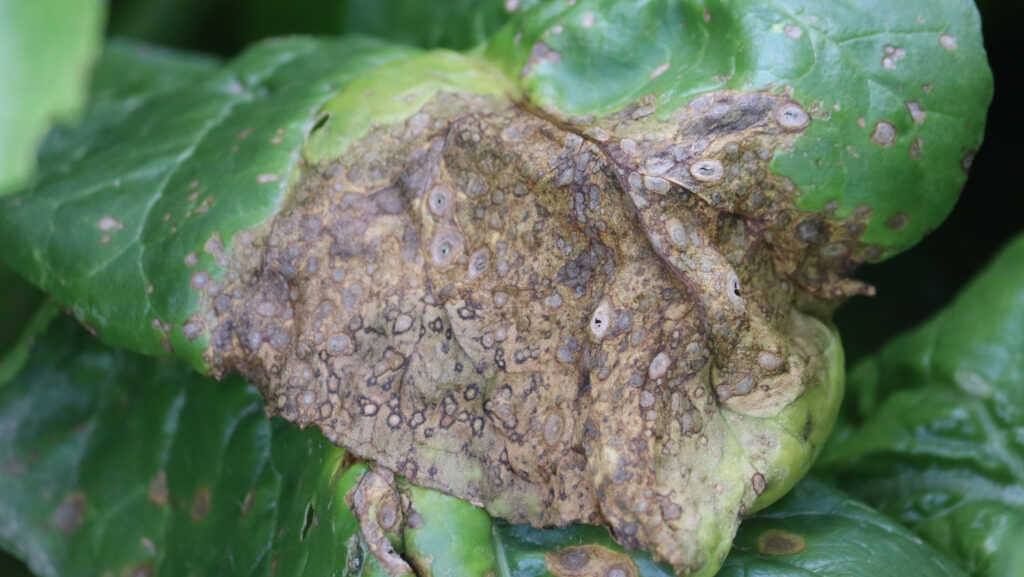 Cercospora beticola on a sugar beet leaf © Adobe Stock
 Adding a plant health elicitor to sugar beet fungicide programmes can improve the plant’s own defences to significantly reduce foliar disease levels and improve green leaf area, according to Agrii trials.
For the past three years, Agrii has trialled conventional fungicide treatments with and without the biostimulant Innocul8, explains Don Pendergrast, technical manager for non-combinable crops at Agrii.
See also: Elicitors offer fresh thinking amid blight control complexity
The active ingredient is PHC101, which is a peptide. This is combined with manganese and zinc, both of which are crucial components in many plant enzymes.
As with a flu vaccine in humans, peptides trigger a hypersensitive response in plants, says Don. This is well researched and documented in the scientific literature first published in the early 1990s.
Innocul8 triggers an immune response by mimicking the effects of a pathogen that damages nearby cell walls. This, in turn, stimulates metabolic pathways associated with the plant defending itself against a pathogen attack, he says.
Don says he originally looked at Innocul8 because he wanted to see if biostimulants could aid green leaf retention into the winter for sugar beet.
“We looked at some of the popular fungicides with a range of different biostimulants. Many of the products we investigated showed an adjusted sugar yield benefit, but Innocul8 stood out. It was visually better in the field.”
Even in trials with tricky-to-control diseases like cercospora, the plant health effects of Innocul8 meant that the fungicide it was mixed with gave better disease control.
Don gives the example that, in one trial, mixing 0.5 litres/ha of Innocul8 with Angle (azoxystrobin + difenoconazole) reduced Cercospora severity by 75%, delivering disease suppression comparable to any other product in the trial.
The key difference, and what led to it achieving the highest adjusted yield, is the continued green leaf retention some weeks after it has been sprayed, believes Don.
“I visited the site 44 days after application, and the product was giving continued support to the crop with its plant health benefits.”
He highlights that it is a challenge to repeatedly see the benefits from biological based solutions that you might see in one trial.
“What excites us about Innocul8 is the consistency in trials you rarely see with other plant health products,” he adds.
This season
Agronomists Miles Doncaster and Adam Mann plan to incorporate Innocul8 into their sugar beet disease control programmes this year, based on the trial data.
“Depending on the pressure, I’ll either pair it with Angle or use it alone for its plant health benefits,” says Miles.
He builds programmes of one, two or three sprays based on the predicted lifting date and the disease pressure as the season progresses.
It also depends on the grower’s attitude to risk and how long they want to leave it between sprays.
Adam advises across the Norfolk-Suffolk border, a known hotspot for cercospora. He says that he will need to lean towards Revystar (mefentrifluconazole + fluxapyroxad) on susceptible varieties.
However, Adam still sees a place for Inocul8, depending on the disease pressure, to deliver on plant health benefits.
“I have growers who have used Innocul8, and they have seen how it keeps their beet standing in dry conditions, especially when their neighbours’ are flat to the floor.
“One of our farmers hosted a trial in South Norfolk last year, and it certainly seemed to keep the beet standing better.
Adam explains that if they lose leaves late in the season, then the sugar levels take a hit as the crop recovers, and weeds can become a problem.