5 top tips on getting the most from slurry on stubble
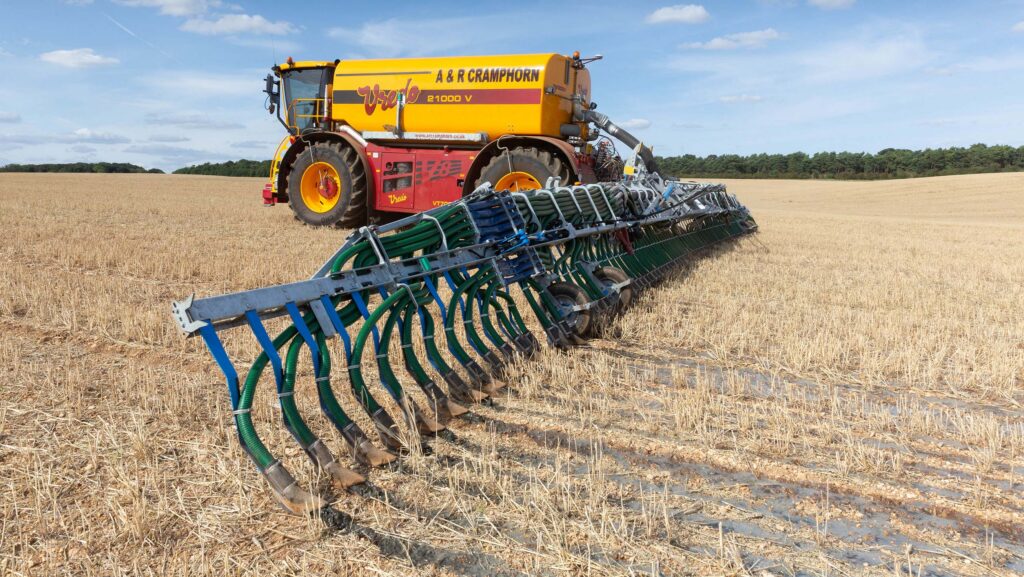 © Tim Scrivener
 The post-harvest period is a crucial time for arable farmers putting nutrients back into soil before incorporating and drilling the next crop.
However, applying slurry in hot conditions can reduce nutrient use efficiency (NUE) and see valuable nitrogen being lost if it is not applied accurately.
Vogelsang’s agricultural sales lead, Andy Hayhurst, offers some top tips to help get the most out of slurry post-harvest.
See also: Big savings in fertilisers can be made by utilising manures
1. Consider two-step process
Post-harvest slurry application can be seen as a two-step process, he says.
Unlike a chemical fertiliser, slurry is immediately plant available from when it is incorporated into the soil.
While it is important to put back lost nutrients, a plan to apply some slurry immediately, but reserve some for when the crop has been planted, will help the newly establishing plants get more benefit from slurry.
2. Manage stored slurry
Managing stored slurry to provide the best-quality material for application is of paramount importance to stubble application.
Separation will help with this, as will covering slurry to prevent valuable nutrients being lost in hot weather.
A well separated slurry will be easier and cheaper to pump, and it can be applied more accurately using dribble bars or a trailing shoe applicator.
The liquid will also be absorbed faster, meaning fewer nutrients are lost in hot weather when slurry is prone to evaporation which causes ammonia losses.
3. Variable-rate applications
Not every field is the same and soil types differ in their capabilities to absorb slurry.
This is why variable-rate application is important and can help provide the optimal volume of slurry for the soil.
Using soil and slurry test results and field maps, along with precision applicators and variable rate, will ensure the soil gets what it needs.
Variable rate is also useful when applying to newly planted crops because it prevents the soil, and early establishing plants, being swamped in slurry.
4. Use separated slurry
Applying to stubbles is an opportunity to create biomass in soil that will help reduce the impact of winter leaching during inevitable spells of heavy rain.
Using separated slurry provides the option to feed the nitrogen-rich, liquid fraction to soil as a starter which helps to rapidly increase biomass.
The solid fraction, which contains most of the P and K, can be subsequently applied as a top dressing in conditions that are not suitable for applying liquid slurry.
5. Timing is crucial
Avoid applying slurry to baked and cracked soils because it will not be absorbed fully and nitrogen will be lost.
Rainy days are also a poor and potentially dangerous time to apply slurry, especially post-harvest when soils are dry because it increases the likelihood of potentially damaging run-off.
Aim for cool, cloudy days when there has been a little rain. This helps the soil to absorb slurry faster and fewer nutrients will be lost by slurry baking on the surface.