How to unlock phosphate and improve herbicide efficacy
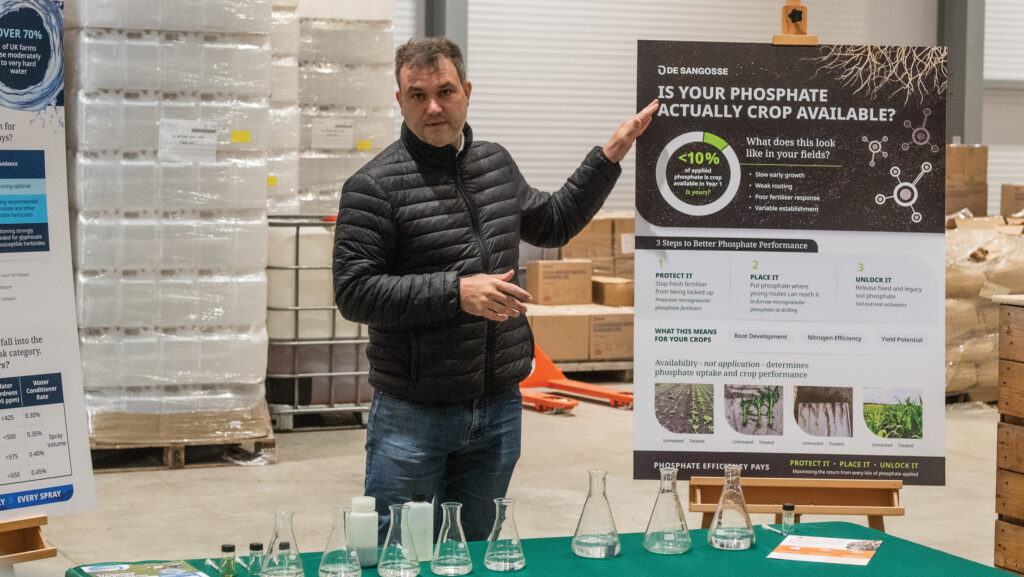 De Sangosse talk at Arable Insights Live at Dyson Farming © Phil Weedon
 Up to 80% of applied phosphate can become locked up within days of application, significantly reducing the effectiveness of the fertiliser.
“Research shows less than 10% of applied phosphate may be crop-available in the first year, while up to 60% never reaches the plant,” says De Sangosse technical manager Rob Suckling.
The primary cause of phosphate lock-up is its interaction with positively charged ions.
In alkaline soils, phosphate binds with calcium, while in acidic soils it reacts with iron and aluminium.
See also: Dry harvest and long storage raise potato disease risk
Other factors such as soil texture, moisture, temperature, organic matter and biological activity can impact this.
Limited phosphate availability restricts root development, reducing access to water and nutrients. This ultimately limits yield potential.
De Sangosse Soil Nutrient Solutions provide a smarter approach by helping crops access both existing soil phosphate reserves and newly applied fertiliser.
At the heart of the system is the proprietary blend of chemistry that targets calcium, iron and aluminium cations responsible for phosphate fixation.
“This activator technology unlocks phosphate already in soil and protects new fertiliser applications.
“This includes our microgranular protected phosphate solutions placed directly in the seed zone at drilling, for OSR, cereals and other key crops,” says Rob.
The problematic cations preferentially bind to the De Sangosse chemistry over other soil components, including phosphate, helping to keep phosphate in a soluble, plant-available form.
Interestingly, trials have shown this mechanism also enhances the uptake of important micronutrients such as zinc, manganese and copper, supporting stronger crop health and resilience.
Research suggests 15-25% more phosphate availability over four to six weeks, up to 25% greater root growth and up to 60% stronger early vigour.
Yield improvements have also been recorded across wheat, barley, oilseed rape, potatoes and maize and sugar beet, explains Rob.
Water conditioners
Water quality is one of the most overlooked factors in herbicide performance – particularly applications of glyphosate – yet it can have a major impact on herbicide efficacy.
More than 70% of UK farms use moderate to very hard water, meaning a significant proportion of spray applications may be compromised before they even reach the field.
Hard water contains dissolved calcium, magnesium and other cations which bind with glyphosate and other weak acid herbicides, reducing their efficacy and reducing weed control.
De Sangosse water conditioners such as X‑Change are designed to act sacrificially, neutralising cations in the spray water before the herbicide is added, thus ensuring full potential of the herbicide remains before it is applied
“By conditioning the water first, the herbicide remains present in a bioactive form, ensuring more consistent uptake by target weeds,” says Rob.
According to the Weed Resistance Action Group, up to 30% loss in glyphosate efficacy can be lost using hard water.
Rob explains: “With glyphosate resistance in Italian ryegrass confirmed on UK farms, it’s essential to ensure optimal herbicide performance.
“Losses in hard water can lead to inadvertent under-dosing.”
Water hardness is measured in total dissolved solids in parts per million (ppm) and varies widely across the UK.
Hard water (200-300ppm) and very hard water (>300ppm) create a high-risk environment where conditioning is strongly recommended for reliable weed control.
Correct conditioner dosing is essential and should be based on measured water hardness.
For example, lower hardness levels may require around 0.10-0.20% conditioner, while higher hardness levels can require up to 0.35-0.45%.
This tailored approach ensures optimal conditioning without over- or under-treating the spray solution.
De Sangosse was presenting at Farmers Weekly’s recent Arable Insights Live event hosted at Dyson Farming, providing industry stakeholders with the latest agronomy advice and technology updates.