

Regen premium helps West Midlands family battle blackgrass
© Oli Lees
Regen premiums have given father and son James and Sam Daw the confidence to dedicate one-third of their cropping area to spring crops and tackle a growing grassweed problem.
“It was a very dirty farm, but a larger area of spring cropping [beans, barley and potatoes] has reduced grassweed numbers,” explains Sam. “We have both blackgrass and ryegrass.”
The payments, which equate to a £7-£15/t premium, are also helping them to introduce green measures across a greater area of their farm.
See also: Guide to ADM’s regen premiums for milling wheat and OSR
James and Sam were one of the first UK farms to sign up to ADM’s re:generations programme (see “How the ADM programme works”) after its launch in 2023 and they have increased the area to the current 950ha, making up 75% of their combinable crop area.
There are three crops in the scheme – milling wheat, oilseed rape and spring barley.
“It fits perfectly with what we are doing on farm and we are being financially rewarded for it,” says Sam, adding that it is effectively adding value.
James explains that he has been caring for soil all his life on the mixed farm. “We adopted cover cropping 20 years ago and have seen the benefits from this.”
The payment allows them to fine-tune their system and adopt measures across a greater area.
Their key adoptions have been cover crops (a mix of oats, vetch, buckwheat and phacelia) ahead of spring barley, and companion crops in both wheat and oilseed rape. The companions are buckwheat in oilseed rape and spring beans in winter cereals.
The Daws are also being rewarded for adding organic manure before oilseed rape, having integrated pest management plans, nutrition plans and tissue testing crops for more targeted nutrient use.
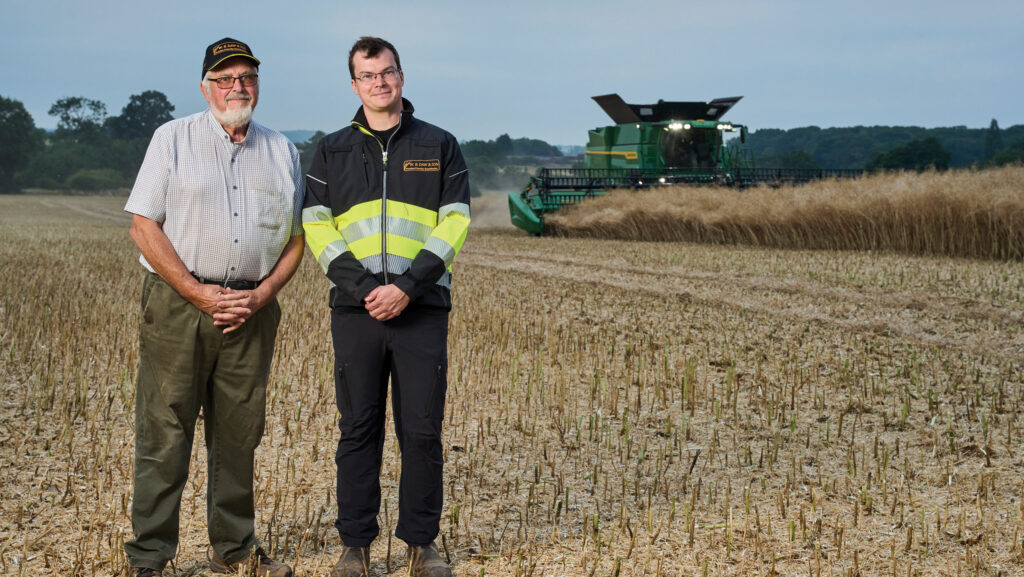
James (left) and Sam Daw © Oli Lees
WB Daw and Son, Home Farm, Staffordshire
- Very variable soils on the border of Warwickshire and Staffordshire
- 2,020ha of total cropping
- Uses appropriate tillage, direct drill, min-till and plough
- Average yields 8.4t/ha for milling wheat, 3.5t/ha OSR over past five years and 5t/ha for spring barley
- In the ADM re:generations programme: 575ha wheat, 200ha oilseed rape and 175ha spring barley
- Other crops not in scheme: potatoes, spring beans and winter oats
- Livestock: 300 beef cattle, 500 ewes plus 2,000 bed-and-breakfast pigs
Flexibility
Allie Hesketh, ADM’s climate smart agriculture country co-ordinator, explains that for each crop there is a list of actions farmers can decide to opt in to. “This is because not all are applicable for every farm.”
For example, James explains that all oilseed rape straw is chopped, but they need the cereal straw for bedding and the biomass boiler. Therefore, they opted in just for OSR.
They also have potatoes in the rotation, so they can’t direct drill wheat after potatoes. They therefore need the flexibility to pick different options.
Another example of the scheme’s flexibility is that muck can’t be applied before every crop, but it allows it to be applied during other parts of the rotation, such as before potatoes, as that will be in wheat the year after.
James explains that they have increased the use of muck to help drive up soil organic matter and it’s making a difference. Some of this is coming from the various straw-for-muck deals.
Nitrogen fertiliser use
Growing only Group 1 wheats means there is a huge focus on hitting protein targets. While nitrogen fertiliser use has risen slightly for milling wheat crops, they have reduced nitrogen use elsewhere in the rotation:
- Spring beans – use no fertiliser and the following wheat crops receive 40kg/ha less
- Spring barley is grown on a low-nitrogen contract premium, so crops receive 130kg/ha
- Milling oats are a low-nitrogen crop, receiving 140-150kg/ha
- Oilseed rape gets 160-240kg.
Sam says in the past they would have applied inputs in three splits, but with the greater weather extremes and the need to hit protein specs, they now take a little-but-often approach and go through wheat six to seven times.
The Daws have invested in a protein analyser on their combine, so they know the protein content of each trailer as it leaves the field. This allows them to segregate according to protein content and blend to miller requirements.
On average, it takes 20,000 readings for each trailer and wheat is split into bays by protein percentage, with low (less than 13%), medium (13-14%) and high (over 14.5%). “It cost £25,000, but it paid for itself in the first year,” says Sam.
They grow Crusoe with its good protein level and Skyfall for its earlier harvest, as they need to spread harvest because all crops are grown for milling. Illustrious is also grown, but they are trialling Cheer and Vibe this year.
Their hope is that a regen approach with soils will keep nitrogen in the ground, which together with the use of manures and cover crops Regen keep n in ground and make better use of nitrogen sohelpreduce reliance on N ferttogether with manure and cover crops.
Measures to reduce energy
James and Sam Daw have adopted several other measures that are helping them to reduce energy use and improve the environment.
Biomass boiler
Diesel use has been dramatically cut by switching to renewable energy for drying grain.
A straw-burning boiler uses about 200-500 bales a year to dry grain and heat buildings. In the past, they found that the conventional diesel-powered dryer could use up to 100,000 litres in a wet harvest year, and this has now been replaced by their own wheat straw.
The system also captures smoke particles using lime, which is added back to the land with the ash.
Sam explains that the boiler runs three drying floors and a continuous-flow dryer with up to 40t/hour capacity.
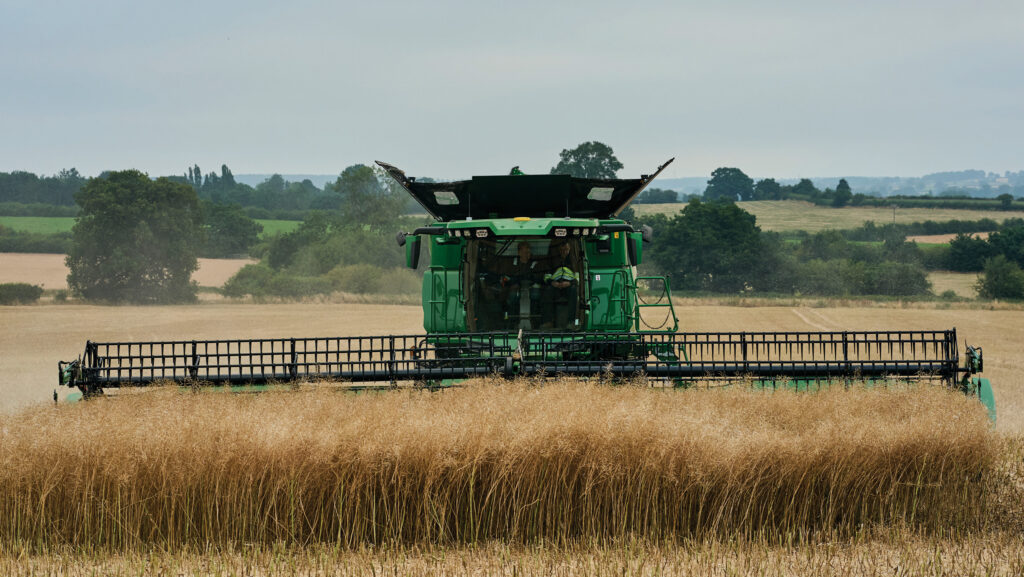
“It’s our second combine.” He explains that growing all milling wheat means they need the capacity to cut crops when they are ready, to avoid losing quality. “We can start cutting earlier at 21% moisture and handle the wetter wheat.”
He explains that it means they can fully use the 40ft cut combine, which harvests 1,212ha each summer.
For the other 10 months of the year, the biomass boiler provides heat for the wedding venue and other commercial properties at the Hall. The boiler uses one bale an hour for grain drying and three bales every 24 hours for heating.
Potatoes
Potatoes are all grown for McCain and managed within its regenerative agriculture framework. Measures include cover cropping, applying organic manures and reduced cultivations, taking a min-till approach instead of ploughing.
Sam says they have cut out about three passes by not ploughing, and applying manure ahead of potatoes has enabled them to cut phosphorus and potassium applications by 60%.
Another novel measure is the use of anti-erosion tines after planting that go over potato tramlines to minimise soil losses, particularly on slopes. Solar panels mean they are about 25% self-sufficient for electricity for potato storage.
How the ADM programme works
ADM Agriculture’s re:generations programme has been designed to help growers implement regenerative practices and reduce greenhouse gas emissions.
The programme was rolled out in the UK in 2023 following success in North America and is being expanded to other European countries.
Growers are paid on an area basis for certain practices, such as cover cropping and conservation tillage.
Available actions
In the UK, there are seven actions for oilseed rape and six for milling wheat, with growers being encouraged to adopt as many as possible. For example, the actions for OSR are:
- Cover crops
- Conservation tillage
- 4R nutrient management
- Use of organic manure/matter
- Companion cropping
- Integrate livestock
- Biodiversity in on-farm habitat.
There are options within each action – the use of cover crops can include winter covers and summer catch crops, for example, while the use of conservation tillage is defined as reduced-, strip- or no-till systems that reduce tillage to a depth of 10cm.
Growers must also have three different crops across the total arable area in the given year.
Data collection
Data collection is key and the UK programme was co-designed with Map of Agriculture.
Allie Hesketh, ADM’s climate smart agriculture country co-ordinator, explains that they want to support farmers on their journey. There is also increasing demand from customers, especially to reduce carbon footprints.
Simon Penson, technical director at ADM Milling, says about 80% of the carbon footprint for flour is from the purchased wheat. “We need to tackle that, and the re:generations programme is part of this.”
He explains that fertiliser accounts for about 80% of the carbon associated with wheat and having healthier, functioning soils will help improve nitrogen use efficiency.
Simon says about 15% of the company’s flour is produced using regen methods, and this has grown over the past three years. “We want the majority of flour to be regen in the future.”
Staying sharp shouldn't be a chore
Explore more / Transition
During the series we follow our group of 16 Transition Farmers through the challenges and opportunities as they seek to improve their farm businesses.
Transition is an independent editorial initiative supported by our UK-wide network of partners, who have made it possible to bring you this series.
Visit the Transition content hub to find out more.
