Why grassweed control is vital in oilseed rape crops
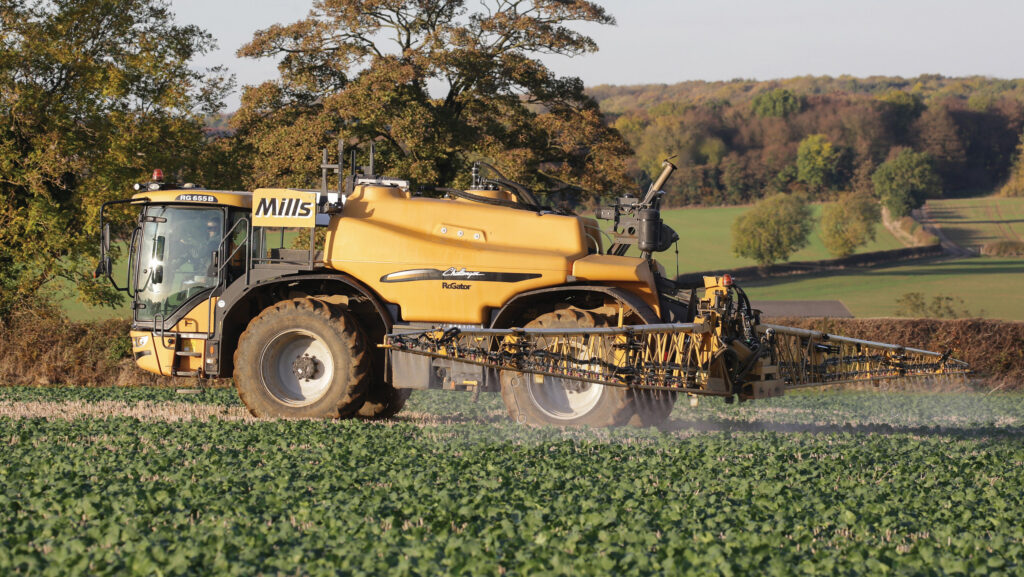 © Tim Scrivener
 Oilseed rape used to be looked upon as a good cleaning crop for grassweeds, but in recent years it has become the weak link in many rotations.
A combination of dry autumns and adult cabbage stem flea attacks has led to patchy, less-competitive crops, which has consequently let grassweeds in.
On top of this, the risk of crop failure means growers are reluctant to spend money until it is well established.
See also: Why Devon farmer is growing oilseed rape again
But as the OSR area expands and grassweed pressure remains, Adas weed specialist John Cussans says there is a need to consider the potential effects on blackgrass control.
He points out on sites with bad blackgrass problems, the worst crops tend to be those following OSR in the rotation.
“There is a need for good weed control in OSR and to bring back its role of cleaning grassweeds in a rotation.”
Two key herbicides that form the backbone of blackgrass control are post-emergence graminicide Centurion Max (clethodim) and residual Kerb (propyzamide).
John says the combination of both chemicals can achieve high levels of grassweed control, so should be seen as a package rather than a choice of either.
Here are some tips on best practice to get the most out of them and help protect their longer-term future.
Clethodim
This post-emergence option offers good control of blackgrass and ryegrass in the UK, says Tom Wheelhouse, technical sales manager at UPL. However, to get the most out of it, there are a number of guidelines.
First, he recommends applying up to mid-October to get the best efficacy, although the label allows application up to the end of October.
In addition, farmers need to follow the no-spray period to reduce the risk of crop damage and also to observe the tank-mixing guidance.
Farmers are advised to use it with a water conditioner, such as X-Change. John points out that farmers need to check the product they are using, as not all have the same function.
“You need to use a true conditioner that chelates cations. Labelling isn’t great, as they fall outside of the Chemicals Regulation Division approvals used for pesticides and adjuvants.”
Centurion Max tips
- Apply by 15 October or when crop reaches leaf six, whichever comes first
- Target weeds from leaf three up to early tillering and actively growing
- No-spray period 10 days before and 14 days after
- Follow tank-mixing guidelines
- Always apply with a water conditioner
Kerb
The key to getting the most out of Kerb is timing. Soils need to be 10C and cooling to get the most persistency, but climate change means farmers are seeing less perfect conditions.
It is, therefore, a compromise between efficacy, application conditions and date.
Hugh Guinan, field technical manager at Corteva, says the sweet spot is the end of October to the end of December. “If you go too late, early-germinating weeds will be too big.”
Farmers also need to match rates to weed levels. “Opt for the higher 850g/ha rate for dense blackgrass or Italian ryegrass populations.”
Finally, don’t forget stewardship. As the herbicide is strongly adsorbed to soil, soil erosion management is key to prevent losses resulting from heavy rainfall/run-off.
Kerb tips
- Use in sequence with Centurion Max
- Match dose to weed pressure
- Timing is critical
- Focus on soil conditions – don’t apply when soils are cracked, dry or saturated
Other factors
Grassweed control also starts before drilling the crop with stale seed-beds. But this could prove more tricky this summer with the dry conditions.
Farmers may not get the luxury of waiting for rain to get a flush and spray off with glyphosate. They may just need to get the crop in, increasing the need for getting weed control right.
John adds that there may be some scenarios for using metazachlor.
“It has gone out of fashion, but if farmers drill in August, it is a long gap until any grassweed control.” If there is high pressure, there may be a need for some control as part of the programme.
Group change
Propyzamide has been reclassified by the global Herbicide Resistance Action Committee following a better understanding of how it works.
Corteva’s Hugh Guinan says it has been moved from group 3 to group 23 – microtubule interference.
This change recognises that it has a different mode of action to the other group 3s, which include pendimethalin.
Propyzamide is the only group 23 herbicide registered in the UK, which makes it a more important tool for resistance management.