Crop Watch: Flowering OSR sprays and septoria in wheat
 © GNP
© GNP This week is set to see the hottest weather of the year so far, with temperatures into the 20s for some parts of the UK.
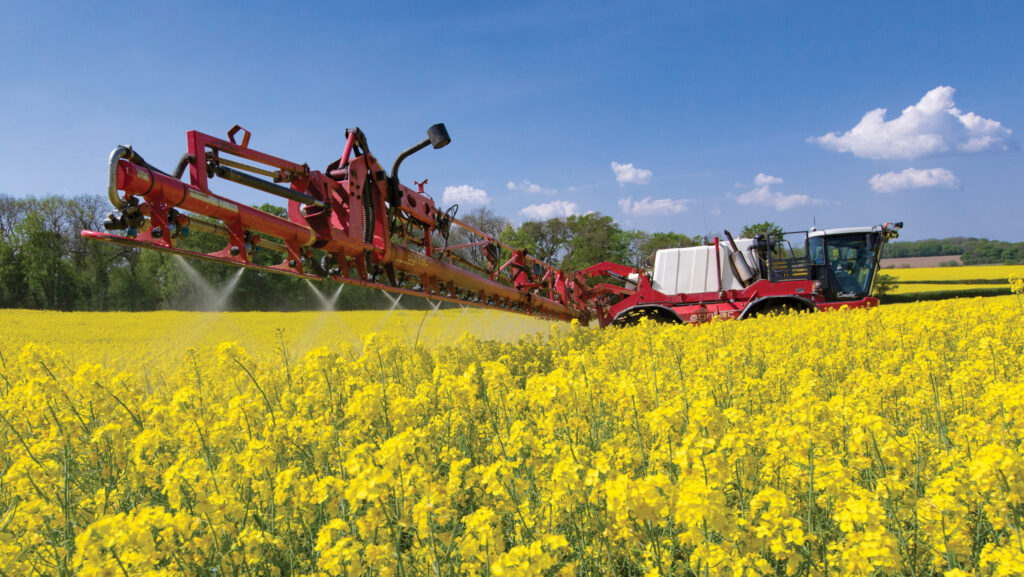
Oilseed rape is now in full flower and our agronomists consider their fungicide strategies for the crop.
See also: How McCain is using a demo farm to reach its regen targets
West
Will Spurdens, Ceres Rural (Shropshire and Cheshire)
T0 sprays have been applied to most wheats now where we are either treating for active yellow rust using tebuconazole or protecting the crops with the addition of a strobulurin in the tank.
Plant growth regulators have been recommended at this pass and consist of chlormequat plus or minus trinexypac-ethyl for the taller and more prone to lodging varieties.
Broad-leaved weed herbicides have been included for the harder to deal with weeds such as groundsel and burchervil.
Foliar nutrition has also been included in this pass to supply the crop with micronutrients it needs as it rapidly grows.
Tip of the week
With disease on lower leaves and more changeable weather forecast, it’s likely we will be using more robust septoria actives at the T1 in wheat.
Will Spurdens
Septoria threat
Thoughts are now moving to the T1 timing towards the end of the month where we are targeting the third leaf of the wheat plant.
With all the talk of yellow rust it is easy to forget our biggest driver disease over here in the West – septoria.
Some of these crops are starting to look dirty with the disease on lower leaves.
With changeable weather forecasted, it’s looking likely that we will be using the more robust septoria targeting actives at the T1 stage (fenpicoxamid or isoflucypram mixes).
These will be priced up accordingly for the level of disease around and with the addition of an active ingredient to tackle any rust that may be present.
Over the next two weeks I shall be walking all the wheats to assess disease levels, growth, weeds and any other surprises along the way.
Since my last Crop Watch article, spring crops are all in the ground and pre-emergence herbicides have been applied where necessary.
Winter barley T1s are recommended and getting applied, winter oats are being tidied up ahead of a fungicide shortly for crown rust and winter rye crops are receiving their T0s as well.
Grassland herbicides are being applied where necessary as the temperatures rise, and maize prep is under way ahead of drilling. I don’t want to tempt fate, but so far the jobs have been getting completed quite nicely.
Let’s see how the next few weeks go.
North
Mary Munro, Munro Agricultural Consultancy (East Lothian)
After a rough Easter weekend with snow and wild winds, the weather has settled into something more acceptably spring like.
I love this time of year – fresh sunny mornings with the season ahead of us and the promise of great crops.
It can all go wrong of course, but at this moment the potential is to be savoured.
Growers have had to dodge away at spraying in the past couple of weeks, going on with wheat T0 when the wind dropped sufficiently.
I have stuck with the usual tebuconazole (plus or minus azoxystrobin) at half rates, a litre of chlormequat and manganese.
Unlike last year, there is very little yellow rust in evidence in East Lothian, but septoria at more normal levels than last year when there was barely any all season.
The crops are looking well, one or two dressings of nitrogen on, and new leaves replacing the wind-battered overwintered ones.
Oilseed rape is at green-yellow bud and some crops beginning to flower.
My OSR crops have had minimal treatments so far and I can only hope the weeds keep out – these spray plans were kicked into touch by weather at the wrong times.
Growth regulators
Winter barley and winter oats are jumping up. I had some nasty crop reactions to Moddus (trinexapac-ethyl) last year and am basically planning to do without it where possible.
Winter rye will get some, but there are other options for most other situations.
Winter wheat will get two splits of a litre of 3C (chlormequat), and the possibility of a Terpal (ethephon + mepiquat)/Cerone (ethephon)/Medax Max (prohexadione + trinexapac-ethyl) treatment later if warranted.
Oats are going to get Canopy (mepiquat + prohexadione). Winter barley will be a similar strategy to wheat – a chlormequat followed by Terpal.
Spring sowing is well under way, and soil conditions are very pleasing.
I haven’t come across much deviation from spring barley despite the limited market, and where there are reductions in acreage the alternative seems to be spring beans for the most part.
Our local veg producers have been offered lots of additional acres, but theirs is also a tricky market.
We have to hope that fuel supplies do not disappear and all the planned field operations can go ahead. These are challenging times, but mostly out of our control.
I have had some interesting conversations about clover as a companion crop for next year, just in case.
East
Rory Kissock, Farmacy (Essex, Herts, Cambs and Suffolk)
Here in the East winter crops look well, and are certainly enjoying the sunshine we have been getting recently.
Winter wheats have received their T0 fungicides and attention switches to T1, which in the main will probably be from the beginning of next week onwards.
Targeting leaf three is very important and the only way to ensure you’re spraying the correct leaf is to unfurl the plant and count back.
There are several different fungicide options available at the T1 timing with various strengths and weaknesses.
Discussion around disease risk, cost, efficacy, variety, yield potential and market price, to name but a few, will all help when it comes down to choosing what product to go for.
Conditions for spring drilling have been excellent and things are now drawing to a close. There has been plenty of moisture for the early drilled crops which are now up and away.
Some of the later drilled crops might be hoping for a rain sooner rather than later. Pre-emergence herbicides may have limited efficacy due to the dry conditions.
Flowering OSR
Oilseed rape is very much enjoying the sunshine and edge to edge fields of bright yellow are a delight to see.
Sclerotinia risk at present would be low due to low rainfall and humidity, however this does not mean a fungicide is not required.
A very small yield response is required to have a positive return on investment and the risk of not protecting crops is considerable, especially as they look so good.
There are a number of options that could be used including boscalid, bixafen, azoxystrobin, prothioconazole and tebuconazole.
This is a also a good opportunity to add some foliar nutrition, two key elements are magnesium and boron especially can help increase flowering and flower retention.
Most sugar beet has now been drilled and into good moisture with some seed having already cracked and small shoots starting to appear.
Due to the drier surface conditions pre emergence herbicides, if utilised, may have a slightly more limited effect than normal.
Phenmedipham, ethofumesate and metamitron combined can be a good start to the weed control programme
South
Justin Smith, Procam (East Sussex)
© Tim Scrivener
Winter barleys are rapidly approaching the T1 timing: with rust and net blotch the main diseases of concern, 0.6litres/ha of Mobius (prothioconazole + trifloxystrobin) is fitting the bill.
A combination of growth regulators – in the form of trinexapac-ethyl and chlormequat – are also being used on most conventional barley varieties.
However, where my hybrid barleys are concerned, I am reaching for the punchier Medax Max combination of trinexapac-ethyl + prohexadione.
The primary aim here is to mitigate the common “bounce back” effect associated with chlormequat, and also to really drive cell wall strength.
These crops have a nasty habit of going from “ground zero” to “skywards hero” in matter of a few weeks.
In my mind this justifies the slightly higher cost point of the stronger growth regulator, especially as growers tend to forget the crop that’s two inches shorter than usual, but will never let you forget the year it went flat.
Wheats
Most winter wheats have received a T0 fungicide and growth regulator treatment, and in many scenarios are already closing in on growth stage 31.
The majority of autumn herbicide treatments were well-timed and have successfully held back the tide of weeds.
However, some flushes of broad-leaved weeds are now starting to appear, with species such as mayweed, groundsel, cleavers, poppy and charlock being treated with Supreme Max (florasulam + tribenuron).
I have found this formulation to not only be very effective, but also kinder to cereal crops than other sulfonyurea (SU) alternatives, especially on sensitive crops such as oats.
Winter oilseed is happily flowering in earnest and if the sun continues to shine and crops continue to flower evenly and at pace, I will try not to worry about the odd pollen beetle that is currently present.
The potential damage to beneficials from a mis-timed insecticide is a risk I am generally not willing to take.