Crop Watch: Hopes for warmer weather after rain arrives
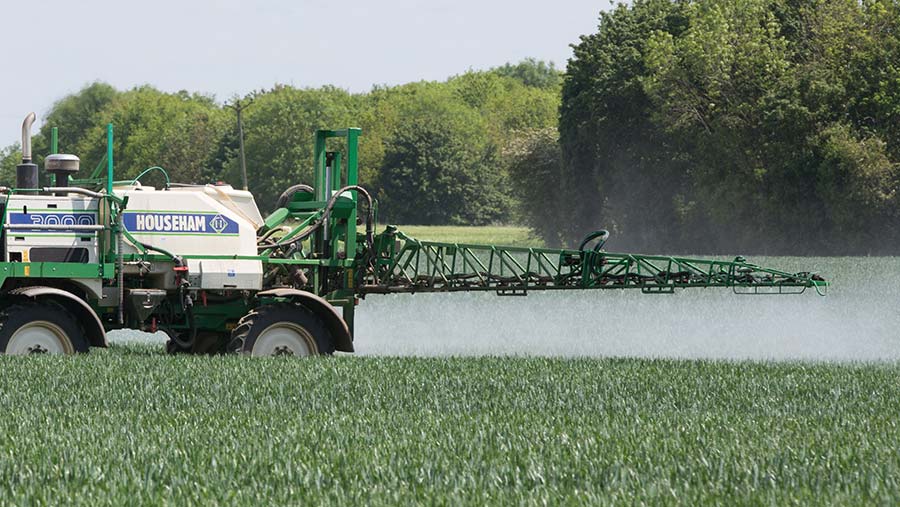 © Tim Scrivener
 Rain has brought much-needed comfort for many crops that have struggled through a cold and very dry April, and they will hopefully benefit further as temperatures warm up.
But with the rain has come an increased risk of disease, so it is crucial to plan T2 flag leaf sprays on winter wheat to control rusts and septoria.
Warmer temperatures will certainly be needed to see maize crop emerging as some have sat in the ground for a month in cold and dry weather.
See also: Advice on keeping wheat green to maximise yields
North
Patrick Stephenson
AICC (Yorkshire)
We had 22 frosts in April, which meant the whole agronomy world went into slow motion, like an extended scene from The Matrix. However, it should also come as no surprise that the minute I don the cricket whites, it rains.
It remains to be seen if this weather change will have arrived in time for the winter barley crops to reach maximum potential. Many crops now have flag leaves fully emerged and are at the majestic height of 20cm.
The crops are universally scorched and exhibit varying degrees of black abiotic spotting. This is often confused with ramularia but, from the crops I have seen, the symptoms are not consistent with the disease. Brown rust is currently the most common disease, and the final fungicide will target ears emerged and consist of a broad-spectrum mix focused on prothioconazole.
Spring barley crops are in varying states of emergence and, after the rain, will now have broad-leaved weeds emerging. I will not be using any early growth regulator, but will target a later application for brackling on many fields. In terms of disease, I find spring barley a much trickier beast. I will generally treat disease as I find it.
Winter wheat crops will get the most benefit as the rain activates the applied nitrogen at long last. Crop growth is approximately seven days behind normal, but this can soon change. Once again there are large variations in crop development across fields.
From a late-September sowing, I can find leaf two 40% emerged and leaf three only 70% in the same field. Yellow rust is bubbling away, but has so far failed to reach epidemic levels. Many of the varieties we grow have good adult resistance to yellow rust, so assessing the need for a fungicide with specific yellow rust activity should be by using known adult susceptibility – for example, Kerrin or Kinetic.
Many growers will rightly have septoria as their major concern, and there is little doubt that Revystar (fluxapyroxad + mefentrifluconazole) and Univoq (fenpicoxamid + prothioconazole) will provide the best levels of control and be key products for T2 timings.
The reality is that September-sown wheat will have ears emerging in early June. It may be a few days later this year, but not weeks. T1 fungicides applied in the past week should comfortably see the crops through to T2. My advice to growers is to keep to traditional T2 timings – do not delay for a “head-and-shoulders effect”. With wheat prices looking very good, risking yield for saving a spray pass is folly.
Oilseed rape crops are limping into full flower and, although rain has arrived, I still feel sclerotinia will be a low risk. However, extended flowering may alter that assessment. Full-flower sprays will include prothioconazole and the mix with bixafen is my choice.
South
Stan Harrison
Zantra (Kent)
It came as no surprise when I heard the BBC weatherman label April 2021 as the coldest since 1922. A cold northerly wind and 14 frosts have been very harsh on crops in the South and have made management decisions a headache to say the least.
However, on the whole, winter wheat, barley and oats have held up well and, given some rain and warmth, should get back on track relatively quickly. Disease levels are low and canopies are short and compact this year – all courtesy of the cold, dry weather. Modest T1 fungicide and growth regulator applications have been made to reflect this.
Tissue analysis has been a valuable tool this spring to help with crop management decisions. Levels of manganese, magnesium, copper and boron were deficient on various sites, so these have been added in where necessary to help alleviate some of the stress these crops have been under.
T2 applications will be assessed from the third week of May, which is where a good fungicide investment can really pay dividends. Cereal crops will also get closely inspected for any late weed flushes, which has been mostly absent so far this spring.
This season’s oilseed rape crops fall in one of three categories – the good, the bad and the ugly.
Some of the early-drilled crops on good, fertile sites have compensated well for the frost and cabbage stem flea beetle pressure and still promise decent potential. Later-drilled crops with poorer root structures have not fared so well, and the warm spring growing conditions may have come too late to salvage any respectable yield for crops in this category. It is also worth noting that the best-looking oilseed rape crops are on a six- to seven-year rotation.
Spring crops have completely stalled for the past six weeks – waiting patiently for some spring rain. Now this has finally arrived, I fully expect them to race through their growth stages – better late than never.
East
Marcus Mann
Frontier (Essex)
Following a dry, cold April, the bank holiday weather was more in line with expectations, with most areas receiving some long-overdue rain, although total amounts varied significantly depending on geography.
The moisture has improved the availability of applied nitrogen – much of which has been sitting on the soil surface since being applied. Crops are responding rapidly and now look better than they did two weeks ago.
Spring cereals that were drilled late and sat in dry seed-beds have shown a protracted pattern of emergence and will now have to realise their potential in a much shorter growing season. To increase root formation, consider applications of phosphite in with early plant growth regulators (PGRs).
Winter cereals are moving, but growth remains slow, combined with much variation in crop growth stages, which is uncharacteristic for this stage of the season. September-drilled crops will quickly be at the T2 timing and, with the recent unsettled spell, septoria will become the focus of the programme.
Fortunately, this year there are robust options in the form of new chemistry with Revysol and Univoq. This will be particularly useful following the showery, “rainsplash” events that will have moved active disease in the base of the canopy onto higher leaf layers.
Winter crops are likely to put on significant late-season growth in response to nitrogen becoming available. It will be important to re-evaluate lodging risk and the need for late-season plant growth regulation, particularly if PGRs were omitted or rates reduced earlier on.
High cabbage stem flea beetle larval pressure is being seen in some OSR crops. However, for crops that are flowering sufficiently, questions will be asked about whether there is enough nitrogen to maximise its yield potential.
Leaf tissue tests will give a fair representation and, if registering low nitrogen levels, a top-up after flower petals have dropped with products such as Oilseed Extra or Nutrino Pro will ensure increased photosynthesis on the pods and leaves to help increase seed size and yield.
For sugar beet crops, the aphid migration forecast is predicted to commence from mid-May and will be the time to start monitoring. At present, control will be had from Teppeki (flonicamid) and the recent emergency authorisation of Insyst (acetamiprid).
West
Giles Simpson
Pearce Seeds (Somerset)
We have at last had some rain and most crops are improving. I have found this season so far one of the most challenging I have experienced, with crops under severe stress – not only because of the lack of moisture, but also the continuous cold weather and frosts.
However, this has meant disease pressure has generally been low. The spray recommendations that have been applied have almost all been slightly late, mainly because of the weather – either frost and then wind – so timings are a bit astray.
Winter barley crops are now heading for the T2 stage and are relatively clean, although some are only 200mm high and have the flag leaf out. All fertiliser has been applied and in some cases we have cut these back as we didn’t think the crop justified it. I fear there won’t be much straw with some of these crops.
The winter wheats have fared better and are looking promising. Spray applications are mostly up to date – I cut back the spend at T1 as the crops were clean and didn’t look like they justified a big spend.
T2 will be as normal and I plan to use an SDHI/strobilurin mix, possibly adding a mildewicide, as we need to protect these crops for the next three weeks and the long range now looks catchy. Only time will see if I am correct.
The maize drilling is almost complete and only the fields where maize is following a cut of grass are left to be drilled. I haven’t seen any maize up yet, although some has been in the ground for a month. Soil temperatures have hovered at only 8-10C for the past three weeks, but hopefully, we will now see them rise to help with early emergence.
We’ve had interesting conversations in the past three weeks about sowing rate, drilling depth and whether to roll or not. All of my maize was drilled at 75-90mm deep, as this was where the moisture was, and in the the early-drilled crops the seed rates were stepped up by 5-8%.
The seed-beds have been good this year and the contractors have made sure they are drilling correctly – some have rolled and some haven’t. Pre-emergence sprays of either straight pendimethalin or a half-rate Wing-P (pendimethalin + dimethenamid) and pendimethalin have been applied on the difficult weed fields.
The spring barley crops are now beginning to move after a cold, dry start. The crops that went in early look really well; some of the later-drilled crops are patchy and needed the rain we are now having.