

What could the future of crop protection look like?
 © GNP
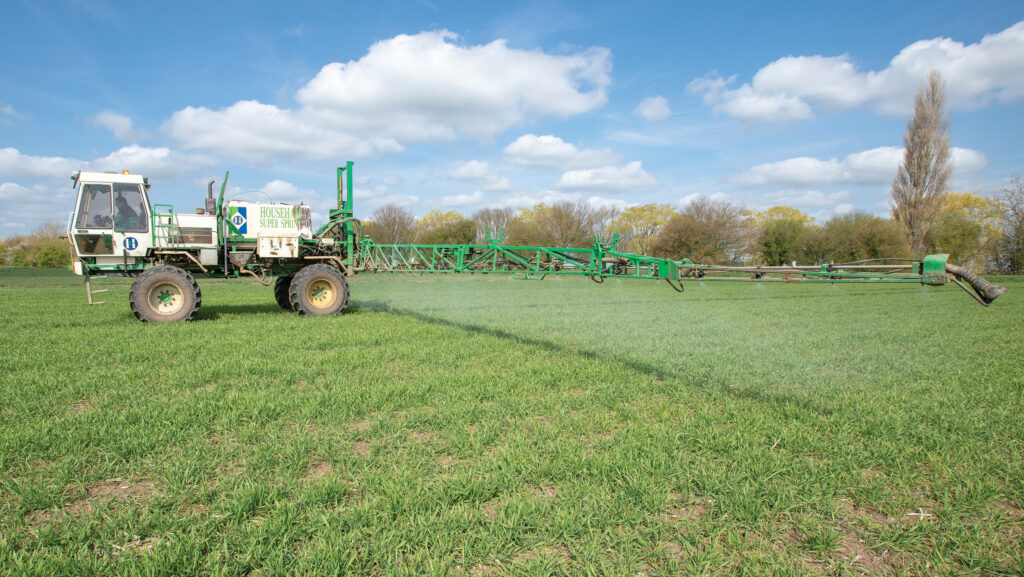
© GNP Biologicals, breeding and better evaluation and co-ordination of multiple farm technologies will be three important building blocks of future crop protection strategies for disease control, as the industry continues its slow transition away from reliance on chemical inputs, according to Niab’s Dr Aoife O’Driscoll.
But while each already shows some promise, there are still some significant practical and technical weaknesses to overcome, she acknowledges.
Biofungicides
Some growers are already using biofungicides, mostly elicitors such as UPL’s laminarin as well as sulphur and phosphonate-based products, but independent data on field efficacy is relatively scarce.
See also: Novel electric weeder works without chemicals or moving soil
EU trials conducted as part of the larger Rustwatch project, involving Niab, found very little efficacy from the tested biofungicides against rusts, but there does appear to be more promise against septoria, Aoife says.
That’s led to the AHDB funding Niab, Adas and SRUC to run trials in Hampshire, Herefordshire and Lothian to investigate the potential of various biofungicides, including elicitors, to control septoria.
Also included are a terpene plant extract that aims to disrupt the fungi’s cell walls, living microbes, including bacterial and fungal-based products, plus some sulphur-based products.
The biofungicides are being tested alone and in combination with a fungicide programme on both a susceptible and a resistant variety, Aoife says.
Learning how best to use some of these products will be vital, she says.
For example, tank mixing a fungal-based biofungicide with a chemical fungicide may kill the spores, meaning it might have to be applied separately.
“The quick wins are more likely to be the phosphonates and sulphur products rather than the bacterial or fungal ones,” she suggests.
“They seem to offer good value, but if you’re only getting 20-30% efficacy, then cost will need to be line.”
Varietal resistance
Breeding, particularly as advances in genomic knowledge and use of precision breeding increases, is likely to remain a key source of disease control innovation in crops, with resistance traits bred into varieties.
But Aoife is also interested in how varietal resistance can be combined at the field level to improve management of diseases, such as yellow rust.
“Why do it just with breeding, which takes a long time?” she asks. “Why not stack resistance in the field using blends?”
To do that more effectively, there’s an opportunity to use more of a genomics-based approach to selecting varieties within blends, she says, which means using available knowledge of what particular resistance markers and sources a variety has.
“There is a lot of publicly available data on parentage, sources of resistance and known resistance genes,” she notes.
That information could be used to create the next generation of variety selection tools, which moves beyond the scope of the current AHDB variety blend tool, to help farmers more easily select diverse blends, as well as combinations of varieties across the farm.
“It would look in more detail at resistance genes and markers, using that alongside or instead of just parentage,” she explains.
Technology
A third area Aoife thinks will help improve disease control in future is new technology. Evaluating multiple technologies in the same field is one way she envisages improving how they are used.
“It’s not just whether it works, but the user experience,” she says.
The concept was tested this season in Leicestershire farmer Will Oliver’s AHDB Strategic Farm trials, where he tested five different decision support tools to help manage septoria and rust in wheat.
Technologies tested included systems from SporeSense and OptiGene, plus Niab PCR lab testing, IPMDecisions, which uses online weather-based decision support tools with the control being a Niab agronomist armed with the organisation’s strategy guide.
Each could have a place, Aoife says. “Niab’s lab test gives more accurate, quantitative results on how much disease is present in the leaf, whereas OptiGene gives more of a yes/no answer. Its advantage is you can do it at home and get instant results.”
On-farm trials with SporeSense, which captures and identifies disease spores providing an early warning system, have allowed users to delay sprays against rust, increase yields by using the right spray at an appropriate timing, or save cost in some combination, she adds.
“In the future, we see the best strategy as combining such approaches,” she concludes.
Future of insect/pest control
© Robert Schneider
Finding new ways of controlling insect pests is crucial as existing chemical solutions are shunned by both the general public and even farmers, with fears over the impact on beneficial insect populations.
Resistance is also impacting on the efficacy of current solutions.
Breeding
Breeding is an approach showing commercial success already, says Prof Tom Pope, professor of applied entomology at Harper Adams University, with the development of varieties with resistance or tolerance to diseases vectored by aphids, such as barley yellow dwarf virus and virus yellows.
“They’re changing the game as varieties continue to improve in terms of other agronomic traits,” Tom says.
Precision breeding techniques could further increase their effectiveness, with gene editing seen as the most likely source of successful resistance against hard-to-control complex problems, such as virus yellows in sugar beet.
Another area of immense promise is research into RNA interference technologies (RNAi). Applied as a spray, they are designed to be highly specific to the target species, Tom explains.
“It only works if the insect ingesting the [sprayed] double-stranded RNA matches and then binds with the target insect’s genetics code.
“That’s what elicits the control effect in the target species as it shuts down the essential genes in the pest, but if a non-target organism ate or came into contact with it, that genetic match isn’t there, so they should have a particularly good environmental profile.”
The technology also can help overcome resistance, he says.
“If the pest develops resistance, you can redesign your RNAi to account for that, so it should be more future proof because you can adapt to the insect’s adaptations.”
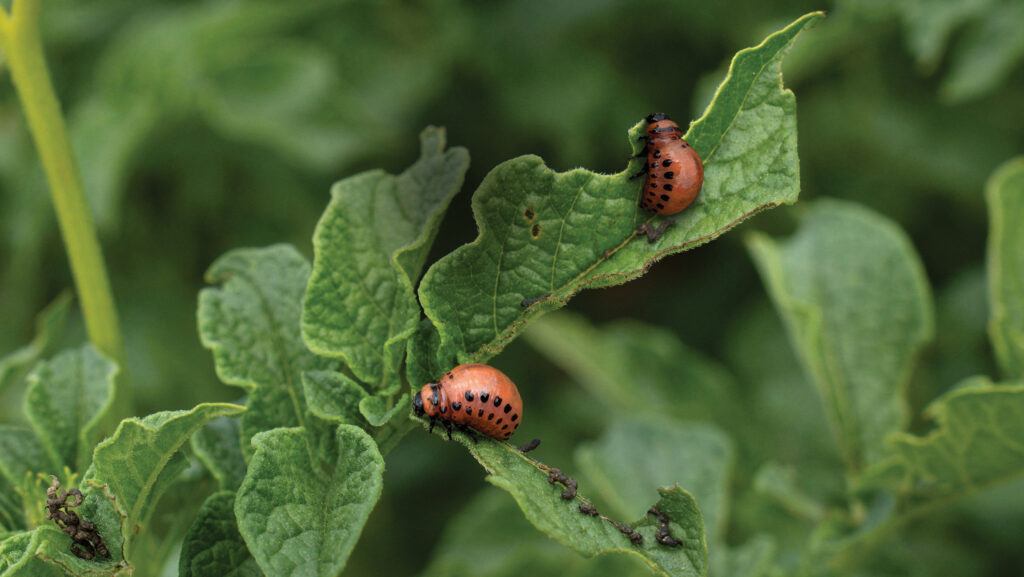
Already used in North America for Colorado potato beetle control, the main hurdle in the UK is for the regulators to be convinced that it is a safe and appropriate technology to use, he says.
Lower persistence
Drawbacks from most biopesticides include lower persistence leading to greater numbers of applications, and often reduced efficacy.
But they do provide better compatibility with target species’ natural enemies and align with environmentally friendly farming aims.
“One thing that might unlock greater use of lower risk products is applying them in a different way, maybe through autonomous application,” Tom suggests.
Combined with the use of biosensors, such as those that can detect the chemical signatures emitted by crop pests, it would be possible to target applications more effectively.
That’s starting to move closer to the integrated approach Tom thinks control programmes should evolve towards.
“We are comfortable with the concept of integrated pest management, but not so good at thinking about the science of IPM.”
Beneficial insect attractant
By that he means intelligently combining IPM compatible tools to obtain a synergistic effect rather than simply swapping one tool for another.
A good example is the recently launched BASF beneficial insect attractant, Apthena ((E)-beta-farnesene), he says.
“By itself, it doesn’t provide any crop protection, but used correctly with other tools, such as growing flowering strips in field margins that encourage beneficial insects, it could be used to draw those natural enemies into the crop earlier than otherwise they might have been.”
Future of weed control
© MAG/Richard Allison
The perhaps uncomfortable truth is conventional herbicides will continue to play a significant role in weed management for many years, suggests Dr Will Smith, Adas senior weed consultant.
“They remain effective, easy to apply and cost effective in most instances,” he says.
As with both fungicides and pesticides, their main weaknesses are resistance build up and regulation, which reduce the availability of effective chemistry and slow down the introduction of new ones.
Unlike diseases and pests, where you have less control over resistance development on your farm, it is possible to manage the risk of herbicide development on your own farm, he notes.
“Taking proactive steps to protect the long-term future of existing herbicides could be your most important actions.”
Herbicide-tolerant crops
While herbicide-tolerant crops have been widely adopted outside of Europe, and to a lesser extent in UK with Clearfield and Conviso in oilseed rape and sugar beet respectively, Will doesn’t see this approach expanded for any of our major crop-weed combinations, such as blackgrass in wheat.
“There aren’t the same opportunities with the tolerance traits available.”
Alternative types of herbicides, particularly bioherbicides, are very much in the development phase.
There are a few examples of commercially available bioherbicides, such as pelargonic acid, but like other biological products, they have lower efficacy with their biggest markets for use in sensitive areas where other products are prohibited.
RNAi herbicides are yet to go beyond the lab testing phase, Will says, and while the use of artificial intelligence and machine learning approaches to help search for and develop other herbicides looks hugely promising, companies using those approaches such as Moa Technology and Bindbridge have not commercialised any products as yet.
Spot spraying
A more imminent development is changing how existing solutions are applied, Will says.
“There are a range of systems available for real-time identification of weeds, including the OpenWeedLocator (OWL), with some coupled with high accuracy sprayers, such as John Deere’s ‘See & Spray’ and Ecorobotix.
“These solutions aim to reduce the total volume of herbicides being applied and theoretically may act as mitigation to maintain product availability in reduced form, with efficacy as good, sometimes better a system using broadacre herbicides,” he says.
But that type of success remains unusual for alternative technologies with the barriers for adoption usually a combination of additional cost, lower reliability or higher labour requirements.
Electric weeders
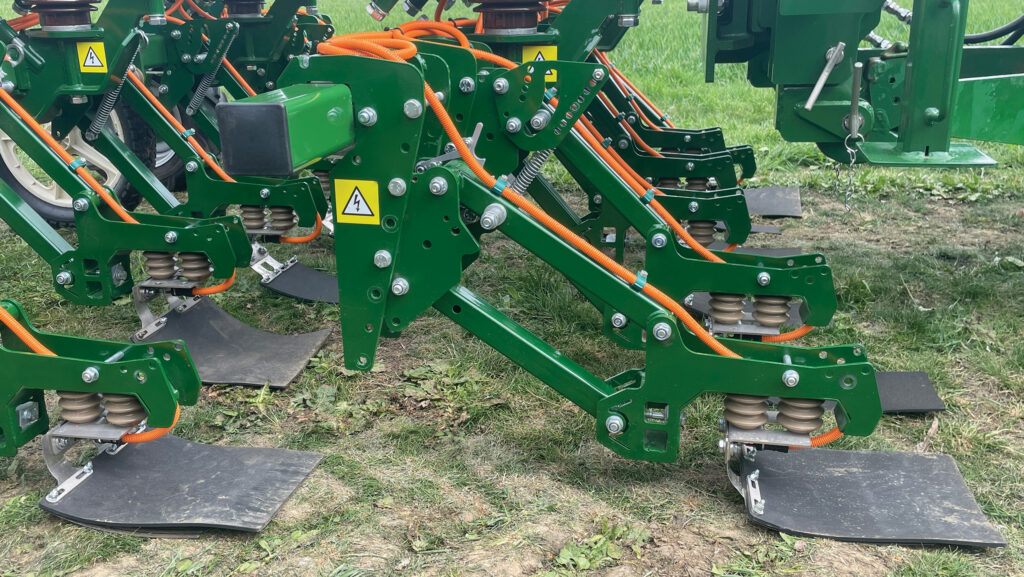
For example, the use of electric or laser weeders has been proven in horticultural crops, but it’s unlikely that will be developed in the immediate future for broadacre crops because of cost, while even with the development of autonomous solutions, there is little room for manoeuvre for reintroducing labour-intensive tasks, such as mechanical weeding.
De-risking uptake of any new technology for growers will be crucial, Will says.
“While for diseases the mechanism for incentivising uptake could be relatively simple – for example by paying for yield differences – this is difficult for weeds where a lack of weed control has a material impact on crop production in following years.
“It’s likely to require cross-industry partnerships that demonstrate best use cases for any new technology,” he concludes.
Interviews for this article were carried out at Groundswell 2026 or subsequently

Staying sharp shouldn't be a chore
Explore more / Transition
During the series we follow our group of 16 Transition Farmers through the challenges and opportunities as they seek to improve their farm businesses.
Transition is an independent editorial initiative supported by our UK-wide network of partners, who have made it possible to bring you this series.
Visit the Transition content hub to find out more.
